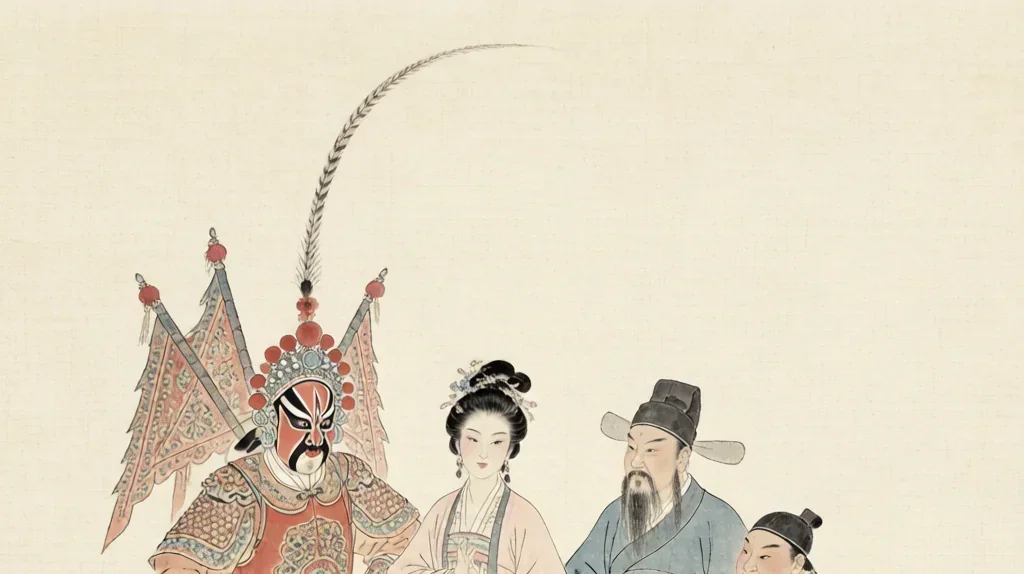
Xiqu, or Xì Qǔ (戏曲), is the grand Chinese term for "traditional theatre" or "Chinese opera" as a whole—the umbrella that covers more than three hundred distinct regional forms, from the courtly Peking opera to the rustic flower-drum plays of the Yangzi. More than a genre, xiqu is a complete performing aesthetic: a synthesis of singing, dialogue, acting, dance, and martial acrobatics in which every gesture is stylized and every emotion externalized through convention. To call something xiqu is to place it in an unbroken lineage reaching from the Southern Drama of the Song to the stages of today. Understanding xiqu means understanding not one art but the family resemblance that binds hundreds of local operas into a single great tradition, and the shared grammar that lets a stranger follow any of them.
What Makes Xiqu "Opera"
Western "opera" is mostly sung; xiqu is sung, spoken, danced, and fought at once. A single scene may open with a stylized walk, shift into a rhymed speech, break into an aria, and end in a swordfight, all in the service of one feeling. The defining principle is convention: a circle drawn on the floor is a boat, a whip is a horse, four soldiers are an army, and a turn around the stage is a journey of a thousand miles. The audience agrees to read these signs, and the actor's job is to make the sign vivid through training rather than realism.
This stylization extends to the body. Movements are codified—the "water sleeves" (水袖), the "cloud steps" (圆场), the specific walks of each role—so that xiqu is sometimes described as "dance-theatre." Music is live and constant, setting the pace of speech and step; without the small orchestra in the corner, the acting would lose its clock. Xiqu is therefore less a play with songs than a total artwork in which song, motion, and meaning are inseparable.
A Thousand-Year River: From Nanxi to Jingju
The xiqu tradition flows from clear sources. It begins with Nanxi (Southern Drama) in twelfth-century Wenzhou, which first told continuous stories in song; branches into the Yuan northern zaju (杂剧), the great poetic dramas of the Mongol era; is refined in the Ming into kunqu (昆曲), the elegant classical opera; then explodes in the Qing into the myriad "local sounds" (乱弹) and clapper operas, culminating in the 1790 Anhui troupes' meeting with Hubei Han opera that produced Peking opera (京剧). Each stage borrowed from the last, so that a modern bangzi troupe still carries Nanxi's aria logic in its bones.
What unites this long history is the method, not the melody. Whether the tune is kunqu's slow grace or a clapper's sharp crack, the craft of role, convention, and combined arts persists. That continuity is why Chinese speakers can call a folk duet and the imperial opera by the same name, xiqu, and mean it without strain.
The Four Role Types: Sheng, Dan, Jing, Chou
Almost every xiqu form organizes characters into four great families. The sheng (生) are the male roles, from bearded officials to tender youths; the dan (旦) the female roles, subdivided by age and rank; the jing (净) the "painted-face" warriors and officials whose bold makeup signals power; and the chou (丑) the clowns, marked by a dab of white on the nose, who speak for the common sense of the audience. Within these, finer grades exist—the qingyi versus the huadan among women, the laosheng versus the xiaosheng among men—but the four pillars hold across the map.
These roles are not just costumes; they are vocal and kinetic languages. A laosheng sings with mature weight and walks with measured steps; a chou patterns in quick speech and shuffles for laughs; a jing roars in a distorted "crooked" voice (花脸) suited to his painted power. Learning xiqu means learning these bodies, so that an actor can inhabit any character the script demands.
Music, Modes, and the Orchestra
Xiqu music rests on two broad melodic families. The "qupai" (named aria) system, inherited from kunqu and Nanxi, fits words to fixed tune-titles; the "banqiang" (meter-mode) system, typical of clapper and Peking opera, builds arias from a basic melody varied by tempo and mode (the erhuang and xipi of pihuang being the famous pair). A small ensemble—strings, winds, and percussion—sits at stage right, setting the "ban" (beat) that governs everything. The drum (单皮鼓) is the conductor; the gong and cymbals paint the mood; the fiddle and flute carry the tune.
Because the orchestra is constant and visible, xiqu feels less like accompanied speech and more like a conversation between voice and instrument. A skilled percussionist can cue a character's entry, underline a joke, or shock the house with a single crash—making the drummer, not the director, the true pace-setter of the traditional show.
The Visual Code: Costume, Makeup, and Symbol
Xiqu is a feast of sign. Costumes signal rank and type through color and cut; a general's flags (靠旗) mean he commands an army, a scholar's fan means refinement. Makeup is even more coded: the jing's lianpu (脸谱) paints character into the face by color—red for loyalty, white for treachery, black for uprightness—while the chou's white nose-dab marks the comic. Even props are symbolic: an oar means a boat, a flag with "water" means a river. The trained eye reads a whole situation from a single entrance.
This visual grammar is what lets xiqu travel. A non-Chinese speaker can still follow a Peking opera battle or a love scene because the signs are legible without words. The stylization that looks "unreal" to newcomers is precisely the shared language that makes three hundred dialects into one theatre.
Xiqu Today: Heritage and Reinvention
Today xiqu is both treasured and tested. Peking opera and kunqu are listed by UNESCO as intangible heritage, and the state supports troupes and academies to keep the forms alive. Yet many of the three hundred regional operas have tiny audiences, and some survive only in recordings. Experiments abound: shortened versions for students, fusion with modern theatre, and new plays on contemporary themes, all trying to keep the conventions relevant without emptying them of meaning.
The enduring power of xiqu lies in its total artistry and its deep root in Chinese feeling about story, body, and symbol. Whether one watches a village huagu or a capital Jingju, the same pact is offered: believe the convention, and a stylized step becomes a journey, a painted face becomes a destiny. That pact, made eight hundred years ago in Wenzhou, is still being kept on stages across the world.
The Discipline of Xiqu Training
To perform xiqu is to master a body as much as a voice, and training begins young. Students spend years on breath control and vocal exercises before they are allowed near a full role, because the singing must project without amplification across an open stage. At the same time they learn the codified movements: the water sleeves, the cloud-step walk, and the distinct gait of each role type, until the gestures become second nature. A single aria may demand that the performer sing, speak, dance, and act within one feeling, so the arts are never studied apart. The great performers are those who make this rigorous system look effortless, conveying grief or heroism through a flick of the wrist or a weighted step. This long, total discipline is why xiqu is described as dance-theatre, and why a convincing performance depends less on natural talent than on decade-deep training passed from master to student.
Xiqu on the World Stage
Xiqu has traveled far beyond China, carried first by overseas Chinese communities and later by state troupes and touring festivals. Peking opera and Kunqu, both listed by UNESCO, are the forms most often seen abroad, but visiting companies now present a range of regional operas as well. For non-Chinese audiences the stylization can be a hurdle, yet the visual code is designed to be legible without words: a whip reads as a horse, a painted face as a character, a turn of the stage as a long journey. This universality is exactly what lets the art cross language barriers. Modern productions also experiment with subtitles, trimmed lengths, and fusion staging to welcome newcomers, while film and streaming spread famous arias worldwide. Whether as heritage spectacle or reinvented theatre, xiqu continues to serve as one of China's most recognizable cultural ambassadors, a thousand-year tradition still performing on global stages.
❓ Frequently Asked Questions
📝 Chinese Vocabulary
戏曲 — : Xiqu, the general term for Chinese traditional opera.
生 — : The sheng, male role type.
旦 — : The dan, female role type.
净 — : The jing, the painted-face role.
丑 — : The chou, the clown role.
乱弹 — : Luantan, the Qing-era term for the myriad local opera sounds that exploded after kunqu.
曲牌 — : Qupai, the named aria tunes that fit words to fixed melody titles in the kunqu-Nanxi method.
板腔 — : Banqiang, the meter-mode system that builds arias by varying a basic melody's tempo and mode.
🎉 Fun Facts
- Xiqu encompasses more than three hundred distinct regional opera forms across China.
- The four role families—sheng, dan, jing, chou—appear in almost every regional opera despite different dialects.
- A single xiqu scene can combine stylized walking, rhymed speech, aria, and acrobatics in service of one emotion.
- Both Peking opera and kunqu are recognized by UNESCO as intangible cultural heritage within the xiqu family.
- The drummer at stage right, not a director, is the true pace-setter of a xiqu show, cueing entries and moods with a single crash.
- A circle drawn on the floor can stand for a boat and a turn around the stage for a journey of a thousand miles, so the same pact of convention lets all three hundred forms share one grammar.