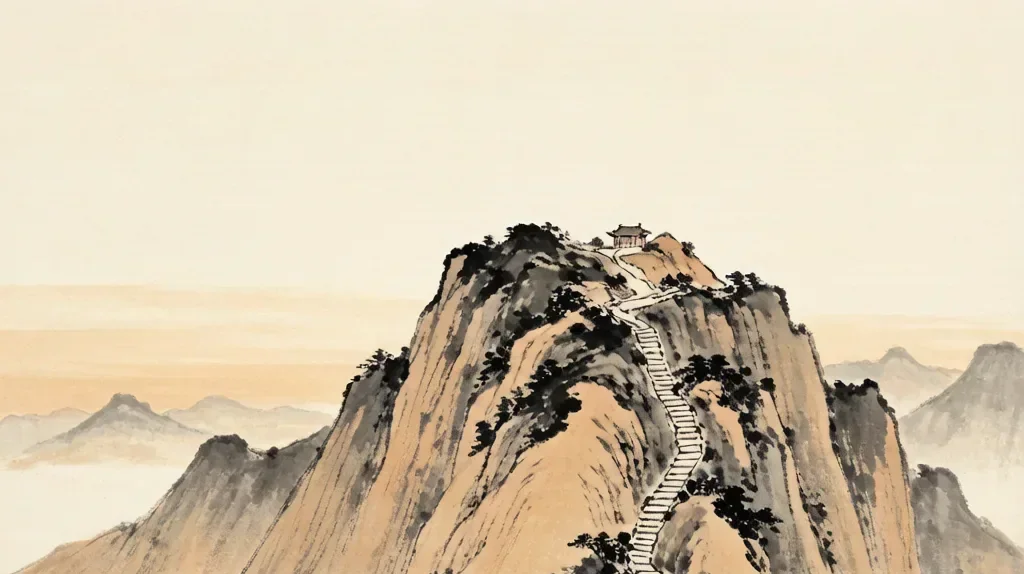
From the plains of Shandong, it rises like a sleeping dragon — Mount Tai (泰山, Tài Shān), the most sacred mountain in Chinese history. For over three thousand years, emperors, pilgrims, and seekers have climbed its slopes to perform the highest rituals of the Chinese tradition: the Feng and Shan sacrifices (封禅, fēng shàn), ceremonies in which the emperor communicated directly with Heaven and Earth from the summit of the world. The Altar of Tai Shan was not merely a place of worship; it was the cosmic axis, the point where Heaven and Earth were closest, and where the Son of Heaven could fulfill his highest duty.
The Sacred Mountain in Chinese Cosmology
Mount Tai is the easternmost of China's Five Great Mountains (五岳, wǔ yuè), corresponding to the direction of the rising sun, the season of spring, and the element of wood. In Chinese cosmology, the east is the direction of birth and renewal, and Mount Tai was the place where yang energy was most potent. The mountain was also believed to be the dwelling place of the Emperor of the Eastern Peak (东岳大帝), the deity who governed human life spans and the fate of souls after death.
The mountain's sacredness was established by the Zhou dynasty and grew through successive dynasties. By the Qin dynasty, the mountain was considered the point where earth and heaven were most accessible, and the emperor who could reach its summit and perform the correct rituals could renew the mandate of heaven for his dynasty. The mountain was also a destination for ordinary pilgrims, who climbed its 7,000 stone steps to pray for health, longevity, and the salvation of their ancestors.
The Feng and Shan Sacrifices
The Feng sacrifice (封) and the Shan sacrifice (禅) were two complementary rituals performed by the emperor on Mount Tai. The Feng sacrifice was performed on the summit, at the Altar of Heaven, where the emperor reported the dynasty's achievements to Heaven and asked for continued blessing. The emperor erected a stone tablet or mound of earth on the summit, symbolically 'sealing' the dynasty's mandate. The Shan sacrifice was performed at the base of the mountain, at the Altar of Earth, where the emperor thanked the Earth for its support and reported to the spirits of the land.
Only the most accomplished emperors performed the Fengshan. In over two thousand years of imperial history, only six emperors are recorded to have completed the full ceremony: Qin Shi Huang, Han Wudi, Han Guangwu, Tang Gaozong, Tang Xuanzong, and Song Zhenzong. The rarity of the ceremony reflected its significance — an emperor who performed the Fengshan was declaring that his reign had achieved the highest possible level of virtue and prosperity.
The Pilgrim's Path: Ascending Tai Shan
For ordinary pilgrims, the ascent of Mount Tai was a ritual in itself. The 'Heavenly Staircase' — over 7,000 stone steps winding from the base to the summit — was a path of purification and devotion. Pilgrims began the climb at dawn, often after a night spent in fasting and prayer at the Temple of the Eastern Peak at the base. They carried incense and offerings, stopping at each of the many temples and shrines along the way.
The most famous landmarks on the ascent include the 'First Gate of Heaven,' the 'Middle Gate of Heaven,' and the 'South Gate of Heaven' — each marking a stage in the journey from the mundane world to the celestial realm. At the South Gate of Heaven, the pilgrim finally reaches the summit and the Temple of the Jade Emperor, the highest building on the mountain. The sunrise from the summit of Tai Shan — the 'Tai Shan sunrise' — is considered the most spectacular sight in China, and the moment when Heaven's blessing is most palpable.
The Rituals and Temples of Tai Shan
Mount Tai is covered with ritual structures from its base to its summit. The Temple of the Eastern Peak (岱庙) at the foot of the mountain is the largest and most important — a sprawling complex of halls, pavilions, and courtyards where emperors prepared for the Fengshan sacrifices. The temple houses a vast collection of stone stelae, inscribed with the records of past imperial visits and ceremonies.
On the summit, the Temple of the Jade Emperor (玉皇顶) is the highest building, marking the point where the Feng sacrifice was performed. The Azure Cloud Temple (碧霞祠) honors the Goddess of the Azure Clouds, the protector of pilgrims and the goddess of fertility. The Rock of the Character for Longevity (寿字石) is a massive stone inscribed with the character 'longevity,' where pilgrims touch the inscription to receive blessings. Every rock, tree, and spring on the mountain has its own legend and its own ritual function.
Tai Shan in Modern China
Mount Tai is no longer the site of imperial sacrifices, but it remains a living ritual center. The Chinese government has declared it a UNESCO World Heritage Site and a symbol of Chinese civilization. Tourists and pilgrims continue to climb the mountain in vast numbers — over 5 million annually. Many still perform traditional rituals: burning incense at the temples, touching the longevity stone, and watching the sunrise from the summit.
The mountain's role in Chinese culture extends beyond pilgrimage. Its image appears on currency, in paintings, and in the logos of countless organizations. The phrase 'as stable as Mount Tai' (wěn rú Tài Shān) is a common Chinese idiom. The mountain that once hosted the emperor's most sacred ritual has become a symbol of the Chinese nation itself — enduring, sacred, and eternally connected to the heavens.
The Deities and Pilgrim Customs of Tai Shan
Mount Tai is thick with deities, and the pilgrim's routine is woven around them. At the foot, the Temple of the Eastern Peak honors the mountain's ruling god, while the Azure Cloud Temple on the slopes is loved by pilgrims who pray for children and safe passage. Along the ascent, smaller shrines and inscribed stones each carry a local legend, and the great Rock of the Longevity character invites a touch for blessing. Ordinary visitors cannot perform the imperial Fengshan, but they keep older folk customs alive: burning incense, offering at the temples, and watching the sunrise from the summit as a moment of closeness to heaven. These practices turn the climb into a sequence of small devotions rather than a single rite. The mountain thus remains a working religious site where imperial cosmology and village piety share the same stones, and where every step can be an act of prayer.
Mount Tai in Chinese Literature and Art
For more than two thousand years Mount Tai has been a recurring image in Chinese poetry, painting, and proverb, a shorthand for stability, height, and moral weight. Poets of the Tang and later dynasties climbed or imagined it and wrote of its clouds, pines, and sunrise as emblems of aspiration and virtue. Its name and silhouette appear on currency, in scroll paintings, and in the logos of institutions that wish to signal endurance. The idiom as stable as Mount Tai shows how thoroughly the mountain entered everyday speech as a measure of steadiness. Emperors added to this prestige by leaving stone stelae recording their visits, so the mountain is also a vast open-air archive of calligraphy and official memory. In this way Tai Shan is more than a peak; it is a cultural symbol, a place where landscape, literature, and state ritual meet and reinforce one another across the centuries.
Preserving Mount Tai as Heritage
Modern China no longer holds imperial sacrifices on Tai Shan, but it treats the mountain as a treasure of civilization. The United Nations listed it as a World Heritage Site, and the state manages it as a protected landscape with rules against removing stones or damaging inscriptions. Millions of visitors each year bring both revenue and strain, so access is balanced with conservation through ticketing, path maintenance, and limits during peak events. The stone stelae and temples are restored as cultural relics, while folk ritual continues as living practice rather than museum display. This dual status, heritage site and active sacred mountain, is the modern form of the old reverence: the summit is no longer the emperor's alone, but a shared national symbol where tourists, pilgrims, and scholars all meet. Preservation thus extends an ancient pact between the Chinese people and their most sacred peak into a new, public age.
Frequently Asked Questions
Chinese Vocabulary
泰山 — : Mount Tai; the most sacred mountain in Chinese tradition
封禅 — : Fengshan; the imperial sacrifices performed on Mount Tai
五岳 — : Five Great Mountains; the five sacred mountains of Chinese tradition
东岳大帝 — : Emperor of the Eastern Peak; the deity who governs Mount Tai
岱庙 — : The Temple of the Eastern Peak at the foot of Mount Tai, where emperors prepared for the Fengshan rites.
玉皇顶 — : The Jade Emperor Summit, the highest point where the Feng sacrifice was performed.
碧霞祠 — : The Azure Cloud Temple, honoring the goddess of pilgrims and fertility.
南天门 — : The South Gate of Heaven, the summit gateway marking entry into the celestial realm.
Fun Facts
- The stone pathway to the summit of Mount Tai has 7,200 steps in total — 6,600 on the main route and 600 on the summit loop. Each step was carved by hand, a process that took centuries.
- Emperor Qin Shi Huang, the first emperor to perform the Fengshan, was caught in a storm on the summit and his stone tablet was destroyed by lightning — an omen that was interpreted very poorly by later historians.
- The Sunrise Pavilion at the summit of Tai Shan can accommodate over 10,000 people on a peak morning, and on clear days, the view extends across three provinces — Shandong, Hebei, and Jiangsu.
- Mount Tai is the eastern peak of the Five Great Mountains and represents the element of wood and the season of spring.
- The phrase as stable as Mount Tai is a common Chinese idiom expressing steadiness and security.
- Over 5 million people climb Mount Tai each year, both as pilgrims seeking blessing and as tourists.