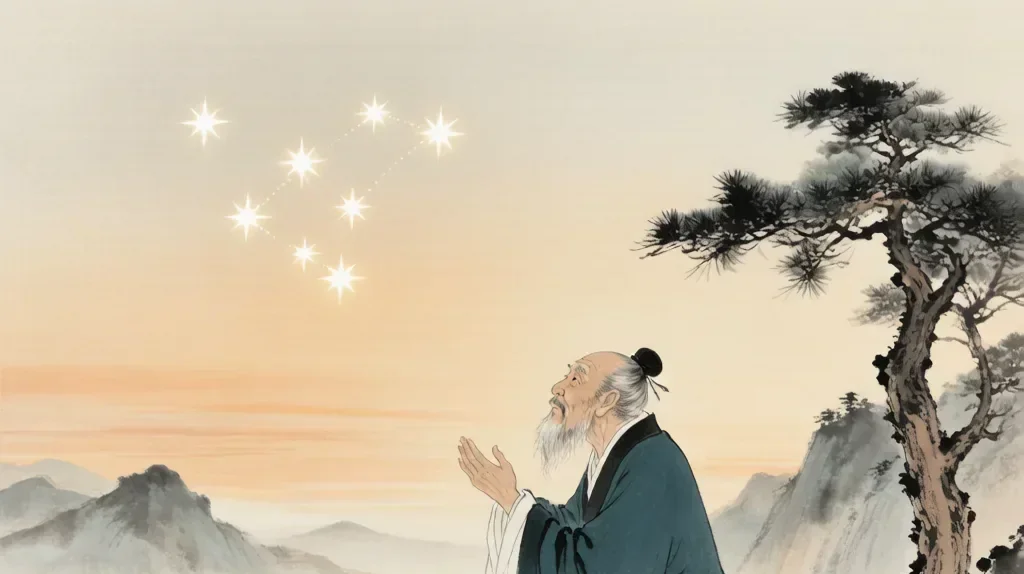
On a high mountain terrace before dawn, the Daoist priest raised his voice in a chant that was older than the temple behind him. He wore a robe embroidered with the eight trigrams and the stars of the Big Dipper. In his hands, he held a sword of peach wood and a bell whose ringing was said to reach the celestial realms. The Daoist Offering (道教斋醮, dào jiào zhāi jiào) was the great ritual of the Daoist tradition — a cosmic ceremony that realigned the forces of the universe, petitioned the celestial bureaucracy, and brought the blessings of the immortals down to earth. In the Daoist worldview, the offering was not merely a request for divine favor but a technical intervention in the workings of the cosmos, a ritual technology that maintained the harmony of Heaven, Earth, and Humanity.
The Cosmology of the Daoist Offering
Daoist ritual is grounded in a cosmology of correspondences. The universe is composed of qi (气, vital energy), which manifests in two fundamental modes: yin and yang. The Daoist priest, through the offering ritual, acts as a technician who balances the yin and yang forces, harmonizes the five phases (wood, fire, earth, metal, water), and aligns the microcosm of the ritual space with the macrocosm of the universe.
The offering is understood as a communication with the celestial bureaucracy — a vast hierarchy of gods, immortals, and officials who administer the universe from their palaces in the heavens. The priest presents a formal petition (奏章, zòu zhāng) to this bureaucracy, requesting specific interventions: the forgiveness of sins, the healing of illness, the prosperity of a family, or the salvation of a soul. The petition is written on yellow paper in formal language and is burned so that the smoke carries it to the heavens. The offering is thus simultaneously a cosmic tuning, a legal petition, and a gift exchange with the divine.
The Structure of a Major Offering
A major Daoist offering — a jiào (醮) — can last from one to seven days and involves elaborate preparation. An altar is constructed with multiple tiers, each representing a level of the celestial hierarchy. Images of the highest deities — the Three Pure Ones (三清) — are placed on the top tier, with lower deities and guardians below. Offerings of incense, candles, tea, wine, flowers, fruit, and cooked food are arranged on the altar in precise patterns.
The priest, assisted by junior priests and acolytes, moves through a complex sequence of rituals over the days of the offering. The sequence includes: purification of the ritual space (cleansing it of all defilement), invocation of the deities (calling them to descend into the altar), presentation of offerings (the 'gift exchange' with the gods), recitation of scriptures (chanting the Daoist canon), the presentation of the petition (the formal request), and the sending-off of the deities (thanking them and asking them to return to their celestial dwellings).
The Ritual Implements and Their Symbolism
Every object used in the Daoist offering carries deep symbolic meaning. The ritual sword (jiàn) cuts through negative energies and seals the ritual space. The ritual bell (líng) calls the deities and marks transitions in the ceremony. The incense burner is the 'mouth' through which prayers ascend to heaven. The mirror (jìng) reveals the true form of spirits and reflects evil away. The water vase (shuǐ guàn) contains pure water that purifies and blesses.
The priest's robe is itself a ritual object, embroidered with the entire cosmos: the stars, the trigrams, the celestial animals, and the characters of power. When the priest wears the robe, he is no longer an ordinary human but a ritual person — a representative of the celestial order. The entire offering is a performance of cosmic harmony, with every gesture, every word, and every object contributing to the restoration of balance.
The Social Function of the Daoist Offering
In traditional Chinese society, the Daoist offering served both spiritual and social functions. A community-wide offering — called a 'prayer-for-peace offering' (平安醮) — was held in periods of crisis: epidemic, drought, flood, or war. The entire village contributed to the cost, and the offering was believed to restore cosmic order and protect the community. The offering was also a social event, drawing people from surrounding villages, generating economic activity, and reinforcing community identity.
For individual families, the offering could be commissioned for specific purposes: healing a sick member, blessing a new house, or assisting a deceased relative's soul. The family paid the priest's fees and provided the offerings. The offering was a significant expense, but it was considered essential for resolving serious problems. The Daoist priest was, in many ways, the spiritual physician of traditional China — and the offering was the prescription. Temples were destroyed, priests were forced to laicize, and ritual texts were burned. The knowledge of the offering rituals — which had been transmitted orally and through apprenticeship for centuries — came dangerously close to extinction. Since the 1980s, however, Daoism has experienced a significant revival, and the offering rituals have been reconstructed and reperformed.
Today, the Daoist offering can be witnessed at major Daoist temples in China, particularly on festival days. The Baiyun Guan (White Cloud Temple) in Beijing, the Qingcheng Mountain temples in Sichuan, and the Daoist centers of Taiwan and Hong Kong are important sites for the preservation of the offering tradition. The rituals have been recognized by UNESCO as Intangible Cultural Heritage, and young priests are once again being trained in the complex traditions. The cosmic harmony that the offering seeks to restore is still, it seems, something that human beings need.
The Priest as Cosmic Technician
In the Daoist view the priest is less a preacher than a technician of the cosmos. Through the offering he balances yin and yang, harmonizes the five phases, and aligns the small ritual space with the great patterns of heaven and earth. He wears a robe embroidered with the entire universe, carries the sword that cuts negative energy, and rings the bell that summons the deities. His steps may trace the Dipper, placing him in command of stellar forces. The offering is therefore a precise operation on the fabric of reality, not a vague prayer, which is why its performance demands years of transmitted training.
Purification and Invitation
Every major offering opens by cleansing the ritual space of defilement and inviting the deities to descend. The priest sweeps and sprinkles the arena, lights the lamps, and recites invocation texts that call the gods by name and rank. Only when the celestial guests are present can the offerings and the petition be presented. This careful opening explains why the rite cannot be rushed; the boundary between the human and divine must be opened correctly before any exchange can occur. The sequence of purification, invitation, offering, and sending-off gives the ceremony its orderly, almost administrative rhythm.
Offerings for the Dead and the Living
Daoist offerings served both the living and the dead. For the living they sought healing, peace, and prosperity; for the dead they assisted the soul's passage and relieved suffering in the underworld. A family might commission a rite to cure an illness or to bless a new house, while a community rite addressed drought or plague. In funerary context priests performed offerings to speed a soul through judgment. This dual reach made the Daoist priest a spiritual physician for every season of life and death, and the offering the prescription suited to each need.
Daoist Offerings in the Modern World
After a period of suppression, Daoist offerings have been renewed since the 1980s and can again be witnessed at major temples on festival days. The Baiyun Guan in Beijing, the Qingcheng Mountain temples in Sichuan, and centers in Taiwan and Hong Kong are key sites for preserving the tradition. UNESCO recognition as Intangible Cultural Heritage has helped train a new generation of priests in the complex choreography. Though the social crises that once prompted village-wide rites are rarer, individuals still commission offerings for health and harmony, keeping the cosmic technology alive in modern China.
Frequently Asked Questions
Chinese Vocabulary
斋醮 — : Daoist offering; the major ritual ceremony of Daoism
三清 — : Three Pure Ones; the highest deities of the Daoist pantheon
奏章 — : Petition; the formal written request presented to the celestial bureaucracy
法器 — : Ritual implement; the sacred tools used in Daoist ceremony
道场 — : Ritual arena; the consecrated space where a Daoist offering is performed
步罡 — : Pacing the stem; the priest's dance-steps tracing the pattern of the Big Dipper
符箓 — : Talismans and registers; the written charms and credentials used by Daoist priests
祈安 — : Prayer for peace; the community offering held to restore cosmic order in a crisis
Fun Facts
- The largest Daoist offering in modern times was held at the Qingcheng Mountain temple complex in 2015, involving 108 priests and lasting seven days. A million paper 'spirit coins' were burned during the ceremony.
- Daoist priests can enter a state of 'walking the stars' (bù gāng) during the offering, where their footsteps trace the pattern of the Big Dipper on the ground — a technique believed to give them control over the forces of the cosmos.
- The 'fire transformation' ritual at the end of a major offering, where the petition and offerings are burned, is timed to the second to align with specific astrological configurations — a misplaced second invalidates the entire ceremony.
- The priest's robe is embroidered with the stars and trigrams so that wearing it turns the priest into a walking map of the cosmos during the rite.
- A major offering ends with a 'fire transformation' in which the written petition is burned so its message rises with the smoke to the celestial court.
- A village 'prayer for peace' offering can be commissioned by an entire community to end drought, epidemic, or flood, drawing villagers from surrounding hamlets.