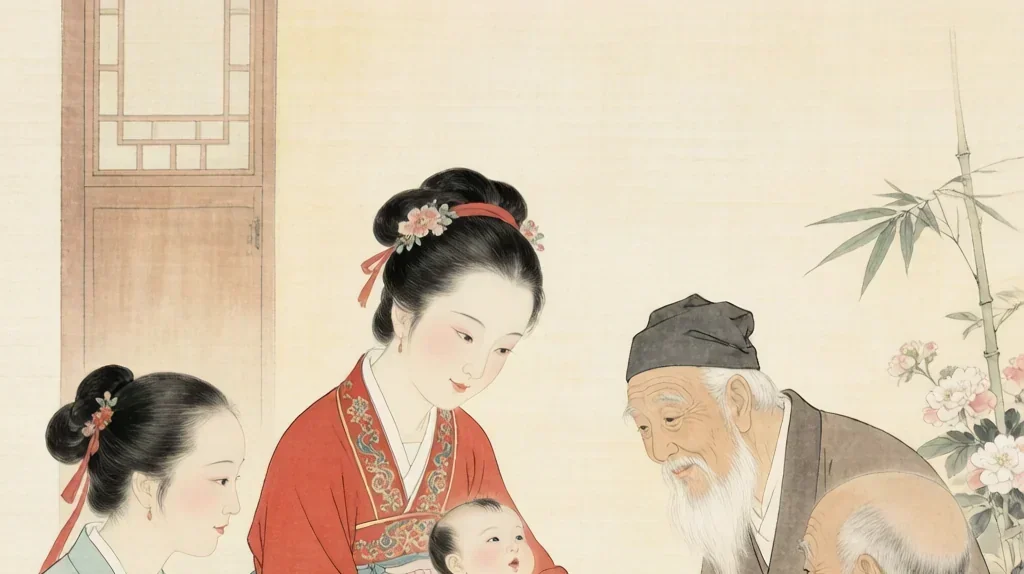
Of all the rites of life in China, the celebration of a newborn's first month — the full-month ceremony (满月, mǎn yuè) — is perhaps the most tender. In a culture that has always prized continuity of the family line, the safe arrival of a child is a victory shared by grandparents, uncles, and ancestors alike. The full-month gathering announces to the world that a new member has joined the clan and survived the fragile first weeks of life. It is also the moment when the mother emerges from her month of confinement, and when relatives stream in with gold locks, red eggs, and blessings. This article walks through how Chinese families welcome a baby, from the red-egg party to the quiet report made to the ancestors.
Welcoming the Baby
The moment a child is born, the paternal grandmother (奶奶, nǎi nai) or a senior female relative often announces the news by distributing small gifts, a custom known as "sending happy news" (报喜, bào xǐ). In many regions the father's family sends the maternal grandparents a whole pig's leg or a box of pastries to signal that mother and child are well. The baby's birth is recorded not only in the household register but, traditionally, in the family tree (族谱, zú pǔ), for a son's name continues the ancestral line and a daughter's links the families.
Immediately after birth the infant is gently bathed in a herbal or plain-warm water and dressed in soft cotton. In parts of Fujian and Taiwan a few drops of "gold water" (gold flecks suspended in wine) were once touched to the baby's brow to wish for a wealthy life, while northern families might rub a little cooked rice on the lips so the child would "never lack food." These small acts are less hygiene than blessing — the first layer of a lifetime of wishes laid upon the child.
Throughout the first month the household keeps a low profile. Strangers are not paraded through the nursery, mirrors may be covered, and the baby's real name is sometimes withheld, a "milk name" (乳名, rǔ míng) or "small name" used instead to confuse jealous spirits who might target a finely named infant. Only at the full month is the child formally named and shown abroad.
The Red Egg and Ginger Party
The centerpiece of the full-month celebration is the feast, called in Cantonese the "ginger-vinegar party" (姜醋宴, jiāng cù yàn). Its signature dishes are hard-boiled eggs dyed red (红鸡蛋, hóng jī dàn) and pork knuckles braised for hours in aged black vinegar with ginger and sweetened with maltose (猪脚姜, zhū jiǎo jiāng). The red eggs are the public emblem of the event: the family distributes them to friends, neighbors, and the parents' coworkers, usually two eggs per recipient, sometimes packaged with a small cake. To receive red eggs is to be told, wordlessly, "a child has been born."
The ginger-vinegar pig's trotters serve a double purpose. In Chinese medicine the dish is "warming" and "blood-replenishing," exactly what a mother needs after childbirth, and it is eaten by her throughout the month. At the party it is shared with guests as a communal blessing of health. The sour-sweet vinegar, the bite of ginger, and the gelatinous trotter make a distinctive flavor that southern Chinese abroad associate instantly with new babies — overseas families in London or Vancouver still brew a pot when a grandchild arrives.
Accompanying dishes carry their own puns. "Red dates and lotus seed soup" (红枣莲子汤) wishes early sons; a whole chicken honors the mother; and "longevity noodles" (长寿面) may be served to wish the child a long life. The menu is less about nutrition than about a vocabulary of luck spoken in food.
Gifts and Taboos
Relatives arrive bearing symbolic presents. The most cherished is the "long-life lock" (长命锁, cháng mìng suǒ), a silver or gold pendant shaped like a padlock, inscribed with characters for longevity and protection, believed to "lock" the child's soul to its body so it cannot be stolen by spirits. Silver bangles, gold "money frogs," and embroidered tiger shoes (虎头鞋, hǔ tóu xié) — the tiger being a guardian against evil — are also common. The maternal grandmother traditionally delivers a "mother's-family basket" (外婆篮, wài pó lán) containing food, baby clothes, and a silver gift.
Certain gifts are pointedly avoided. A clock (钟, zhōng) is forbidden because it sounds like "end" (终, zhōng); a pair of shoes might symbolically let the baby "run away" from home; and white or black clothing for the infant is shunned as funeral colors. Even the number of gifts matters — even numbers, especially six and eight, are lucky, while four (四, sì) is avoided because it echoes "death" (死, sǐ).
Taboos also guard the mother and baby. During the confinement the mother should not be exposed to wind or cold water, and visitors with colds are turned away. In earlier times a "sitting-month" woman would not leave her bed for ten days and would eat only warming broths. Modern families often hire a "monthly nurse" (月嫂, yuè sǎo) or book a postpartum hotel (月子中心) to observe the custom with professional help.
Reporting to Ancestors
A deeply important step, often overlooked by outside observers, is reporting the birth to the ancestors (上谱, shàng pǔ / 报祖, bào zǔ). On or near the full-month day the father's family may place a stick of incense before the ancestral tablet (牌位, pái wèi) and announce the child's name, birth hour, and — for a son — his position in the generational poem (字辈, zì bèi) that dictates each branch's naming character. In lineage villages of the south, the birth is simultaneously entered into the printed family genealogy, a document some clans have maintained for forty generations.
This act is the spiritual hinge of the whole celebration. The child is not merely welcomed by the living but enrolled among the dead, who are believed to watch over descendants. A son's entry continues the ancestral sacrifice; a daughter's, while recorded, traditionally passed to her husband's line at marriage. The incense, the bow, and the soft spoken name thus bind the newborn into a vertical community stretching back centuries and forward into the unborn.
Modern Practice
Today the full-month celebration thrives in transformed form. Urban parents often hold the party at a restaurant and supplement red eggs with elaborate "full-month cakes" (满月蛋糕) and photo cards of the baby. Social media has produced the "birth announcement" post and the "one-month challenge" of daily infant photos. In Hong Kong and Singapore, caterers deliver ginger-vinegar in microwave-ready packs, and some hospitals host a small naming ceremony.
The custom has even spawned industry: postpartum care centers (月子中心, yuè zi zhōng xīn) in Shanghai and Beijing can cost more than a university semester, offering nutritionists, lactation consultants, and "sitting-the-month" suites. Yet the emotional core is unchanged. Whether marked with a village feast or a WeChat red-packet storm, the full month remains China's way of saying: this small life is wanted, is blessed, and now belongs to the family and its ancestors.