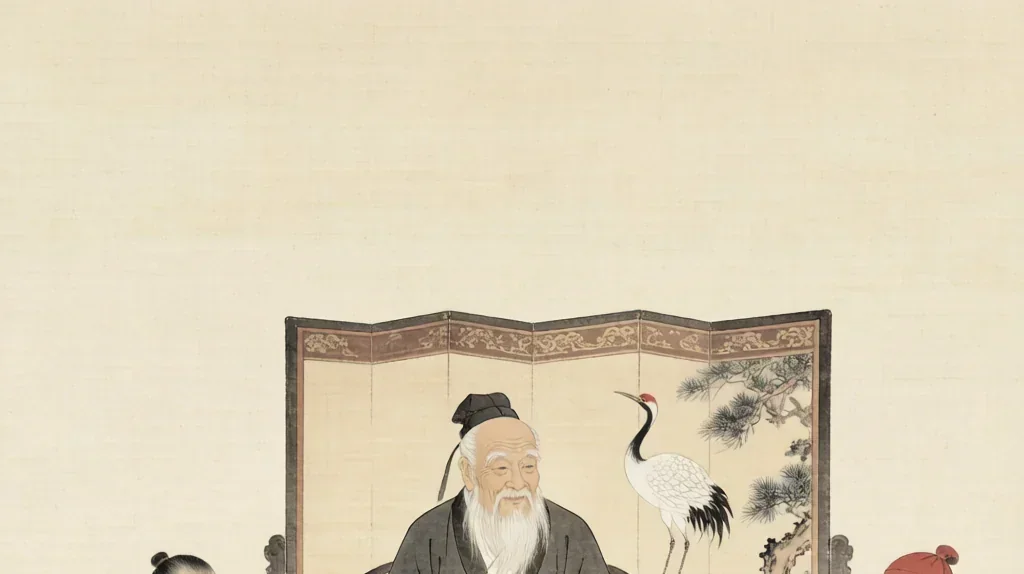
While a child's first birthday is about the future, an elder's milestone birthday is about the past — a life lived long enough to be honored. In Chinese tradition, once a person reaches old age their birthday is no longer a private affair but a "shou" (寿, longevity celebration), an event in which the whole family repays decades of care. The rite, called "doing longevity" (做寿, zuò shòu), wraps filial piety, mythology, and sheer festivity into a single day of peaches, noodles, and bowing. To understand it is to understand how Chinese culture turns aging into an achievement rather than a decline.
When a Birthday Becomes a Shou
Not every birthday qualifies as a shou. Common custom reserves the grand celebration for age sixty, the point at which a person completes one full sexagenary cycle (六十花甲, liù shí huā jiǎ) — the sixty combinations of ten heavenly stems and twelve earthly branches that form the traditional Chinese calendar. To have lived through all sixty is, in the old view, to have come full circle, and sixty was historically a venerable age when average lifespans were far shorter.
After the first shou, the milestones thicken: seventy is "rare old age" (古稀, gǔ xī), a phrase borrowed from the Tang poet Du Fu's line "rare to reach seventy" (人生七十古来稀); eighty and ninety are "a long life of age" (耄耋, mào dié); a hundred is "a life of a century" (期颐, qī yí). Some families begin the shou at fifty, but the later the age the grander the feast. A person who reaches a shou is addressed with new respect — as "old birthday star" (老寿星, lǎo shòu xīng), echoing the star god of longevity, Shouxing (寿星).
There is also a numerical etiquette. Many regions celebrate "nine, not ten" (做九不做十): a family marks the seventy-year shou when the elder turns sixty-nine. The logic is phonetic. The number ten (十, shí) sounds like "death" (死, sǐ) in several southern dialects, while nine (九, jiǔ) sounds like "long-lasting" (久, jiǔ). Celebrating at nine borrows the lucky homophone and dodges the grim one — a small linguistic superstition with large emotional weight.
Peaches and Longevity Noodles
Two foods define the shou table. The first is the longevity peach (寿桃, shòu táo). In Daoist myth the Queen Mother of the West (西王母, Xī Wáng Mǔ) tends a orchard of immortal peaches that ripen only once every three thousand years; whoever eats one gains eternal life. A birthday peach is therefore a portable piece of immortality. In practice it is a steamed bun, often colored pink at the tip and pinched into a fruit shape, sometimes filled with red-bean paste. Restaurants stack dozens into a "peach mountain" (寿桃山) as a centerpiece.
The second is longevity noodles (长寿面, cháng shòu miàn). These are served long and, crucially, uncut; the diner is expected to slurp the strand without breaking it, because its unbroken length mirrors a long life. The noodles are usually in a light broth with a beaten egg, and the elder eats first. Breaking the noodle by accident was once thought to invite a shortened life, so children were sternly instructed to swallow gently — a small lesson in patience wrapped in a meal.
Both foods are more blessing than sustenance. They appear even when the banquet is lavish, sitting among elaborate meat and seafood dishes as the symbolic core that gives the whole meal its purpose. A shou without peaches and noodles is, to Chinese sensibility, barely a shou at all.
The Banquet
The shou banquet (寿宴, shòu yàn) is typically hosted by the elder's adult children and held at a restaurant or the family home. The seating places the birthday star at the seat of honor facing the door, often on a chair draped with a red "shou" character. Before the meal, younger generations line up by age and perform the birthday bow (拜寿, bài shòu), kneeling or bowing and offering greetings such as "may you enjoy boundless longevity" (福如东海, 寿比南山, fú rú dōng hǎi, shòu bǐ nán shān — "fortune like the East Sea, longevity like the Southern Mountain").
Gifts reinforce the theme. The most traditional is a crimson plaque or scroll bearing the character 寿 (shòu) written in the "wheel" style with concentric circles, or a "hundred shou" piece embroidered with a hundred variations of the character. Children present a peach-shaped cushion, new clothing in festive red, and red envelopes (红包, hóng bāo). In return the elder gives the youngest grandchildren "longevity money" (压岁钱-style packets) to pass the blessing down.
The menu follows auspicious logic: a whole fish (鱼, yú) for surplus, a duck or chicken for prosperity, and "may you have surplus year after year" (年年有余) puns. The tone is joyous but reverent; guests toast the elder, and a professional singer or the grandchildren may perform a song. The banquet is at once a family reunion, a status display, and a thank-offering.
Filial Piety in Action
At its heart the shou is the public enactment of filial piety (孝, xiào), the Confucian virtue ranking a child's duty to parents above almost all else. By organizing the celebration, the children demonstrate that the elder is not a burden but the honored root of the family. The bowing, the gifts, and the funding all say: we remember what you gave, and we return it openly.
This was not only moral but political in imperial times. The "Filial Piety Classic" (孝经, Xiào Jīng) taught that a well-governed realm begins with filial homes, and a local official might commend a family that honored a very aged parent, sometimes granting the son exemption from labor or a ceremonial gate (牌坊, pái fāng). A successful shou thus reflected credit on the entire lineage and the village. Even today, colleagues and neighbors read a grandparent's well-attended shou as evidence that the children are "filial and capable" (孝顺能干, xiào shùn néng gàn) — a reputation worth more than the banquet's cost.
The rite also structures family hierarchy gently. The order of bows and toasts follows generation and age, teaching children their place in the continuum. In an age of small nuclear families, the shou remains one of the few occasions when three or four generations deliberately gather around the eldest.
Ties to the Double Ninth Festival
The shou connects naturally to the Double Ninth Festival (重阳节, Chóngyáng Jié), the ninth day of the ninth lunar month, which since 1989 has been officially designated Senior Citizens' Day (老人节, Lǎorén Jié) in China. Both occasions share the homophonic logic of "double nine" (重九) with "long-lasting" (长久) and center on respecting the aged. Families often combine a ninth-month visit to elderly parents with a small shou-like meal of chongyang cake (重阳糕), whose layered height echoes the Southern Mountain of longevity.
The two rites also share symbols: the chrysanthemum (菊花, jú huā), drunk as wine at Double Ninth for its association with long life, and the dogwood sprig (茱萸, zhū yú) worn to ward off harm — both echo the protective care shown to elders at a shou. In rural areas the Double Ninth is the day when several generations climb a hill (登高, dēng gāo) together, a moving metaphor for lifting the elder up. The shou and the festival are thus two faces of one cultural value: that a long life is the family's proudest treasure, to be celebrated, protected, and passed on as example.