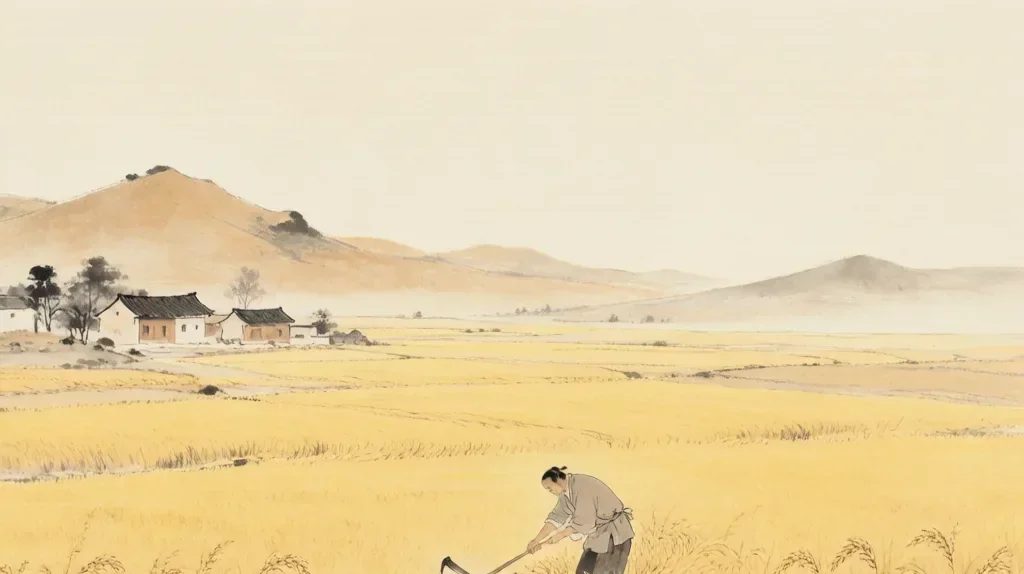
In the golden autumn fields, when the rice had been cut and the granaries were full, the entire village gathered at the edge of the fields — the oldest farmers carrying bundles of the first sheaves, the children carrying gourds of new wine, and the women carrying baskets of freshly steamed cakes. The Harvest Sacrifice (祭谷, jì gǔ) was the agricultural community's greatest annual ritual, a ceremony of thanks to the gods and spirits who had brought the crops to maturity. In a civilization whose foundations were built on rice and millet, the harvest sacrifice was not optional piety but existential necessity — a communication with the powers of the earth that ensured the cycle of planting and reaping would continue for another year.
The Agricultural Calendar and the Harvest Rites Cycle
Chinese agricultural rituals followed the cycle of the farming year, with specific rites for each phase. The spring planting rites invoked the Earth God for fertility. The summer rites petitioned for rain. But the autumn harvest rites were the climax — the moment when the community acknowledged its dependence on the land and expressed gratitude for its yield. The harvest sacrifice was thus the heaviest, most elaborate, and most joyful of the agricultural ceremonies.
The timing of the harvest sacrifice varied by region and crop. In the rice-growing south, the sacrifice occurred after the late rice harvest in October or November. In the wheat-growing north, the timing was late summer. The key principle was that the sacrifice could not be held until the entire harvest was brought in — the gods were not thanked until the full extent of their gift was known. In good years, the sacrifice was lavish; in lean years, it was modest but no less important, as the community needed divine favor even more desperately.
The Village-Level Harvest Sacrifice
At the village level, the harvest sacrifice was organized by the village head and the local Earth God temple association. A temporary altar was erected in the threshing ground or at the edge of the most productive field. The altar held the tablet of the Earth God (土地神), along with tablets for the local deities and, in some regions, the Dragon King for his role in providing rain. Offerings included the first grains of the season, new wine, steamed buns shaped like agricultural tools, and a whole pig roasted and arranged on a large platter.
The village priest or ritual master led the ceremony, offering incense and reading a prayer of thanks that listed the crops and their yields. The villagers bowed in unison — three bows for the Earth God, three for the ancestors of the village, and three for the gods of the locality. Firecrackers were set off. The offerings were then distributed to the attending families, each taking home a portion of the blessing. The shared meal that followed was often the largest communal feast of the year, strengthening the social bonds that held the village together.
The Imperial Harvest Sacrifice
At the opposite end of the social scale, the emperor performed his own harvest sacrifice — a ceremony of immense state importance. The emperor worshipped at the Altar of the God of Agriculture (先农坛, Xiān Nóng Tán) in Beijing, an altar complex that included fields actually plowed by the emperor himself. In a rite called 'personally plowing the field' (qīn gēng), the emperor guided a plow through three furrows, followed by senior officials who plowed additional furrows. This symbolic act was the harvest ritual's first movement.
The imperial harvest sacrifice proper involved offerings of grains, silk, and jade at the altar, followed by prayers for the realm's agricultural prosperity. The emperor's performance of the harvest ritual was believed to influence the weather and soil quality of the entire empire. If the emperor performed the ritual correctly and with sincerity, the harvests would be abundant; if he neglected or performed the rites improperly, famine would follow. The burden of agricultural prosperity was thus placed squarely on the emperor's ritual shoulders.
Regional Harvest Rituals and Their Deities
Different regions of China honored different deities during the harvest sacrifice. In Fujian and Taiwan, the harvest sacrifice was dedicated to the Great Emperor Who Protects the People (保生大帝). In Guangdong, the goddess Mazu received the offerings of fishermen and coastal farmers. In Yunnan, the harvest rites involved complex dances performed by shamans who entered trances to communicate with the mountain spirits.
The Miao and Yao ethnic minorities in southwest China held multi-day harvest festivals that combined sacrifice with courtship, music, and competitive games. The Tibetan communities of Qinghai held a 'thanksgiving to the mountain gods' ceremony that involved scattering barley flour, offering butter lamps, and hanging prayer flags from the highest peaks. Despite the diversity, the core structure was universal: a community gathered to acknowledge that the food on their tables came from forces beyond their control, and to express gratitude for the gift of survival.
The Harvest Sacrifice in Modern China
The traditional harvest sacrifice declined dramatically after the communist revolution of 1949. The collectivization of agriculture, the suppression of 'superstitious' practices, and the secularization of rural life all contributed to the erosion of the harvest rites.
In recent decades, however, the harvest sacrifice has experienced a revival in many parts of rural China. The revival is driven by a combination of factors: government support for 'intangible cultural heritage,' the economic revival of rural areas, and a genuine spiritual hunger for the rituals that once gave meaning to agricultural life. The Chinese government has even established an official 'Chinese Farmers' Harvest Festival' (中国农民丰收节) on the autumn equinox — a modern state-sponsored version of the ancient harvest sacrifice. The gods may no longer be universally invoked, but the impulse to give thanks for the harvest — to pause at the end of the agricultural cycle and acknowledge one's dependence on the earth — continues to move Chinese farmers as it has for millennia.
The Meaning of the First Fruits
Central to the harvest sacrifice was the offering of first fruits, the earliest gathered grain or produce laid before the altar before the community ate from the new crop. This act acknowledged that the yield came as a gift of earth and heaven rather than merely human labor, and it reserved the best portion for the powers that made growth possible. In the tasting-the-new rite, the family or priest sampled the fresh food first, a gesture of reverence and of ensuring the supply's purity. By delaying ordinary consumption until the deity was honored, farmers affirmed a moral order in which gratitude preceded enjoyment. The first fruits thus turned a biological event, the ripening of grain, into a moment of reciprocal relationship between people and the sources of their sustenance.
Music, Dance, and Communal Feasting
Harvest rites were rarely silent or solitary; they drew the whole village into song, drumming, and shared meals. At the local altar, elders led prayers while youths performed dances and musicians played gongs and pipes to stir the earth god's favor for the season ahead. The sacrifices of wine, meat, and grain were followed by a feast in which every household took part, dissolving the boundary between offering and celebration. Such performances strengthened neighborly bonds as much as they honored the spirits, since cooperation in the rite mirrored the cooperation of the fields. Through rhythm, food, and collective motion, the harvest sacrifice became a festival of thanks that renewed both the soil's fertility and the community's sense of itself. In music and in shared meal alike, the rite made gratitude something the whole village could feel as one body rather than as isolated households.
Harvest Sacrifice and the Cosmic Order
Beyond local thanks, the harvest sacrifice expressed a vision of the world in balance. Chinese thought held that human prosperity depended on harmony between heaven, earth, and the myriad things, and the rite was a way of keeping that harmony. By presenting the season's bounty to the earth god and to heaven, farmers returned a portion of what they had received, completing a cycle of gift and gratitude. The emperor's plowing and sacrifice extended this logic to the whole realm, casting agricultural success as a sign that the ruler governed in accord with cosmic principle. In this framing the harvest was never only economic; it was a moral event in which right relationship with the unseen powers secured the people's continued nourishment.
Frequently Asked Questions
Chinese Vocabulary
祭谷 — : Harvest sacrifice; the ritual of giving thanks for the grain harvest
土地神 — : Earth God; the local deity responsible for agricultural fertility
先农坛 — : Altar of the God of Agriculture; the imperial harvest altar in Beijing
亲耕 — : Personal plowing; the emperor's symbolic act of plowing the imperial field
社日 — : Altar day; the seasonal festival held at the village earth altar to honor the soil god.
五谷 — : The five grains; the staple crops offered in thanks, wheat, rice, millet, beans, and sorghum.
尝新 — : Tasting the new; the rite of first sampling the fresh harvest before ordinary eating.
神农 — : Divine Farmer; the culture hero credited with teaching agriculture and honored at harvest.
Fun Facts
- The Chinese characters for 'year' (年, nián) originated as a pictograph of a person carrying harvested grain — the year was defined by the harvest.
- Some villages in remote parts of Guizhou continue to perform a harvest sacrifice that includes a 'rice soul calling' ritual, where the shaman calls the spirit of the rice back from the fields to the granaries, ensuring next year's fertility.
- During the imperial harvest sacrifice, the emperor's plow was made of pure gold, decorated with dragons and clouds — a tool so valuable and so sacred that it was used only once a year and stored in a locked shrine.
- The first sheaves of the crop were often set aside as an offering before the family ate from the new harvest, a gesture of gratitude to the soil.
- Harvest thanks were sometimes accompanied by a shared village meal in which every household contributed a dish, binding neighbors through the feast.
- In some regions a sheaf or ear of grain was hung above the door through the winter as a charm of continued abundance.