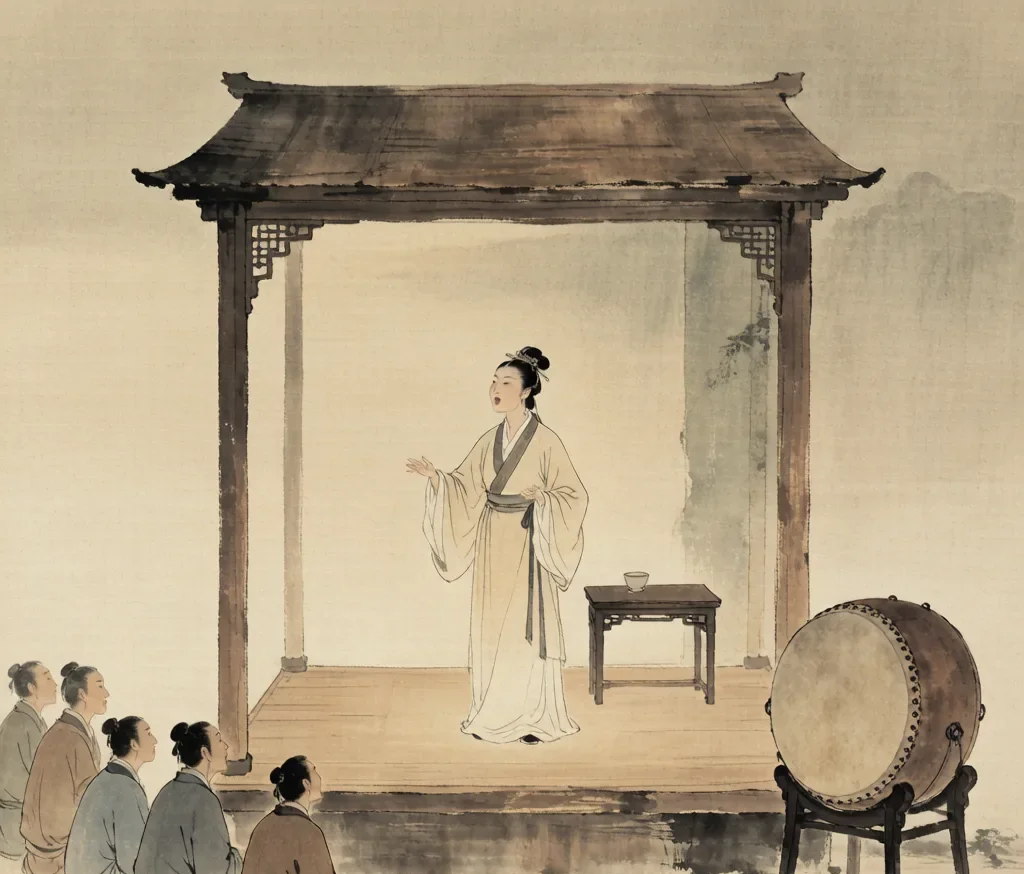
Jīngyùn dàgǔ (京韵大鼓), the "Beijing-rhyme big drum," is the refined northern story-song of Tianjin and Beijing — a solo art in which one singer narrates tales of heroes and immortals over a small drum, a clapper, and a string quartet. Born in the late Qing from the rougher drum-singing of Hebei, it was polished in the capital's teahouses into a concert art of elegant vocal ornament and literate texts. At its height it was the opera of the storyteller, and its greatest master, Liu Baoquan, left recordings that remain the gold standard more than a century later.
Origins in the Late Qing
Jingyun dagu grew out of the Hebei drum-song traditions that had long entertained the North China countryside. In the late nineteenth century, professional storytellers brought these rustic styles into the teahouses of Beijing and Tianjin and adapted them for urban, paying audiences. The transformation was deliberate: texts were rewritten in more literary Mandarin, melodies were smoothed, and the vocal manner was refined to suit listeners who wanted sophistication as well as story. The name "jingyun" — "the rhyme of the capital" — announces this ambition to sound like Beijing itself: polished, confident, and central.
The Performer and the Drum
A jingyun dagu performance is anchored by a single artist who stands behind a small drum on a stand. In the left hand are the clappers (often the wooden paiban or the metal "moon" plates); in the right hand is a slender drumstick. The singer both narrates and plays, switching from spoken exposition to sung aria without leaving the beat. Behind the soloist sit the instrumentalists: a sanxian (three-string lute) for dry rhythmic pluck, a pipa (pear-shaped lute) for flowing runs, a sihu or four-string fiddle for a sustained bowed line, and sometimes a yangqin. The soloist's drum is the conductor's baton, cueing entries and lifts.
Vocal Technique and Ornament
What sets jingyun dagu apart is its vocal art. The singer must command a wide range — from a deep chest voice for authority to a ringing high register for passion — and deploy a vocabulary of ornaments: trills, glissandos, vibrato, and the characteristic sliding turns that make a phrase feel "rhymed." Because the same voice plays every character, technique carries the drama: a dropped pitch and a roughened tone sketch a villain; a bright, even line sketches a heroine. Years of training go into making these shifts sound effortless, and the art's prestige rests on exactly this control.
The Repertoire
The jingyun dagu canon draws on China's novelistic and legendary inheritance. Famous pieces include "The Single-Sword Meeting" (Dan Dao Hui) from the Romance of the Three Kingdoms, "The Farewell at the River" (Bawang Bie Ji) on the doomed hero Xiang Yu, and episodes from "The Legend of the White Snake." Pieces are valued as much for their delivery and wordcraft as for plot, and a fifteen-to-thirty-minute item is typical for the concert stage. Many texts are praised as small literatures in themselves, with balanced couplets and witty internal rhymes that reward close listening.
Liu Baoquan, the Great Master
No account of jingyun dagu is complete without Liu Baoquan (刘宝全, 1869–1942). Widely regarded as the tradition's finest exponent, Liu standardized the repertoire, refined the vocal method, and elevated drum-song from teahouse diversion to respected stage art. His early acoustic recordings from the 1910s are among the earliest surviving Chinese sound documents and remain the definitive interpretations against which later singers are measured. Liu's career marks the moment jingyun dagu became "refined" (ya) rather than "popular" (su) — an art fit for the concert hall and the gramophone alike.
Jingyun and Xihe: Town and Country
Jingyun dagu and xihe dagu are close relatives, sharing the drum-and-clappers skeleton and the northern storytelling inheritance, but they represent opposite poles of refinement. Xihe kept the plain diction and quick shifts of the village; jingyun took those same bones and dressed them in the courtesy of the city. A listener hears the difference at once — xihe feels like a market square, jingyun like a salon. Understanding the pair is the quickest way to grasp how one northern tradition branched into an earthy rural form and an elegant urban one.
Decline and Modern Revival
Like many quyi arts, jingyun dagu declined through the mid-twentieth century as radio, film, and later television drew audiences away. Since the 1980s, however, it has seen a revival. It is taught at the Beijing Academy of Traditional Arts and similar institutions, performed at festivals, and adapted for recording and broadcast. Young singers are experimenting with new texts while preserving the classical vocal technique, and Liu Baoquan's recordings circulate online, inspiring a new generation. The challenge remains to find contemporary audiences without flattening the very refinement that gives the art its name.
Why Jingyun Dagu Endures
Jingyun dagu endures because it compresses a great deal into a small space: literature, voice, rhythm, and story, delivered by one person with a drum. It is intimate yet public, ancient yet adaptable, and its "capital rhyme" still sounds like a city that liked to think of itself as the center of taste. For listeners, a good performance offers the peculiar pleasure of watching a single artist become an army, a court, and a heartbreak — all within the span of a drumbeat and a song.
❓ Frequently Asked Questions
What makes jingyun drum "refined"?
It polished the rougher Hebei drum-singing into a concert art, with elegant vocal ornament, literate Mandarin texts, and a smoothed, capital-city manner.
Who accompanies the singer?
The soloist's own small drum and clappers, plus a string ensemble of sanxian, pipa, and the four-string sihu fiddle, sometimes with yangqin.
What does jingyun dagu perform?
Historical tales, scenes from novels like the Three Kingdoms and the White Snake, and lyrical set pieces — valued as much for delivery as for story.
How did it develop?
From late-Qing Hebei drum-song brought into Beijing and Tianjin teahouses and refined for urban audiences into a polished concert art.
Who was Liu Baoquan?
The supreme jingyun dagu master (1869–1942) who standardized the repertoire, refined the vocal technique, and left the definitive early recordings.
How does it differ from xihe dagu?
Both are northern drum-song, but jingyun is the elegant, urban, refined form, whereas xihe keeps the plainer, quicker, rural character.