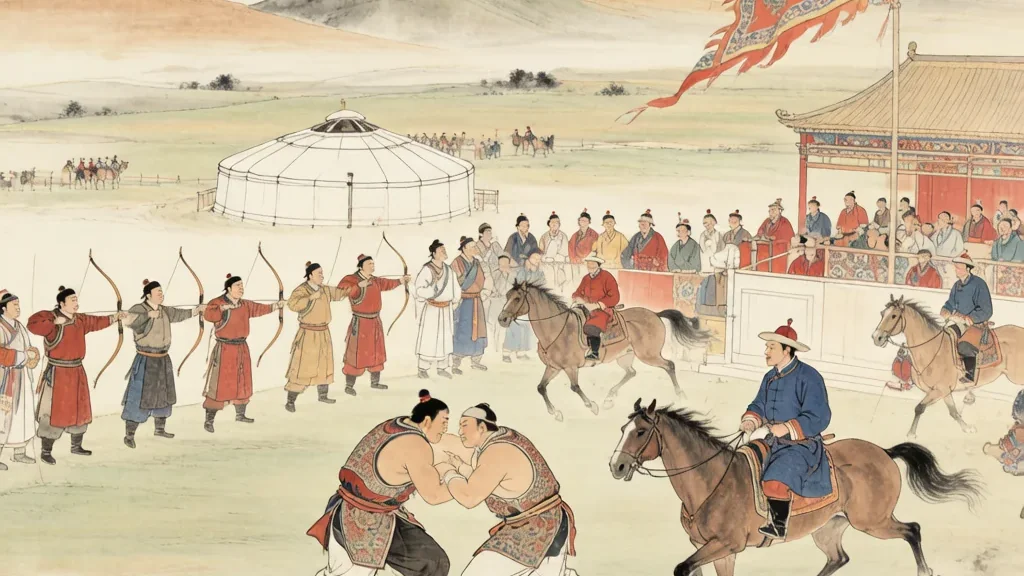
Naadam (那达慕, Nàdámù) is the great summer gathering of the Mongols — a festival of sport, song, and solidarity on the open steppe. Centred on the three "manly sports" of wrestling, horse racing, and archery, it is at once a contest of skill, a celebration of pastoral life, and a living emblem of Mongolian identity shared by Mongols in Mongolia and across China's Inner Mongolia.
Origins and History
Naadam's roots lie in the military reviews of the Mongol empires, when Chinggis Khan used contests of wrestling, riding, and archery to keep his cavalry in fighting trim. What began as essential training for warriors slowly became a popular festival woven into the seasonal rhythm of herding life on the grasslands.
By the Yuan dynasty the games were already a fixture of Mongolian court and countryside alike. In later centuries local lords and monasteries patronised Naadam to gather scattered communities, settle disputes, and display horsemanship, and the modern form took shape in the early twentieth century.
Mongolian Wrestling (Bökh)
The wrestling, called bökh (搏克), is the most prestigious of the three sports. Wrestlers wear an open-fronted jacket (zodog), tight shorts (shuudag), and boots, and there are no weight classes, so a slight youth may face a heavy champion. A bout ends the instant any part of the body above the knee touches the ground.
Victors earn traditional titles such as "Lion" and "Giant", and the greatest are honoured for life. Before and after each match the wrestlers perform the eagle dance, spreading their arms like wings — a gesture of respect to the audience and to the steppe that sustains them.
Horse Racing
Naadam horse races are tests of endurance rather than sprints. Child jockeys, typically aged five to thirteen and chosen for their light weight, ride unsaddled across fifteen to thirty kilometres of open grassland, racing horses grouped by age rather than by the rider's skill alone.
The winning horse, not the jockey, receives the greater glory: it is sprinkled with milk and honoured with a praise song celebrating its stamina. Trainers and owners lavish care on these animals for months, for a fast horse lifts the standing of an entire encampment.
Archery
Archery (surin kharbaa) uses the traditional Mongolian composite bow, built from birch, horn, and sinew, and shoots at rows of small leather targets. Men and women both compete, loosing arrows from around seventy-five metres while singers chant the names of those who strike true.
Though modern equipment exists, many archers still favour the historic design for its cultural resonance. Prizes go to the steadiest hands, and the sport keeps alive a hunting skill that once meant survival on the harsh grasslands of the north.
Ceremonies, Music and Feasting
A grand Naadam opens with a parade of athletes, monks, and dancers, often accompanied by speeches and the unfurling of ceremonial scarves (khadag). In many localities the games follow worship at an ovoo — a cairn of stones piled on a high place — where participants circle the mound and leave offerings for local spirits and for prosperity.
Between events the air fills with the Mongolian long song (urtiin duu), whose stretched melodies evoke the vastness of the steppe, alongside throat singing (khoomei) and the horse-head fiddle (morin khuur). Families share feasts of roasted lamb, dairy curds, and airag, turning the festival into a vast picnic under the sky.
Regional Variations
Naadam is celebrated both in Mongolia — where the national holiday runs from 11 to 15 July — and across Inner Mongolia in China, where summer events in places like Xilingol and Ordos draw huge crowds. Buryat, Tuvan, and other Mongolic peoples hold kindred games, each with local rules and flavour.
Within Inner Mongolia the scale ranges from village meets to provincial spectacles broadcast on television. Despite the differences, the three sports and the spirit of friendly rivalry remain constant wherever the festival travels across the steppe.
Recognition and Modern Life
In 2010 Mongolian Naadam was inscribed on UNESCO's Representative List of Intangible Cultural Heritage, securing international backing for its transmission. Today the festival also serves tourism and civic pride, with improved stadiums, prize money, and women taking part in archery and horse racing alongside the men.
Yet organisers guard its essence: the unsaddled child riders, the jacketed wrestlers, and the ancient bow are deliberately preserved so that Naadam stays a transmission of heritage rather than merely a commercial show.
Cultural Meaning
At its core Naadam celebrates the skills a pastoral people needed to thrive — strength, horsemanship, and a steady eye — and turns them into shared joy. It is a moment when the dispersed households of the steppe become one community, bound by memory and friendly contest.
For Mongols everywhere, the festival is a declaration that their nomadic heritage remains vivid and dignified in the modern world, a yearly proof that the wind, the horse, and the wrestling ring still belong to them.
Women, Children and the Home Camp
Although wrestling and archery were long seen as men's pursuits, Naadam has always been a family affair. Women run the home camps, prepare the feasts, and in many modern meets compete in archery and even horse racing, while children watch the rites that will one day be theirs. The festival is thus a school of culture as much as a contest.
Girls and boys learn the long song, the dances, and the etiquette of the ovoo from elders during the gathering. This informal education keeps Mongolian language, dress, and custom alive between one Naadam and the next, passing identity across generations without classrooms.
Naadam in the Modern Calendar
In Mongolia the festival is bound to the national holiday of Naadam (11–15 July), commemorating the 1921 revolution, so the games carry both cultural and civic meaning. In China's Inner Mongolia, local governments schedule major Naadams through July and August, often linking them to tourism and trade fairs.
Television and live streams now carry the events to Mongols far from the steppe, and diaspora groups hold smaller Naadams abroad. However the setting changes, the three sports and the spirit of friendly rivalry remain the measure of a true Naadam.
❓ Frequently Asked Questions
📝 Chinese Vocabulary
那达慕 — : Naadam; the Mongolian summer games festival.
搏克 — : Bökh; Mongolian traditional wrestling.
蒙古 — : Mongolia; the ethnic group and region.
马头琴 — : morin khuur; the horse-head fiddle.
呼麦 — : khoomei; Mongolian throat singing.
乌日汀道 — : urtiin duu; the Mongolian long song.
敖包 — : ovoo; a cairn of stones piled for worship.
哈达 — : khadag; a ceremonial silk scarf of greeting.
马奶酒 — : airag; fermented mare's milk.
🎉 Fun Facts
- Mongolian Naadam was inscribed on UNESCO's Intangible Cultural Heritage list in 2010.
- Naadam wrestlers wear an open jacket and shorts with no weight classes, and a bout ends when any part above the knee touches the ground.
- Horse-race jockeys are typically children aged five to thirteen, riding without saddles to keep the horses light.
- Mongolia's national Naadam holiday runs from 11 to 15 July each year.
- Winning wrestlers earn titles such as "Lion" and "Giant", honouring them for life.
- The horse, not the jockey, receives the greater glory in Naadam races and is sprinkled with milk.
- The morin khuur, or horse-head fiddle, is a signature instrument of Mongolian music performed at the festival.
- Traditional archery uses a composite bow of birch, horn, and sinew, still favoured for its cultural meaning.