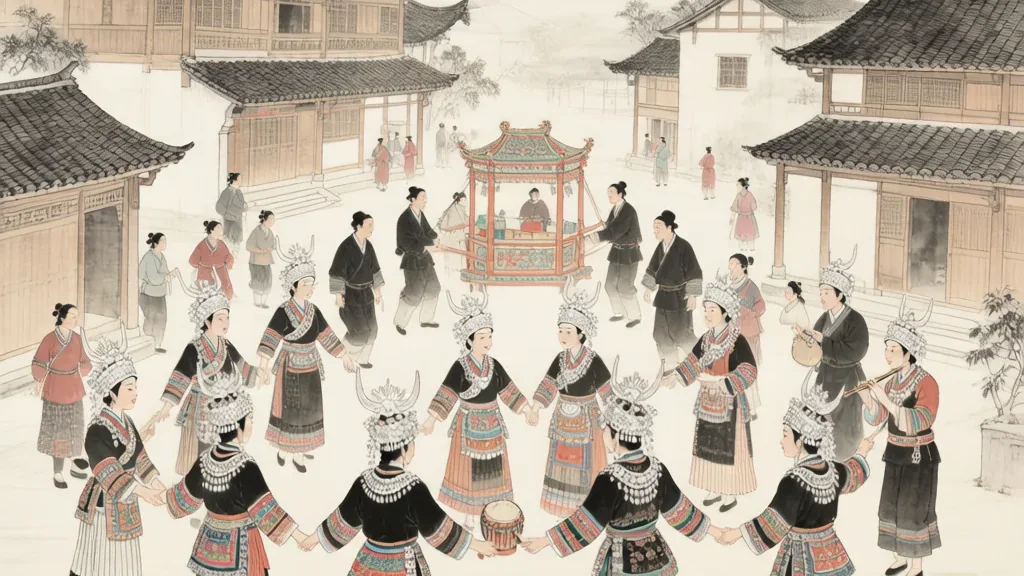
The Sisters' Meal Festival (姊妹节, zǐ mèi jié) is among the most romantic gatherings of China's Miao (Hmong) people, held mainly in the river towns of Taijiang and Jianhe in southeast Guizhou. At its center is a quiet game of courtship: young women cook glutinous "sister rice" dyed in bright colors and tuck small tokens inside that hint at their feelings for the young men who come to court them. Part love match, part family reunion, and part cultural pageant, the festival honors both the freedom to choose a partner and the lasting bond among sisters.
Legendary Origins
Miao oral tradition traces the festival to a tale of two sisters married into far-off villages who could meet only once a year when the rivers swelled. Cherishing those fleeting reunions, women of the area began gathering to cook and share a special rice meal that celebrated sisterhood and the brief season families could be together. Over the centuries this women-led gathering merged with courtship, as unmarried girls used the happy occasion to meet young men from neighboring hamlets.
The festival therefore remains unusual in Chinese folk life: it is organized and directed by women, who set the terms of the meeting and decide which suitors receive an encouraging reply. That female leadership is the festival's signature, distinguishing it from the many seasonal rites led by elders or by men.
Where and When
The festival's heartland is the Shidong (施洞) area of Taijiang County along the Qingshui River, with related celebrations in Jianhe and neighboring parts of the Qiandongnan Miao and Dong Autonomous Prefecture. It is timed to the third lunar month, most famously the 15th through 17th days, when the pause between spring plowing tasks leaves time for feasting and visiting. Villages announce the dates through established local custom.
Because the Miao are not a single group but many branches with their own dialects and dress, the exact rituals differ from valley to valley. Yet the core—colored rice, singing, and courtship—unites them all, and the surrounding communities know the season by the sudden brightness of the riverside gatherings.
The Sister Rice
The "sister rice" (姊妹饭, zǐ mèi fàn) is the festival's signature. Glutinous rice is steamed and then tinted with natural plant dyes: gardenia and wild turmeric yield yellow, the butterfly-pea flower gives blue, red comes from crushed amaranth or rose, and a dark leaf brew produces the deep purple-black favored in some villages. The colors are more than decoration.
By custom they carry feeling—yellow for warmth and welcome, blue for fidelity, red for passion—so that the very appearance of a packet speaks before a word is said. Girls shape the rice into small mounds or wrap it in fresh leaves, then add the hidden token that carries the real message. The dyeing is itself a skill passed from mother to daughter.
Tokens of Love
Inside each packet a girl hides a small object, and the choice is the heart of the game. A sprig of pine needles or a pair of chopsticks signals interest and a wish to meet again; a folded bamboo leaf may mean friendly regard without romance; a clove of garlic or a chili is a gentle "no." The system lets a girl answer a suitor without a word spoken aloud.
A young man who receives a packet reads the sign, and if he is hopeful he returns the gesture with a small gift of money, a length of cloth, or silver. The exchange is playful and public yet respectful, a structured way for two strangers to test each other's intent without losing face. Elders watch and tease, but the final answer belongs to the young pair.
Dress, Silver, and Song
The festival is also a parade of Miao artistry. Women wear their finest embroidered jackets and, above all, their silver: headdresses, neck rings, bracelets, and the broad "silver horn" (银角, yín jiǎo) that crowns the costume. A full set can weigh several kilograms and represents years of family saving, displayed with open pride on the riverside.
To the music of the lusheng (芦笙, lú shēng), a reed-pipe instrument, dancers circle in step, while "flying songs" (飞歌, fēi gē)—high, free Miao melodies—ring across the water. Singing contests between young men and women are both entertainment and a courtship arena, where quick wit and a good voice win as much admiration as any gift of silver.
Regional Variations
Because the Miao span dozens of branches, the Sisters' Meal Festival is not identical everywhere. In some valleys the emphasis falls on the rice-token courtship; in others the lusheng dance or the embroidery display takes center stage. Neighboring Dong communities may join with their own songs, and the precise date shifts with local agricultural rhythm.
What stays constant is the women's ownership of the event: it is they who invite, cook, and decide. This female leadership makes the festival a rare space in rural Chinese festival life where young women's voices and choices are openly honored rather than merely observed by the community's men.
Modern Celebration
In recent decades the festival has grown from a local custom into a celebrated public event. County governments in Guizhou now host organized programs around the Shidong dates, drawing visitors from across China and abroad. Stages are built for lusheng competitions and embroidery shows, and the riverside fills with food stalls and craft sellers.
For many young Miao, the festival is a chance to meet partners from beyond the village at a time when migration to cities has thinned rural youth. Tourism brings income and pride, though it also nudges some rituals toward performance for an outside audience, a tension the communities navigate each year.
Heritage and Meaning
The Sisters' Meal Festival was listed among China's national intangible cultural heritage, recognition of its role in keeping Miao language, dress, and music alive. Beyond spectacle, it matters as a living institution of choice: in a region where arranged matches once dominated, the festival carved out a sanctioned space for young people—especially women—to size up partners on their own terms.
It also binds generations, as grandmothers teach granddaughters the dye recipes and the meaning of each token. In that sense the "sisters" of the name are not only siblings but the whole chain of women who pass the custom down, keeping both a courtship and a kinship alive at once.
❓ Frequently Asked Questions
📝 Chinese Vocabulary
姊妹节 — : Sister Meal Festival; Miao courtship festival.
姊妹饭 — : "sister rice"; colored glutinous rice.
苗族 — : Miao (Hmong) people.
银饰 — : silver ornaments; Miao traditional jewelry.
银角 — : silver horn; the crest of a Miao woman's headdress.
芦笙 — : lusheng; Miao reed-pipe instrument.
飞歌 — : "flying song"; high, free Miao singing style.
施洞 — : Shidong; the festival's heartland in Taijiang, Guizhou.
黔东南 — : southeast Guizhou; the Qiandongnan Miao and Dong Prefecture.
🎉 Fun Facts
- Miao silver headdresses worn at the festival can weigh several kilograms and represent years of family savings.
- The colored rice uses only natural plant dyes—gardenia or turmeric for yellow, butterfly-pea for blue, amaranth for red.
- The festival is led by women, who invite, cook, and decide the terms of the courtship gathering.
- The Sisters' Meal Festival is listed as a national intangible cultural heritage of China.
- The hidden token system lets a girl refuse a suitor gently, without either side losing face.
- Lusheng reed-pipe music and "flying songs" turn the riverside into an open-air concert and singing contest.
- The festival's main dates fall on the 15th–17th of the third lunar month, a pause between spring plowing tasks.
- In some valleys the silver "horn" (银角) can span over a foot wide, echoing the horns of a water buffalo, a Miao totem.