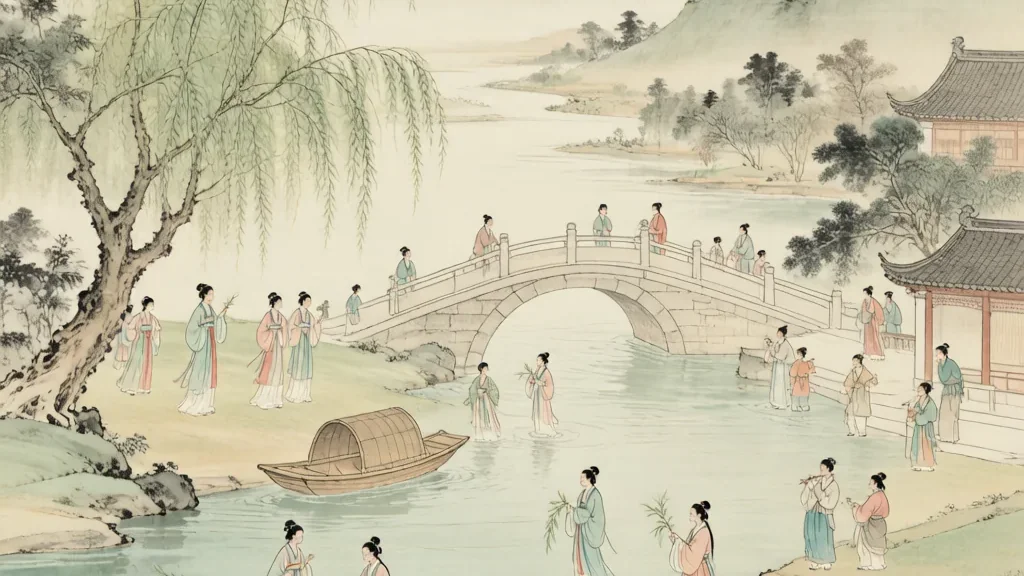
The Shangsi Festival (上巳节, Shangsi Jie) is the ancient spring cleansing by the river — a day when people bathed in flowing water, floated wine cups, and met beside the orchids to wash away misfortune and welcome the season. Held on the third day of the third lunar month, it was once among the liveliest festivals of the Chinese year.
Origins in the Zhou Dynasty
Shangsi began as a purification rite recorded in the "Rites of Zhou" (周礼). Its name means the first "Si" day (巳, the snake branch) of the third month, later fixed as the third day of the third lunar month (三月三). Commoners gathered at streams to wash away illness and bad luck before the busy farming season.
The Classic of Poetry (诗经) describes the custom vividly in its "Qin and Wei" (溱洧) song of the Zheng state, where young men and women meet by the riverside carrying orchids (兰), laughing and flirting as they purify themselves — evidence that Shangsi was already a festival of courtship as well as cleansing.
Scholars note the festival's deep root in agricultural anxiety. Early spring was a perilous time before sowing, and washing in cold water was both hygiene and a charm against disease. The river, source of life, was the natural place to ask for health.
Over centuries the date's logic shifted: what began as a movable day chosen by the sexagenary cycle was fixed to the third of the third for convenience, which is why the festival is also called "Double Third" (重三). The change shows how folk calendars balanced astronomy with ease of memory.
The Rite of River Cleansing
The core act was fuxi (祓禊) — wading into a river to rinse away impurity. Participants also soaked orchids or mugwort in water and sprinkled it over themselves and one another, believing the early-spring stream carried off sickness and sorrow. The third month's waters were held to be especially potent.
Orchids gave the festival its refined air. People wore the fragrant blooms as ornaments and floated them on the water as offerings. The flower's clean scent came to symbolize the moral and physical freshness the rite was meant to bestow.
The rite was not only personal. Communities gathered as groups, and the shared bathing smoothed social lines for a day — servants and masters, young and old, met at the same bank without the usual distance between them.
Women, too, took part by bathing and floating orchids, and the day was one of the few when they could gather openly by the water. This gendered freedom, recorded in poetry and painting, is part of why Shangsi is remembered as a gently liberating spring holiday.
The Orchid Pavilion Gathering
Shangsi's finest hour came in 353 CE, when the calligrapher Wang Xizhi (王羲之) hosted more than forty literati at the Orchid Pavilion (兰亭) on the third day of the third month. They played "floating wine cups" (曲水流觞): cups of wine set adrift in a winding stream, drunk by whoever they paused before.
Those who failed to compose a poem on the spot drank forfeit, and Wang Xizhi penned a preface to the collected verses. The "Orchid Pavilion Preface" (兰亭集序) is honored as the greatest work of Chinese calligraphy, forever linking Shangsi with literary grace.
The gathering's fame rests on its preface more than its poems. Wang Xizhi's flowing, spontaneous script captured the mood so perfectly that later emperors copied it and the original became a cultural relic treasured for centuries.
Courtship and Matchmaking
From the "Qin and Wei" poem onward, Shangsi was a sanctioned time for young people to meet. The riverside setting, the shared bathing, and the festival's air of freedom made it a gentle occasion for romance, much like a spring Valentine's Day of the ancient world.
This romantic strain survived longest among minority peoples. The Zhuang (壮族) still keep "San Yue San" (三月三) with song contests in which young men and women answer each other in verse and exchange gifts — a direct descendant of the riverside meeting.
The freedom was unusual in a society that tightly guarded young women's movements. Shangsi thus offered a rare, sanctioned space for open meeting — one reason the festival was fondly remembered long after its rites faded.
Flourishing in the Tang Dynasty
Under the Tang, Shangsi became a grand public spring outing. Court and commoners alike flocked to the Qujiang (曲江) waterside in Chang'an for boating, picnics, and poetry. The day blurred into the broader custom of "treading the green" (踏青), walking the fresh spring meadows.
Tang poets such as Du Fu and Wang Wei wrote of these excursions, and imperial gatherings at Qujiang became set pieces of the calendar. The festival's ease and elegance made it a favorite subject of the age.
Imperial patronage lifted the day's status: the emperor himself might sail Qujiang, and officials competed to produce the finest verses, making Shangsi a stage for career as well as pleasure.
Decline and Merger with Qingming
From the Song dynasty onward Shangsi's distinct observance weakened. As the lunar calendar shifted and the cold-food and tomb-sweeping customs of Qingming (清明) grew prominent, the river-cleansing of Shangsi was gradually absorbed into the broader spring outing of Qingming.
By late imperial times the "third day of the third month" survived more as a quiet folk date than a major festival in the Han heartland, though its spirit lived on in outings, poems, and the minority celebrations of the south.
Part of the shift was practical — as cities grew and riverside land was built over, the ritual of group bathing lost its setting. What remained was the outing itself, detached from the old purification.
San Yue San Among Ethnic Minorities
In the south, Shangsi endured most strongly as "San Yue San" (三月三). The Zhuang of Guangxi turn it into a song festival (歌圩) with antiphonal singing, dances, and feasts; in 2014 Guangxi made it a two-day regional public holiday.
Neighboring peoples keep kindred rites: the Li (黎), Dong (侗), and Miao (苗) all mark the third of the third with song, courtship, and special foods, each weaving the old river festival into its own heritage. Zhuang song fairs are listed among China's national intangible cultural heritage.
The song contests are no small affair: thousands gather in Guangxi's parks and hills, and the best singers win local fame. For the Zhuang, San Yue San is both heritage and a living, joyful reunion of kin and neighbors.
Foods and Customs
The signature dish of San Yue San is five-colored glutinous rice (五色糯米饭), dyed with natural plants — yellow from buddleja (密蒙花), red and purple from herb leaves, black from maple — then steamed into a vivid, fragrant mound shared at the feast.
Families also dye eggs and wrap glutinous treats, offering them to guests as blessings. The bright colors are read as omens of health, harmony, and a good year, and the communal meal keeps the festival's ancient spirit of sharing by the water.
The colors carry wishes: red for joy, yellow for wealth, black for protection, and so on. Offering the rice to elders and friends spreads the blessing, much as the old riverside rites spread a shared fortune.
Beyond the rice, families prepare spring herbs and boiled eggs, sometimes dyed and cracked against one another in play — a small game that, like the colored rice, belongs to the season of renewal. Such homely customs keep San Yue San intimate even as it grows into a public spectacle.
Cultural Legacy
Shangsi traveled abroad. Japan's Hinamatsuri (Doll Festival, March 3) and Korea's Samjinnal (삼짇날, March 3) both descend from the Chinese Shangsi purification custom, carried across the sea with Buddhism and court culture.
Today the festival is revived through cultural tourism, minority song festivals, and a fresh interest in its ecological message — that clean water and shared nature are worth honoring. From a Zhou-dynasty cleansing to a modern heritage event, Shangsi still invites people to the river each spring.
Modern environmental groups have adopted Shangsi's water theme, holding river-cleaning events on the third of the third. The old wish to be cleansed by the stream thus finds a new, ecological expression.
In China itself, riverside outings on the third of the third survive in places like Shaoxing, where locals still walk the water towns and recite Wang Xizhi's preface. The festival thus persists not only abroad but in the very landscapes where it was born.
❓ Frequently Asked Questions
📝 Chinese Vocabulary
上巳节 — : Shangsi Festival; Double Third.
三月三 — : Third Month Third Day; the festival date.
祓禊 — : river purification rite.
兰亭 — : Orchid Pavilion.
曲水流觞 — : floating wine cups on a winding stream.
兰 — : orchid; the fragrant plant of purification.
踏青 — : treading the green; spring outing.
五色糯米饭 — : five-colored glutinous rice.
歌圩 — : song fair; Zhuang singing festival.
溱洧 — : Qin and Wei; the Zheng-state rivers of the classic poem.
🎉 Fun Facts
- The "Orchid Pavilion Preface" by Wang Xizhi is regarded as the greatest masterpiece of Chinese calligraphy.
- Shangsi influenced Japan's Hinamatsuri and Korea's Samjinnal, both held on March 3.
- Guangxi grants a two-day regional public holiday for Zhuang "San Yue San."
- The festival's name originally referred to the first "Si" (snake) day of the third month, not a fixed calendar date.
- Five-colored glutinous rice is dyed using natural plant pigments, not artificial color.
- The "Qin and Wei" poem in the Classic of Poetry already describes riverside courtship at Shangsi.
- In the Tang dynasty, Chang'an's Qujiang waterfront was the center of Shangsi outings.
- From the Song dynasty, Shangsi's customs were gradually absorbed into Qingming observances.