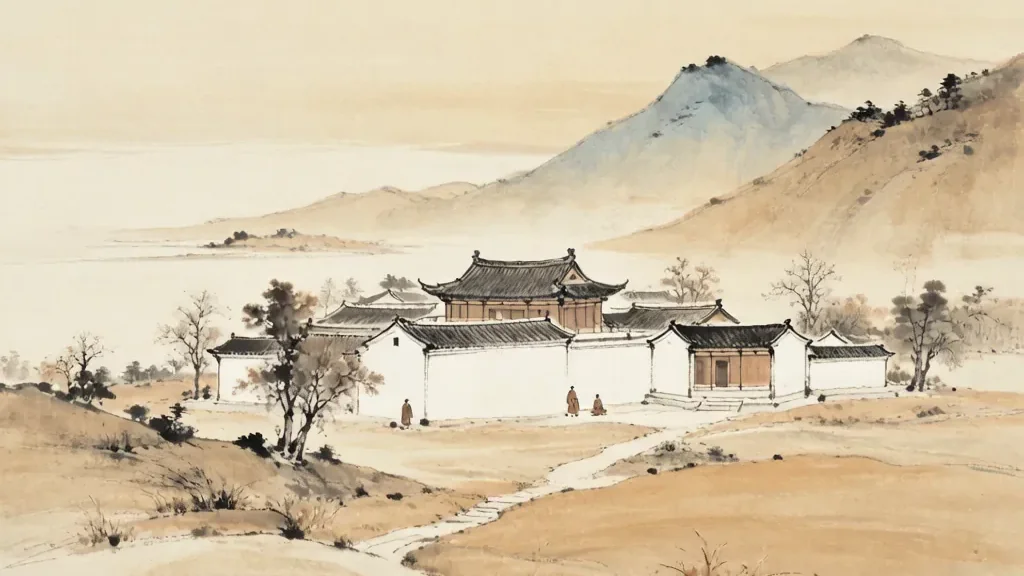
The Dali kingdom was the successor state to Nanzhao in the Yunnan highlands, ruling from the tenth century until its conquest by the Mongol Yuan in 1253. Founded after the collapse of the Meng-led Nanzhao order, Dali was governed chiefly by the Duan clan and became celebrated for its relative peace, its deep Buddhist piety, and its role as a stable civilization bridging China, Tibet, and Southeast Asia. Less militarily aggressive than Nanzhao, Dali prospered through agriculture, trade, and religion, and its kings often shared power with powerful Buddhist monastic lineages. The kingdom's fall to Kublai Khan's Mongols brought Yunnan firmly into the Chinese imperial system, but Dali's cultural heritage endured long afterward in the temples and traditions of the region.
From Nanzhao to Dali
The transition from Nanzhao to Dali was the product of internal upheaval rather than outside invasion. After the Meng dynasty weakened through coup and revolt, a series of short-lived regimes rose and fell around the Erhai basin until the Duan clan established a more enduring order centered on the city of Dali. The new kingdom inherited the territory, Buddhism, and administrative habits of its predecessor.
Unlike the turbulent founding of Nanzhao, Dali's early rulers sought stability and legitimacy through continuity. They maintained the capital, preserved the temples, and cultivated the same syncretic culture, presenting themselves as heirs rather than revolutionaries. This smooth transmission helped Dali avoid the destructive wars of succession that had plagued the earlier state.
The Duan Clan and the Royal Office
The Duan family supplied most of Dali's kings across centuries of rule, giving the kingdom a rare dynastic continuity in a region of shifting peoples. The monarchy, however, was often constrained by powerful ministerial and monastic families, and at times the kingship was more symbolic than absolute, with real authority shared among hereditary elites and Buddhist prelates.
A distinctive feature of Dali was the frequency with which kings abdicated to become monks. Several rulers renounced the throne for the monastic life, a practice that reflected the prestige of Buddhism and the belief that spiritual merit outranked worldly power. This blurring of crown and cloister gave Dali a tone markedly different from the warrior courts of the north.
The City of Dali and Its Setting
The capital Dali lay in the Erhai Lake basin, shielded by the Cangshan mountains, a setting of rare beauty and agricultural bounty. The city served as the political, religious, and commercial heart of the kingdom, linked by roads and rivers to the caravan networks of the southwest. Its position made it both a refuge and a crossroads.
Dali's urban culture drew on Chinese models of planning while remaining rooted in highland tradition. Markets, temples, and workshops filled the basin, and the court attracted artisans, merchants, and monks from across inner Asia. The city's enduring fame rests on this blend of serenity and cosmopolitan exchange, a character still associated with Yunnan today.
Buddhism as State Religion
Buddhism permeated every level of Dali society and government. The kingdom patronized both Mahayana and Esoteric Buddhist traditions, built pagodas and monasteries, and produced a remarkable school of Buddhist art in bronze, painting, and scripture. The famous three pagodas of Dali, still standing, testify to the architectural ambition of the age.
The close alliance of throne and altar meant that monasteries held land, influence, and sometimes political authority. Buddhist rites sanctioned royal rule, and the clergy served as counselors, diplomats, and record-keepers. In a kingdom where the king might also be a monk, religion was not a private devotion but the very fabric of the state.
Economy, Agriculture, and the Caravan Trade
Dali's wealth rested on the productive rice fields of the Erhai basin, supplemented by the highland products of tea, horses, and minerals. The kingdom sat astride the southern branches of the trade routes that connected China with Tibet, India, and Burma, and the horse trade with the Song dynasty was especially lucrative, supplying the northern armies with sturdy southwestern mounts.
Commerce brought not only goods but ideas, as merchants carried Buddhism, craft techniques, and fashions between civilizations. Dali's relative peace allowed this trade to flourish, and the kingdom became a prosperous intermediary rather than a conqueror, a role that suited its geography and temper.
Relations with the Song and Other Neighbors
Dali generally maintained peaceful, tributary relations with the Song dynasty to the north, exchanging horses for silk, tea, and manufactured goods. Unlike Nanzhao, Dali did not wage great wars against China, and the two states coexisted as trading partners separated by mountains. The Song valued Dali's horses for cavalry against northern rivals.
To the west and south, Dali interacted with the peoples of Burma, Assam, and the upland Southeast Asian corridors, extending cultural and commercial influence without large conquests. Its soft power rested on Buddhism and trade, allowing it to command respect across a wide region without the expense of empire.
Art and the Dali Buddhist Heritage
The artistic legacy of Dali is among the richest of any southwest state. Bronze images of Buddhist deities, painted scrolls, and illuminated texts show a refined synthesis of Indian, Tibetan, and Chinese styles. The kingdom's artisans were renowned, and their works were sought by collectors in China and Tibet alike.
Surviving scrolls and ritual objects reveal a sophisticated iconography, including protective deities and astral diagrams distinctive to the region. This art was both devotional and diplomatic, gifted to neighboring courts as tokens of Dali's civilization, and it remains the clearest window into a kingdom that left few written records of its own.
The Mongol Conquest
Dali's independence ended when the Mongols, under the leadership of Kublai Khan, campaigned into the southwest in the mid-thirteenth century. Approaching through the difficult terrain of Tibet and the highlands, the Mongol armies outflanked the kingdom's defenses and took Dali, incorporating Yunnan into the expanding Yuan empire. The conquest was part of the broader Mongol strategy to outflank the Song from the west.
After the fall, the Duan family was allowed to retain a measure of local authority as subordinate rulers under Mongol oversight, a pragmatic arrangement that preserved continuity. Yunnan was thus drawn into the Chinese provincial system more firmly than ever before, yet Dali's Buddhist culture survived the change of dynasty.
Legacy of the Dali Kingdom
Dali is remembered as a kingdom of peace and piety, a contrast to the martial states around it. Its long survival, deep Buddhism, and flourishing trade made it a civilized anchor of the southwest, and its art remains a treasure of Chinese regional heritage. The Duan line's partial continuity under the Yuan shows how durable its institutions were.
For Yunnan, Dali represents the height of indigenous statehood before the province was fully integrated into the Chinese empire. Its temples, pagodas, and the enduring identity of the Bai people who descend from its subjects keep the kingdom's memory alive, making Dali both a historical state and a living cultural landscape.
❓ Frequently Asked Questions
When did the Dali kingdom rule?
Dali ruled from the tenth century until the Mongol conquest in 1253, succeeding the Nanzhao kingdom.
Who governed Dali?
The Duan clan provided most kings, though power was often shared with ministers and Buddhist monastic leaders.
Why was Buddhism so central?
Buddhism was the state religion, kings sometimes became monks, and monasteries held land and political influence.
How did Dali relate to the Song?
It kept peaceful tributary trade with the Song, supplying horses in return for tea, silk, and goods.
How did Dali end?
The Mongols under Kublai Khan conquered Dali and brought Yunnan into the Yuan empire.
What is Dali's legacy?
It is remembered as a peaceful Buddhist kingdom whose art and culture endure in Yunnan today.