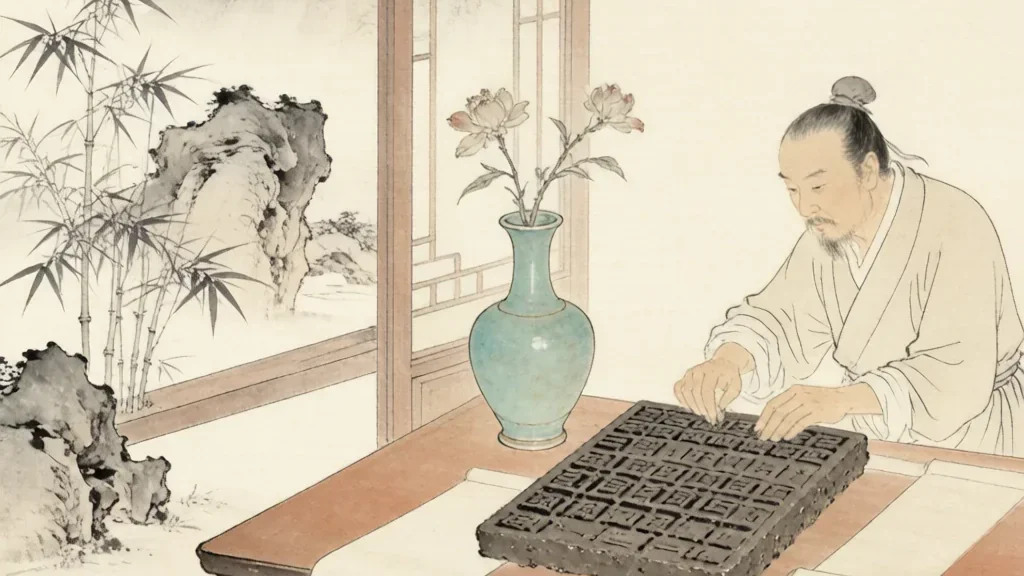
The Song (宋, Sòng, 960–1279 CE) is often called China's early-modern age. Militarily weaker than the Han or Tang, it nonetheless presided over an economic and technological takeoff unmatched anywhere in the pre-industrial world. Its founders built a state run by exam-selected civilians, its cities teemed with markets and entertainers, and its scholars gave Confucianism a new metaphysical depth. Split into the Northern Song (with its vibrant capital Kaifeng) and the Southern Song (centered on the lake city Hangzhou), the dynasty traded frontier glory for internal refinement — and in doing so, reshaped daily life for everyone.
Founders and the Exam State
The Song began in 960 when the Later Zhou general Zhao Kuangyin (赵匡胤, 927–976) was proclaimed emperor by his troops in the famous "Chenqiao mutiny" (陈桥兵变), where he awoke beneath a yellow robe of sovereignty. As Emperor Taizu (宋太祖), he faced the classic warlord problem: how to keep generals from overthrowing him. His solution was elegant — he invited his former comrades to a banquet, persuaded them to retire with pensions, and transferred military power to civilian officials.
The result was a uniquely civil bureaucratic state. The Song expanded the examination system (科举, kējǔ) so that scholar-officials, not hereditary nobles or soldiers, governed. An elaborate central administration with multiple overlapping agencies checked any single minister's power. This "rule by civilians" (重文轻武, "honor civil, slight military") brought stability but also left the frontier chronically under-defended.
When the Jurchen (女真) Jin captured Kaifeng in 1127 and carried off the emperor, the surviving prince re-founded the dynasty as the Southern Song at Hangzhou (杭州). There the Song endured another 150 years, balancing against northern powers through diplomacy and tribute rather than conquest.
An Economic Revolution
No dynasty transformed everyday economy like the Song. The adoption of early-ripening Champa rice (占城稻) from Vietnam allowed two harvests a year, fueling a population that surpassed 100 million. Surplus grain fed dense, commercial cities — Kaifeng may have held over a million people, and Hangzhou (described by the Venetian visitor Marco Polo a generation later) struck observers as the world's richest city.
The Song minted enormous quantities of copper cash yet still faced currency shortages, so private merchants in Sichuan issued the world's first paper money, the jiaozi (交子), later adopted and regulated by the state. A national market emerged, linked by canals, rivers, and a booming maritime trade that exported silk, porcelain, and tea for foreign silver.
Iron and coal production soared — some estimates put Song iron output higher than early Industrial Revolution Europe. With abundant fuel and metal, the Song built suspension bridges, mechanical clocks, and a navy. This was capitalism before its name, restrained only by the state's suspicion of unruly merchants and soldiers. The state itself profited by monopolizing key goods such as salt and tea, and its maritime customs stations collected duties from foreign shipping at Quanzhou and Guangzhou. The result was a fiscal system increasingly dependent on commerce rather than land tax — a striking preview of the tax structures of early modern states elsewhere in the world.
Printing, Gunpowder, Compass
The Song matured three of China's Four Great Inventions. Woodblock printing was already old, but Bi Sheng (毕昇) invented movable-type printing (活字印刷, huózì yìnshuā) around 1040 using fired-clay characters — a leap that made books cheap and learning widespread. The state printed standardized examination manuals, law codes, and paper money by the millions.
Gunpowder (火药, huǒyào), known earlier, was weaponized under the Song: they deployed primitive bombs, fire-lances, and rockets against the Jurchen and, finally, the Mongols. The magnetic compass (指南针, zhǐnánzhēn), described by Shen Kuo (沈括) and others, guided ocean-going ships, enabling the maritime spice trade. The polymath Shen Kuo's Dream Pool Essays (梦溪笔谈) recorded these and many other discoveries.
Together, these technologies spread westward along the Silk Road and by sea, reaching Europe by the Renaissance and helping to remake the world. The Song's "refinement" was as much engineering as aesthetics.
Neo-Confucianism
Amid material wealth, Song thinkers launched an intellectual renewal. Buddhism and Daoism had dominated for centuries, and Confucians sought to answer them on their own terms. The result was Neo-Confucianism (理学, Lǐxué), a synthesis that treated the cosmos as governed by an underlying principle (理, lǐ) manifest in human morality.
The giant of the movement was Zhu Xi (朱熹, 1130–1200), who organized the Confucian canon into the "Four Books" (四书, Sìshū) — the Analects, Mencius, Great Learning, and Doctrine of the Mean — and wrote commentaries that became the official examination standard from the Yuan through the Qing. His emphasis on serious study (格物, géwù, "investigating things") and moral self-discipline shaped the values of the scholar-gentry for six centuries.
Neo-Confucianism gave the Song a serious, sometimes austere cultural tone, even as its cities grew playful. It also hardened social hierarchies — especially the confinement of women under stricter ideals of chastity — a complex legacy later dynasties inherited.
Refined Urban Culture
Song cities were pleasure-grounds as well as markets. Night markets, teahouses, restaurants, and theatrical stages filled the wards; the government even relaxed the old Tang curfews, letting Kaifeng and Hangzhou stay lively after dark. Printed illustrated books, playing-card games, and the new lyric poetry called ci (词) entertained a broad public.
The visual arts turned inward and lyrical. Landscape painting (山水画, shānshuǐhuà) reached sublimity in the hands of masters like Guo Xi and the emperor-artist Huizong (徽宗, r. 1100–1126), whose meticulous bird-and-flower works and calligraphy defined court taste. Ceramics — the celadon (青瓷) and Ru ware (汝窑) — achieved a restraint later collectors idolized as the essence of Chinese elegance.
When the Southern Song finally fell to the Mongols in 1279 at the sea battle of Yamen, Chinese mourned the loss of a refined world. But the Yuan conquerors inherited the Song's inventions, its exams, and its urban habits — proof that the dynasty's quiet revolution outlasted its walls. Even in defeat, the Southern Song had mounted a stubborn resistance for a century and a half, fielding gunpowder weapons and a naval fleet that foreshadowed modern war. The scholar-official class, tempered by Neo-Confucian discipline, carried its values into the Yuan, Ming, and Qing, so that the examination system and the printed book — both Song innovations — became the bedrock of late imperial China. The Song proved that a state could be world-leading without being militarily dominant.