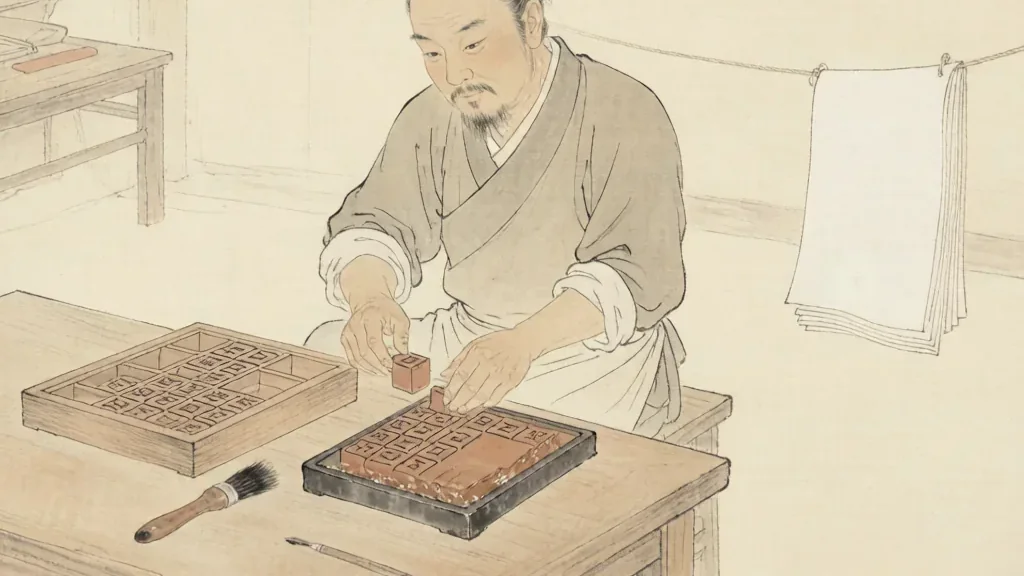
Between 1041 and 1048 CE, in the city of Hangzhou during the Northern Song Dynasty, a common artisan named Bi Sheng (毕昇, Bì Shēng) accomplished something that would change the course of human history: he invented movable type printing. Using characters carved from fired clay and assembled in an iron frame, Bi Sheng created a system that allowed individual Chinese characters to be rearranged and reused to print different pages — the first known practical application of the movable type concept anywhere in the world. This was not merely an incremental improvement on existing printing technology but a fundamental conceptual breakthrough: the idea that text could be decomposed into reusable individual elements and recomposed at will. Bi Sheng's invention predated Johannes Gutenberg's famous movable type printing press by approximately 400 years and established China as the birthplace of one of the most transformative technologies in human civilization.
The Predecessor: Woodblock Printing
To appreciate Bi Sheng's innovation, one must understand the technology that preceded it. Woodblock printing (雕版印刷, diāobǎn yìnshuā) had been practiced in China since at least the Tang Dynasty (618–907 CE), with the earliest surviving printed book — the Diamond Sutra (金刚经, Jīngāng Jīng), dated 868 CE — demonstrating a level of technical sophistication that suggests the technology had been developing for some time. Woodblock printing involved carving an entire page of text and illustrations in reverse on a wooden block, applying ink to the raised surface, and pressing paper against it to transfer the image. This technique was revolutionary in its own right: it allowed the mass production of texts, making books far more widely available than hand-copied manuscripts, and it contributed significantly to the flourishing of literature, scholarship, and Buddhist scripture dissemination during the Tang and Song dynasties. However, woodblock printing had significant limitations. Carving each page was enormously labor-intensive — a single block could take a skilled carver days or weeks to complete. If a mistake was made, the entire block was ruined. Blocks could only be used for one specific text, requiring separate carving for every book. Storage of the wooden blocks for a major publishing project could fill entire warehouses. Most critically, the process was poorly suited to the Chinese writing system, which uses thousands of distinct characters rather than a small alphabet. A typical book might require carving tens of thousands of individual characters, each one separately and irreversibly committed to a specific block.
Bi Sheng's Innovation: Ceramic Movable Type
Bi Sheng's genius lay in recognizing that the labor-intensive carving process could be eliminated if individual characters were created as separate, reusable pieces. According to the detailed account preserved in the 'Dream Pool Essays' (梦溪笔谈, Mèngxī Bǐtán) by the Song Dynasty scholar Shen Kuo (沈括, 1031–1095), Bi Sheng's method worked as follows: He first carved individual Chinese characters in relief on small blocks of fine clay, creating what were essentially tiny stamps. These clay blocks were then hardened by firing in a kiln, producing durable ceramic type pieces. To compose a page, Bi Sheng would set up an iron frame and coat it with a mixture of pine resin, wax, and paper ash. He would then arrange the ceramic characters in the frame to form the desired text, and heat the frame gently to melt the resin mixture. When the resin cooled and solidified, it held all the characters firmly in place, creating a solid printing plate. After printing the required number of copies, the frame could be heated again to melt the resin, allowing the characters to be removed and sorted back into their storage compartments for reuse. For characters that were frequently used, Bi Sheng prepared multiple copies — sometimes twenty or more of common characters — ensuring that he would not run out in the middle of composing a page. For rare characters that were not in his collection, he could quickly carve a new one from clay and fire it on the spot. This system was elegantly practical and addressed the fundamental challenge that had limited earlier printing technologies: the enormous investment of labor required to create a unique printing surface for every page.
Why Movable Type Was Challenging for Chinese
Despite Bi Sheng's brilliant invention, movable type printing did not immediately revolutionize Chinese publishing the way Gutenberg's press would later transform Europe. The reason lies in the fundamental difference between alphabetic and logographic writing systems. A European printer using movable type needed to stock perhaps 100 distinct characters — uppercase and lowercase letters, numerals, and punctuation marks — with multiple copies of each. A Chinese printer, by contrast, needed to maintain a collection of several thousand distinct characters, with many copies of the most common ones. The sheer logistical challenge of organizing, storing, and retrieving type from a collection of 5,000 to 10,000 different pieces was formidable. Moreover, the Chinese tradition of calligraphy valued the aesthetic quality of handwritten characters, and early movable type — with its standardized, mechanical appearance — could not match the beauty of woodblock printing, which preserved the calligraphic style of the original carver. For these reasons, woodblock printing remained the dominant printing technology in China for centuries after Bi Sheng's invention, while movable type was used primarily for large-scale government printing projects where speed and volume justified the organizational complexity. Nevertheless, the conceptual breakthrough was made, and later Chinese printers refined the technology: Wang Zhen (王祯) of the Yuan Dynasty developed wooden movable type around 1298, creating a system of revolving storage tables that made it easier to find and retrieve characters, and bronze movable type was developed in Korea during the Goryeo Dynasty in the early 13th century, producing the world's oldest surviving book printed with metal movable type — the Jikji (直指), printed in 1377, predating Gutenberg's Bible by 78 years.
Legacy: The Knowledge Revolution
The question of whether Gutenberg knew of or was influenced by Asian movable type remains a subject of scholarly debate. There is no direct evidence that information about Bi Sheng's invention reached Europe before Gutenberg's time, though the Silk Road and Mongol Empire had created unprecedented channels of communication between East and West during the 13th and 14th centuries. Some historians have suggested that reports of Chinese and Korean movable type printing may have reached Europe through travelers like Marco Polo or through Arab intermediaries. Regardless of the question of transmission, the fundamental importance of movable type printing to human civilization cannot be overstated. The ability to produce books quickly, cheaply, and in large quantities democratized knowledge, enabled the spread of new ideas, fueled the Renaissance and the Scientific Revolution, and laid the foundation for modern mass communication. That this revolutionary technology was first conceived by a humble artisan in Song Dynasty China — a man of whom we know almost nothing beyond his invention — is a powerful reminder that transformative ideas can come from any corner of society. Bi Sheng's ceramic characters have long since crumbled to dust, and no examples of his printing survive. But the idea he brought into the world — that knowledge could be broken down into reusable elements and endlessly recombined — has proven to be one of the most enduring and consequential innovations in human history.