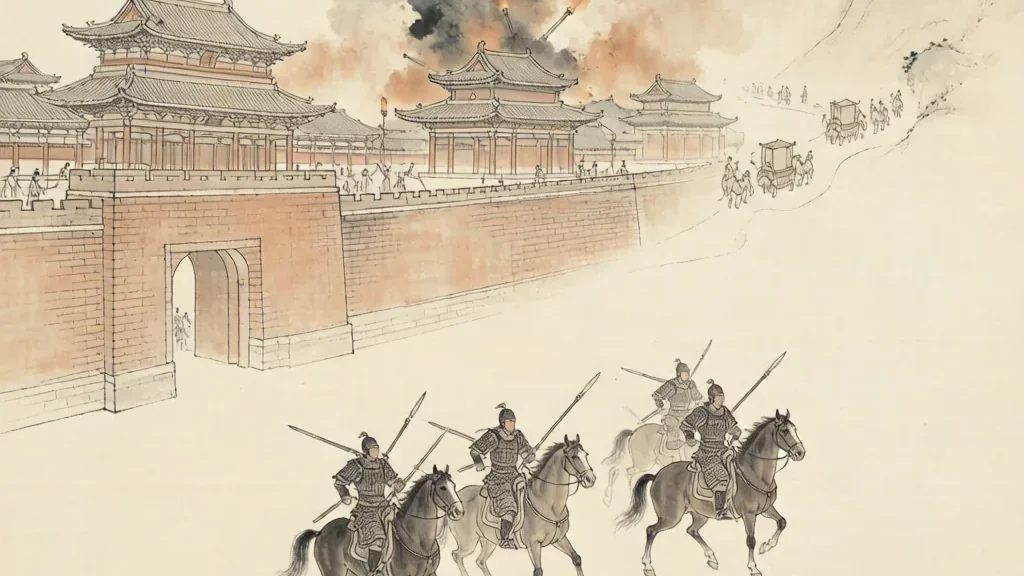
There is a Chinese saying that a great dynasty dies not with a foreign sword but from a wound inside. The Tang at its height was the most glorious court on earth — Chang'an, a city of a million, where Persian merchants, Buddhist pilgrims, and Tang nobles mingled under the same lanterns. Then, in a single winter, that world caught fire. From 755 to 763, the An-Shi Rebellion (安史之乱, ān shǐ zhī luàn) drowned the golden age in blood, cut the population by perhaps two-thirds, and turned the confident cosmopolitan empire into a fragile, inward-looking state. It is the great dividing line of medieval China.
The Overstretched Empire
By the mid-eighth century the Tang faced threats all along its borders — Tibet to the west, the Khitan and Xi to the northeast, and restless steppe powers. To meet them, the court had created the post of military governor, or jiedushi (节度使, jié dù shǐ), granting regional commanders both troops and tax revenue. This solved the frontier problem but created private armies loyal to generals rather than the emperor. At the same time, the aging Emperor Xuanzong (玄宗, Xuánzōng) had drifted from statecraft into pleasure, captivated by the concubine Yang Guifei (杨贵妃, Yáng Guìfēi) and reliant on the manipulative minister Li Linfu, who deliberately promoted non-Chinese frontier generals like An Lushan so they could not rival him at court.
When Li Linfu died, the Yang family's relative Yang Guozhong took his place and clashed openly with An Lushan. The central government, hollowed out by faction and flattery, no longer commanded the loyalty of the men with the swords.
The Rebels and the Emperor
An Lushan (安禄山, Ān Lùshān) was a remarkable figure: a huge, partially blind, possibly Sogdian-Turkic general who entertained the emperor with clowning and claimed Yang Guifei as his adoptive mother. He controlled the three northern frontier commands — roughly 160,000 troops, the best in the empire. In December 755 he proclaimed himself emperor of a new Yan (燕) dynasty and marched south. The Tang's own regional armies, trained for the frontier, crumbled or joined him.
Xuanzong fled the capital in panic. At Mawei Station, his escort mutinied, strangled Yang Guifei, and killed her relatives, forcing the emperor to abdicate in favor of his son Suzong. The romance of the doomed emperor and his beloved concubine became one of China's most enduring tragedies, immortalized in Bai Juyi's poem 「长恨歌」 (Song of Everlasting Sorrow).
The Course of the War
The rebels took the eastern capital Luoyang in 756 and the great western capital Chang'an soon after, forcing the court into exile in Sichuan and the northwest. For a moment it seemed the dynasty was finished. But the rebellion fractured: An Lushan was assassinated by his own son An Qingxu in 757, who was in turn killed by the subordinate Shi Siming — hence "An-Shi" (安史), the families of the two rebel surnames.
The Tang survived by borrowing desperately from beyond the frontiers, especially the Uighur Turks, who helped retake Chang'an and Luoyang but looted the cities in payment. The war dragged on as a grinding series of sieges and reprisals across the north China plain. Finally, in 763, the last rebel stronghold fell and the Tang banner flew again — over a country unrecognizable from the one of 755.
The Devastation and the New Order
The human cost was almost beyond counting. Pre-rebellion census registers listed some 53 million people; post-war figures fell near 17 million. Even discounting households that simply vanished from the tax rolls, the combination of massacre, starvation, and epidemic killed tens of millions. The densely populated Huai and Yellow River regions, once the empire's granary, were laid waste; the economic center of gravity shifted permanently south of the Yangtze, where rice from the Jiangnan region now fed the court by canal.
Politically, the Tang never recovered its authority. To suppress the rebels the court had created yet more regional warlords, who now governed their provinces as hereditary fiefs. The centralized examination-based bureaucracy of the early Tang gave way to a balance of military strongmen. The dynasty limped on for another 144 years, increasingly a figurehead, until it dissolved into the Five Dynasties in 907.
Why the An-Shi Rebellion Still Matters
The rebellion is the hinge on which the Tang story turns. Before it lies the open, confident, international Tang of Li Bai's wine and moon poems; after it lies a somber, introspective age whose greatest voice is Du Fu (杜甫, Dù Fǔ), whose "poetry of history" (诗史, shī shǐ) recorded refugee camps, broken homes, and the emperor's ruined palaces with documentary grief. The contrast between the two poets marks the cultural wound.
It also left lasting institutional scars: the permanent decentralization of military power, the southward shift of China's economy, and a wariness toward concentrated frontier command that later dynasties — the Song especially — encoded into civil-first governance. And it reshaped memory: the fall of Chang'an became the archetype of a golden age lost to internal rot, a cautionary tale recited by statesmen for a thousand years. Few events so completely redrew the map of Chinese demographics, governance, and art.
The cultural scar of the rebellion proved as lasting as its demographic one. In the south, the displaced aristocracy and the refugees who fled the ruined north carried the high Tang arts with them, seeding a southern literary renaissance centered on the Yangtze delta. The court's loss of prestige also loosened the grip of the examination elite and opened space for regional patronage of Buddhism and landscape painting that defined the later imperial aesthetic. For ordinary people, the memory of the war lived in ballads of separated families and burned villages that survived for centuries in oral tradition. Later rulers from the Song to the Qing studied the An-Shi Rebellion as a warning about trusting frontier generals too much and about the cost of a court that mistakes pleasure for governance, ensuring that the catastrophe of 755 was remembered not as a freak disaster but as a preventable failure of statecraft whose lessons every dynasty rehearsed.