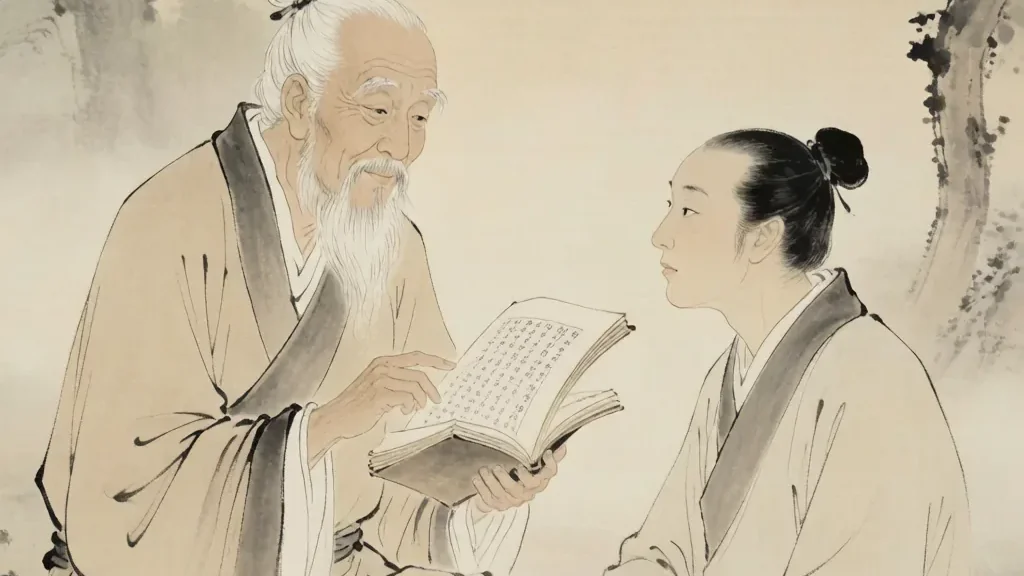
The Jiuzhang Suanshu (九章算术), or 'The Nine Chapters on the Mathematical Art,' stands as the most influential mathematical text in Chinese history and one of the great mathematical works of the ancient world. Compiled over several centuries — with its earliest material dating from the Zhou Dynasty (c. 1046–256 BCE) and its final form established around the first century CE during the Han Dynasty — the text presents 246 practical problems organized into nine thematic chapters, each addressing a different category of mathematical application. For over 1,500 years, the Jiuzhang Suanshu served as the foundational textbook for Chinese mathematics, shaping the education of countless scholars, officials, and engineers. Its influence extended far beyond China: the text was transmitted to Korea and Japan, where it became the basis for mathematical education, and through the Silk Road and Indian Ocean trade routes, many of its methods reached the Islamic world and ultimately influenced the development of mathematics in medieval Europe. The Jiuzhang Suanshu is remarkable not only for the breadth and sophistication of its mathematical content — which includes the earliest known use of negative numbers, the first systematic treatment of fractions, and the first description of matrix methods for solving systems of linear equations — but also for its distinctive approach to mathematics as a practical tool for solving real-world problems.
The Nine Chapters: A Survey of Mathematical Knowledge
The nine chapters of the Jiuzhang Suanshu cover an extraordinary range of mathematical territory. Chapter 1, 'Rectangular Fields' (方田, Fāngtián), deals with the calculation of areas for fields of various shapes — rectangles, triangles, trapezoids, circles, and segments of circles — and includes detailed rules for operations with fractions, including addition, subtraction, multiplication, division, and reduction to lowest common denominators. Chapter 2, 'Millet and Rice' (粟米, Sùmǐ), addresses problems of proportional exchange, particularly the conversion of different types of grain and commodities at specified rates — essentially a comprehensive treatment of ratio and proportion. Chapter 3, 'Proportional Distribution' (衰分, Cuīfēn), extends the concept of proportion to problems involving the distribution of goods, taxes, and labor according to various schemes of differential allocation. Chapter 4, 'Lesser Breadth' (少广, Shàoguǎng), deals with division by mixed numbers and the extraction of square and cube roots. Chapter 5, 'Construction Consultations' (商功, Shānggōng), covers the calculation of volumes for various solid shapes encountered in construction and earthworks — prisms, pyramids, cylinders, cones, and frustums — making it an essential reference for civil engineers and architects. Chapter 6, 'Fair Transport' (均输, Jūnshū), addresses complex problems of resource allocation and transportation logistics, combining proportional reasoning with considerations of distance, population, and taxation. Chapter 7, 'Excess and Deficit' (盈不足, Yíngbùzú), introduces the 'method of excess and deficit' — a powerful technique for solving problems that would now be handled by linear equations — which became known in medieval Europe as the 'Rule of False Position.' Chapter 8, 'Rectangular Arrays' (方程, Fāngchéng), presents the first known systematic method for solving systems of linear equations using what we would now recognize as matrix operations — elimination procedures performed on a counting board that are essentially identical to modern Gaussian elimination. Chapter 9, 'Base and Altitude' (勾股, Gōugǔ), is devoted to problems involving right triangles and the relationship known in the West as the Pythagorean theorem, including applications to surveying, distance measurement, and the solution of quadratic equations.
Mathematical Innovations: Ahead of Their Time
The Jiuzhang Suanshu contains several mathematical innovations that were centuries or even millennia ahead of their counterparts in the Western mathematical tradition. The text is the earliest known work to systematically employ negative numbers, representing them with red counting rods (positive numbers used black rods) — a convention that survives today in the use of red ink for debits in accounting. Chapter 8's method for solving systems of linear equations, using elimination operations on a matrix of coefficients, is essentially identical to the Gaussian elimination method that would be developed in the West by Carl Friedrich Gauss in the early 19th century — a gap of roughly 1,800 years. The text's treatment of fractions, which includes rules for finding common denominators and simplifying complex fractions, is more systematic and comprehensive than anything found in Greek or Roman mathematics. Chapter 9 contains several proofs and applications of the gougu theorem (the Chinese equivalent of the Pythagorean theorem), including problems that demonstrate an understanding of what would later be called Pythagorean triples. Perhaps most remarkably, the Jiuzhang Suanshu presents problems whose solutions require what we would now recognize as the use of indeterminate equations and modular arithmetic — concepts that would not be formalized in the West until the work of Diophantus (3rd century CE) and would not reach their full development until the 17th and 18th centuries.
The Chinese Mathematical Tradition: Algorithm and Application
To understand the Jiuzhang Suanshu's significance, one must appreciate the distinctive character of Chinese mathematics as compared to the Greek mathematical tradition that ultimately shaped Western thought. While Greek mathematics, as exemplified by Euclid's Elements, was built on deductive logic, axiomatic foundations, and formal proof, Chinese mathematics was fundamentally algorithmic and computational. The Jiuzhang Suanshu does not prove theorems; instead, it presents problems, provides general solution methods, and demonstrates those methods through worked examples. Each problem follows a consistent format: a statement of the problem in concrete terms (often involving practical situations like field measurement, tax calculation, or construction planning), a statement of the answer, and a description of the method for obtaining that answer. This algorithmic approach was perfectly suited to the Chinese counting-rod system, which functioned as a mechanical computing device capable of performing complex arithmetic operations with remarkable efficiency. The emphasis on practical application reflected the text's intended audience: imperial officials who needed mathematics to administer the empire's vast territories, collect taxes, manage granaries, plan construction projects, and organize military logistics. This practical orientation did not, however, limit the sophistication of the mathematics — on the contrary, the need to solve real-world problems drove Chinese mathematicians to develop techniques that were often more advanced than those of their Greek contemporaries.
Liu Hui's Commentary: Illuminating the Classic
In 263 CE, the mathematician Liu Hui (刘徽) produced a comprehensive commentary on the Jiuzhang Suanshu that transformed it from a practical handbook into a profound mathematical treatise. Liu Hui did far more than annotate the original text — he provided rigorous justifications for its methods, developed new techniques, and extended the mathematical content far beyond its original scope. His commentary includes the first known use of decimal fractions, a method for approximating pi by inscribing regular polygons in a circle (the 'method of exhaustion'), and geometric proofs that establish the validity of the text's formulas for areas and volumes. Liu Hui also introduced the concept of mathematical limits, using a process of infinite subdivision to calculate the area of a circle and the volume of a pyramid — ideas that would not appear in European mathematics until the development of calculus in the 17th century. The Liu Hui commentary became an integral part of the Jiuzhang Suanshu tradition, ensuring that later generations of Chinese mathematicians could not only apply the text's methods but understand why they worked. The commentary was itself expanded by subsequent scholars, most notably by Li Chunfeng (李淳风) during the Tang Dynasty, who produced the official annotated edition that was used as the standard mathematical textbook for the imperial civil service examinations.