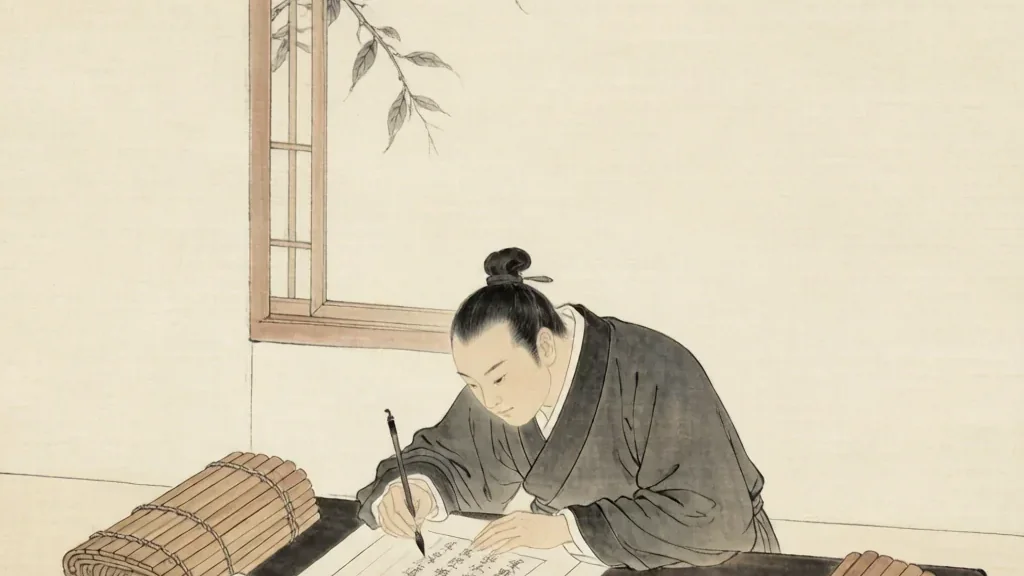
The greatest change in the shape of Chinese characters happened not in a palace but at a clerk's desk. As the Han empire (汉, Hàn) swelled with documents — censuses, tax rolls, laws, and memorials — the slow, curving seal script became a bottleneck. Out of the need for speed was born clerical script (隶书, lì shū), the hand that flattened ancient curves into the square, brush-driven forms we still recognize. Historians call it the single decisive turn between the "ancient" and "modern" faces of Chinese writing.
The Clerk's Revolution
The name says it all: li (隶, lì) means a subordinate, a clerk, even a convict laborer. Clerical script was the writing of the bureaucracy's lower ranks, the men who copied all day and could not afford the leisurely precision of seal carving. Legend gives the reform a face in Cheng Miao (程邈, chéng miào), a Qin jail clerk who, while imprisoned, is said to have tidied the seals' forms into three thousand faster characters. Whether or not one man did it, the force behind the change was collective: thousands of hands seeking efficiency.
What they did was radical. Seal script's round turns were "broken" — straightened and squared. A circle became a box; a curve became two strokes meeting at a corner. The result was quicker to brush and easier to read at speed, exactly what an expanding administration required.
The "Silkworm Head and Swallow Tail"
Clerical script has a beauty of its own. Its most famous feature is the horizontal stroke that begins with a slight thickening — the "silkworm head" (蚕头, cán tóu) — and ends in a flicked, rising tail like a swallow's forked tail (燕尾, yàn wěi). Characters tend to be wider than tall, giving steles from the Eastern Han a calm, spreading dignity. This decorative sweep is the script's signature and the mark of a mature brush art.
Yet beneath the flourish lies a structural change with huge consequences: the stroke, not the picture, became the unit of the character. Once writers thought in strokes rather than in miniature drawings, the door opened to the disciplined, repeatable forms of all later Chinese calligraphy. Clerical script is where writing became, technically, "modern."
Why the Han Needed Speed
The Han was the first truly bureaucratic Chinese empire, governing tens of millions through written law and a recruited civil service. Paper was still centuries away, so clerks wrote on narrow wooden and bamboo slips, often bound into scrolls. Every edict multiplied into copies sent to commanderies across the realm. In that world, the time saved by a faster hand was the difference between a functioning state and a stalled one.
Surviving Han wooden slips — found in the dry sands of the northwest — show clerical script in its working clothes: practical, fluent, sometimes sloppy, but always legible. These humble slips are the paper trail of an empire, and they prove that the "turning point" was not a stylistic whim but administrative necessity made visible.
The Square That Built an Empire of Books
Clerical script's squared shapes had a consequence its users never planned: they made Chinese writing fit a grid. Once characters occupied a predictable square, they could be arranged in neat columns on bamboo slips, copied without drift, and later carved into the uniform cells of woodblock prints. This regularity underwrote the great dictionaries and the flood of Han texts that preserved classical learning through war and fire. The squared form also tamed variation — regional hands that had diverged under the Warring States were pulled back toward a common outline, so that a document from the capital and one from the frontier looked like the same script. In this sense clerical script did for writing what the Qin's standardized axle-width did for roads: it made the realm legible end to end. The humble clerk who wanted only to write faster had, by flattening a curve, laid the typographic foundation on which two millennia of Chinese publishing would stand.
The social meaning of clerical script is worth pausing on. Before it, beautiful writing was the mark of the aristocrat and the specialist; after it, clear writing became the tool of the administrator and, eventually, the people. By speeding the pen, li shu helped turn a scribal elite into a broad bureaucratic class recruited by examination, because the written word was no longer the bottleneck it had been. The script thus quietly democratized record-keeping and, with it, access to office and learning. When we trace the square shapes of a modern character back through regular script to clerical, we are tracing a path that runs from a clerk's desk to the foundations of the imperial state — and to the exam halls where millions of ordinary young men rose by their brush. The turn was not only graphical but social, and its effects outlasted every dynasty that used it.
The survival of clerical script in stone makes its character concrete. Eastern Han steles such as the "Stele of Cao Quan" (曹全碑, cáo quán bēi) and the "Stele of Zhang Qian" (张迁碑, zhāng qiān bēi) show the hand at its mature, confident best — balanced, spreading, with the silkworm-head tail flicking across the stone. Rubbings taken from these steles became the textbooks of later calligraphers, so the clerk's script of the bureaucracy also became the artist's model. What began as administrative speed was refined, by the pressure of taste, into a canonical beauty. That double life — practical and artistic at once — explains why clerical script never fully disappeared even after regular script took over daily writing. It lives on in official title boards, shop signs, and the deliberate archaism of a calligrapher who wants to evoke the gravity of the Han. The turn toward the modern was, from the first, also a turn toward elegance.
Bridge to Regular Script
Clerical script did not freeze. Over the later Han and the Three Kingdoms, scribes gradually removed its archaic flare and unevenness, evening the proportions and dropping the swallow tail. The outcome was regular script (楷书, kǎi shū), the upright, balanced hand taught in schools ever since. In other words, every character a child learns today is clerical script with its ornaments trimmed away.
The achievement of li shu is easy to miss because it was so complete. By turning the pictograph into the stroke and the curve into the square, it gave Chinese writing a body it could live in for two thousand years. The clerk who only wanted to write faster changed, without meaning to, the very shape of Chinese civilization's memory.