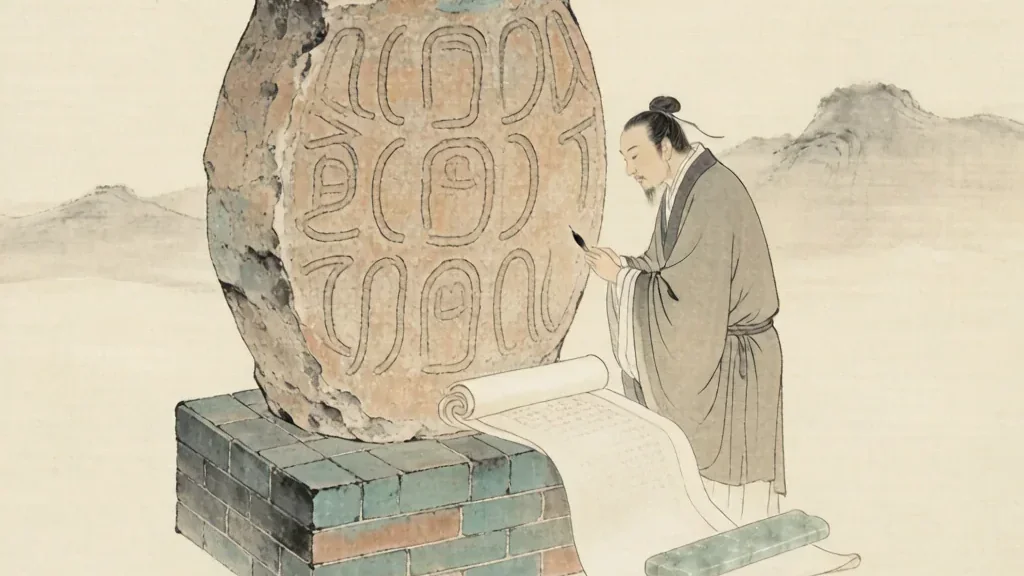
When the First Emperor of Qin unified China in 221 BCE, he did not only join warring states under one throne — he joined them under one way of writing. Out of the tangle of regional hands that had grown since the bronze age, his chancellor Li Si forged a single, graceful standard: seal script (篆书, zhuàn shū). With its balanced curves and solemn symmetry, seal script is the first truly empire-wide Chinese writing, the form carved on mountainsides to proclaim a conqueror's glory and the ancestor of every imperial seal stamped in red down to the present day.
Great Seal: The Older Hands
Before uniformity came variety. The broad category called great seal (大篆, dà zhuàn) covers the scripts of the late Zhou and the Warring States period (战国, zhàn guó, 475–221 BCE), including the elegant "stone-drum" script and the many local variants used by rival kingdoms. Because each state developed its own conventions, a merchant crossing from Qin to Chu might meet characters that looked like distant cousins of his own. Great seal preserved the rounded, full-bodied feel of bronze inscriptions but without a common standard.
This diversity was culturally rich yet politically unworkable. An empire that minted one coin and built one road network could not tolerate a hundred ways to spell the same decree. The drive toward a single script was thus less an artistic choice than the linguistic face of unification itself.
The Qin Unification of Writing
Qin Shihuang (秦始皇, qín shǐ huáng) is remembered for walls and tombs, but his quietest revolution was the pen. Having crushed the six rival states, he commanded that "the carriage tracks be of the same width, the laws and measures be uniform, and the written characters be of one shape." The man entrusted with the characters was Li Si (李斯, lǐ sī), whose polished small-seal model was imposed from the capital to the frontiers.
The reform did not invent characters so much as rationalize them. Li Si selected the clearest forms, evened out their proportions, and fixed a consistent stroke order. Local oddities were suppressed. For the first time, a peasant in the south and a clerk in the north wrote the same sign the same way — the foundation of a shared literary culture that would outlast every dynasty to come.
The Look of Small Seal
Small seal (小篆, xiǎo zhuàn) is instantly recognizable: slender, even lines; rounded turns; and a calm, vertical balance that makes each character look engraved rather than written. The strokes are of uniform thickness, with none of the thick-and-thin contrast of later brush writing. This was deliberate — the script was designed for carving in stone and casting in metal, where a steady, symmetrical line reads as authority.
Famous monuments display it at its grandest. The "Stele of Mount Tai" (泰山刻石, tài shān kè shí) and other imperial steles recorded the emperor's tours and virtues in columns of small seal, meant to be read by posterity as the voice of heaven's son made visible in stone. Even today, the script conveys dignity and antiquity in a way no later hand quite matches.
Seal Script as Art
Long after it left daily use, seal script found a second life as the most prestigious calligraphic and monumental style. From the Han onward, emperors and officials set up stone steles in seal script to lend their edicts the gravity of antiquity; the medium itself signified authority, since small seal was the script of the First Emperor's proclamations. In the art of the name seal — the red square stamp pressed on paintings, letters, and contracts — seal script remains indispensable, because its balanced, archaic lines read as both personal and timeless. Collectors still judge a seal by the elegance of its carved characters, and an artist's seal is as prized as a signature. Calligraphers practice seal script as a discipline of control: its even strokes permit no careless flourish, training the hand in poise and proportion. So a form born of imperial uniformity became, ironically, a vehicle for individual artistry — the script that once enforced conformity now expresses refinement, and it survives not in the clerk's ledger but in the connoisseur's cabinet.
The cultural weight of small seal is easy to underestimate because we meet it mostly on souvenirs and stamps. Yet for two millennia it was the script of legitimacy: rebels and founding dynasties alike issued their edicts and minted their coins in seal forms to claim the mandate of heaven. When a new regime wanted to look eternal, it reached for the gravity of the unified script. That is why the style survived every later reform — clerical, regular, even the modern simplification — as the one register no one dared discard. It is the costume the state puts on for its most solemn occasions. To study seal script is therefore to study how China imagined its own unity: a single, balanced hand imposed once by an emperor and never fully abandoned, lingering in every red seal that still closes a letter or certifies a work of art.
Great seal also left monuments of its own, notably the "stone drums" (石鼓文, shí gǔ wén), ten drum-shaped stones from the late Zhou carved with hunting poems in a robust, archaic hand. Their discovery centuries later became a sensation among antiquarians, who saw in them the unmistakable ancestor of small seal and proof of the script's continuity. Such relics matter because they show the reform was a refinement, not an invention: Li Si did not conjure characters from nothing but distilled a tradition already a thousand years old. The stone drums and the regional bronzes together form the evidence that small seal was the climax of a long aesthetic, not a break with the past. Reading them, we watch the Chinese script rehearse, over centuries, the calm symmetry it would finally achieve under the First Emperor's decree.
From Seal to Brush
Beautiful as it was, small seal was too slow for government. Its many curves and its demand for precision bogged down the clerks who copied edicts onto wooden slips by the thousand. Almost as soon as the empire adopted it, a faster, flatter hand began to emerge — the clerical script (隶书, lì shū) — which straightened seal's circles into efficient strokes. Within a century seal script had retreated to monuments, seals, and ceremony.
Yet seal script never died. It became the "formal" register of the culture: the script of the imperial seal, of the artist's signature, of the stele set up to honor a virtuous official. To write in seal script was to speak with the gravity of the state and the weight of antiquity — a role it still plays whenever a Chinese name is pressed in red onto a document.