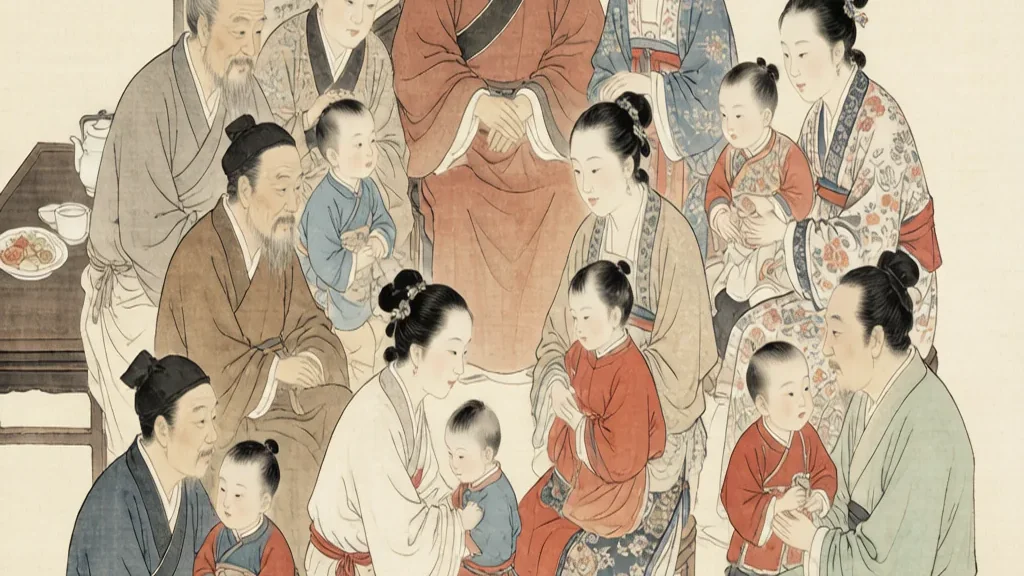
Family is the gravitational center of traditional Chinese society, and the writing system shows it at every turn. Characters for family, surname, parents, siblings, and ancestors are among the most ancient and socially charged in the language. The word for "surname" itself, 姓 (xìng), joins the "woman" radical 女 with 生 ("to bear"), a clue that early clans were traced through the mother. Kinship terms are finely graded—distinguishing elder brother from younger, paternal from maternal—and virtues like 孝 (filial piety) were written into the script as core duties. This article explores the family characters, how they encode lineage and rank, and what they reveal about a culture built around the household and the ancestor.
姓 and 名: surname and given name
姓 (xìng, surname) is a phonosemantic compound whose meaning-part is 女 (woman) and whose sound-part is 生 (shēng, "to be born"). The woman radical reflects the matrilineal tracing of early clans: a 姓 originally marked a birth-group descended from a common female ancestor. 名 (míng, given name) pairs 夕 (night/dusk) with 口 (mouth), explained as the name called out to identify someone in the dark.
Together 姓名 means "full name," and the strict order—surname first, given name last—mirrors the cultural priority of the lineage over the individual. To give your 姓 is to place yourself in a family line that reaches back generations.
家: the home and the pig
家 (jiā, home, family) is a compound of a roof 宀 (meaning "house") over 豕 (shǐ, "pig"). The common explanation is that an early settled household kept a pig under the same roof, so the character joins shelter and livestock to mean "home." The pig was a sign of domestic prosperity, making 家 a picture of the settled, farming family.
家 extends from the physical house to the family group and even to a "school" or "specialist" (专家, expert). Its roof radical 宀 heads many words about dwelling and family life, confirming that the home was the central social unit.
Parents: 父 and 母
父 (fù, father) is often explained as a picture of a hand holding a tool or a rod of authority, the senior male of the household. 母 (mǔ, mother) is a pictograph of a woman with two marks emphasizing the breasts, signaling the nursing mother. Both characters are ancient and appear on oracle bones, and both carry deep respect.
The paired terms 父母 (fùmǔ) mean "parents" and stand for the immediate source of one's life and duty. Filial care for 父母 is the first obligation taught by Confucian ethics, and the characters themselves carry that weight.
Children and generations: 子, 女, 孙
子 (zǐ) is a pictograph of a baby with a large head, meaning "child" or "son," and it is also the first Earthly Branch. 女 (nǚ) is a pictograph of a woman with arms folded, meaning "female." 孙 (sūn, grandson) joins 子 (child) and 小 (small) to mean the child's child, marking the next generation downward.
Upward, 祖 (zǔ, ancestor) pairs the "altar" radical 示 with 且 (a phonetic and possibly a phallic/tablet shape), naming the forebear honored at the family altar. The line from 祖 through 父 to 子 to 孙 is literally written in these characters as a chain of generations.
Siblings and rank
Chinese kinship is famously precise about birth order. 兄 (xiōng) is elder brother, 弟 (dì) is younger brother, and the pair 兄弟 means "brothers." 姐 (jiě) is elder sister, 妹 (mèi) is younger sister. The distinction is not optional politeness but a grammatical and moral requirement, because rank governs deference and responsibility.
This grading reflects a society where an elder sibling held real authority and a younger owed obedience. The characters thus encode a whole social hierarchy within the household, and the same care extends to cousins distinguished by paternal versus maternal lines.
Husband and wife: 夫 and 妻
夫 (fū, husband, man) is a pictograph of a person 大 with a mark on the head, perhaps a hairpin or cap marking adult male status. 妻 (qī, wife) is more complex; its early form seems to show a woman with a hand arranging her hair, signaling a married woman. The pair 夫妻 means "husband and wife."
Marriage joined two lineages, and the wife's character 妇 (in older form, woman with a broom) marked her domestic role in the husband's household. These characters are a record of how marriage was understood as alliance and labor, not just affection.
Filial piety: 孝
孝 (xiào, filial piety) joins 老 (old) above 子 (child), picturing a child supporting an elder—the young bearing up the aged. It is the central Confucian virtue: respect, care, and ritual obligation toward parents and ancestors. The character is a compact diagram of the generational contract.
孝 links the family characters to ethics and statecraft, because Confucius taught that a son who honors his father will be a loyal subject. The shape of 孝 therefore bridges the home and the polity, showing how family and government shared one logic.
The Hundred Surnames
The classic text 百家姓 (Bǎijiāxìng, "Hundred Family Surnames"), compiled in the Song dynasty, lists several hundred common surnames as a rhyme for children to memorize. It begins 赵钱孙李 (Zhào, Qián, Sūn, Lǐ) and remains a cultural touchstone; most Chinese surnames number in the few hundred, with a relatively small set covering the majority of the population.
The text shows how central surname identity was: to know a person's 姓 was to know their clan, region, and standing. Surnames were (and are) passed father-to-son, preserving patrilineal lines across millennia.
Family in idiom and literature
Family characters saturate Chinese idiom. 家喻户晓 ("every house understands, every door knows") means widely known; 家教 (family teaching) means upbringing; 家风 (family style) is the household ethos passed down generations. The phrase 成家立业 ("build a family and establish a career") marks the standard adult path.
In literature, the family is the stage of the great novels—the household with its ancestors, siblings, and in-laws—and the characters for these relations are the cast. To know the family vocabulary is therefore to hold a key to Chinese narrative itself, where lineage is plot.
Modern legacy
Family characters remain everywhere: in names, in the polite forms that specify "your father" versus "my father," and in festivals like 春节 (Spring Festival) centered on the reunion dinner (团圆饭, tuányuánfàn). Even migration and diaspora keep the 姓 as a link to homeland clans.
For learners, the family characters are a key to Chinese social grammar. Once you see how 女, 子, 宀, and 示 combine to build home, parent, child, and ancestor, the script's care for lineage becomes impossible to miss.
❓ Frequently Asked Questions
Why does the surname character 姓 use the woman radical?
Early clans were traced through the mother, so 姓 combines 女 (woman) with 生 (to bear), marking the birth-group descended from a common female ancestor.
What does 家 (home) depict?
家 shows a roof 宀 over 豕 (pig), reflecting the early settled household that kept a pig under the same roof as a sign of domestic prosperity.
Why are there separate words for elder and younger brother?
Birth order governed authority and obligation in the household, so 兄 (elder) and 弟 (younger) are distinct by grammar and by moral duty, not just courtesy.
What is 孝 (filial piety)?
孝 joins 老 (old) over 子 (child), picturing a child supporting an elder; it is the core Confucian virtue of respect and care for parents and ancestors.
What is the Hundred Surnames text?
百家姓 (Bǎijiāxìng) is a Song-dynasty rhyme listing common surnames for children to memorize; it shows how central surname identity was in Chinese culture.
How do family characters reflect social hierarchy?
They grade rank by generation and birth order (父母, 兄弟, 姐妹) and link the home to the state through virtues like 孝, encoding a household-based social order.