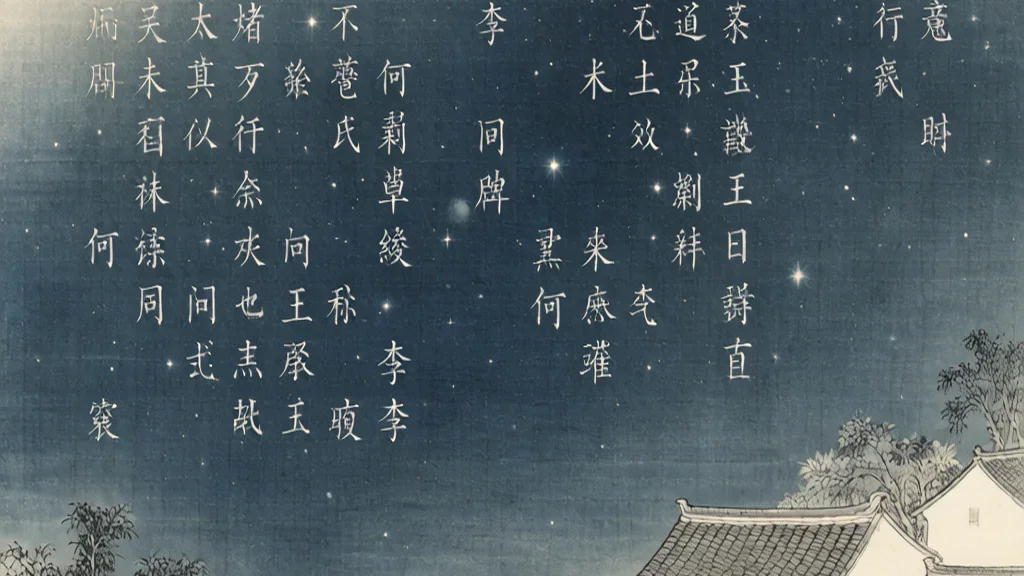
The Hundred Family Surnames (百家姓, Bǎijiāxìng) is a classic Chinese primer that lists surnames in rhyming four-character lines, composed during the Northern Song dynasty (960–1127) and used for centuries to teach children reading and social literacy at once. Despite the title promising "hundred," the original text contains several hundred surnames, opening with 赵钱孙李 (Zhào, Qián, Sūn, Lǐ) — an order reflecting the Song royal house and its influential allies. More than a memory aid, the work is a compressed map of Chinese kinship, rank, and regional history. To read it is to grasp how Chinese identity has long been organized around the lineage name (xìng) passed from father to child, a thread linking living families to ancestors stretching back dozens of generations.
Compilation in the Song Dynasty
The text took shape in the early Song, likely among educated commoners in the lower Yangtze region. Its famous opening — 赵 first — honors the founding Zhao imperial clan, while 钱 (Qián) and 孙 (Sūn) reflect the defeated Wuyue kingdom's ruling house and its in-laws, and 李 (Lǐ) nods to the preceding Tang. This political courtesy embedded in a children's book shows how even a surname list encodes a moment of history.
Scholars attribute no single author; it grew as a folk compilation, revised in later dynasties to add or reorder names. Its survival for nearly a millennium testifies to the prestige of surnames in Chinese society and the appetite for texts that were both moral and practical.
Structure and Rhyme
The Hundred Family Surnames arranges names in lines of four characters, each line ending on a rhyme to ease recitation. Because most Chinese surnames are a single syllable, this format packs four families per breath. Children memorized the whole litany before understanding every character, building both pronunciation and a social vocabulary simultaneously.
The rhyme is not semantic: surnames are grouped for sound, not meaning, which is precisely why the text works as a phonetic drill. A child who can chant "Zhào Qián Sūn Lǐ / Zhōu Wú Zhèng Wáng" has practiced tone, rhythm, and the shapes of common characters in one sweep.
From "Hundred" to Hundreds
The received Song version lists 411 surnames in 504 characters, while later expansions pushed the count higher; a Ming-dynasty edition reaches over four hundred single and compound surnames. The word bǎi, "hundred," is idiomatic for "many" rather than a literal tally, much like "the hundred flowers."
Compound surnames such as 欧阳 (Ōuyáng), 司马 (Sīmǎ), and 诸葛 (Zhūgě) appear toward the end, reminding readers that Chinese family names are not all monosyllabic. These longer names often carry stories of official titles or place origins turned into hereditary labels.
Surnames as Social Identity
In Chinese culture the surname (xìng) precedes the given name and signals patrilineal descent. Two strangers sharing a xìng traditionally address each other as "family" (zìjǐ rén), and clan genealogies (zúpǔ) trace the name back through centuries. The Hundred Family Surnames thus taught a child not just letters but a sense of place in a vast kinship web.
This weight explains why surname frequency is a serious demographic subject. The text's opening names — Zhào, Qián, Sūn, Lǐ — no longer match today's most common, showing how migration and politics reshuffle the roll of families over time.
The Most Common Surnames Today
Modern surveys of the People's Republic of China regularly place 王 (Wáng), 李 (Lǐ), 张 (Zhāng), 刘 (Liú), and 陈 (Chén) among the very top, each borne by tens of millions. Together the hundred commonest surnames cover the overwhelming majority of the Han population, a concentration unusual by world standards.
Regional skew persists: 陈 and 林 cluster in the southeast and among the overseas diaspora, while 王 and 李 spread broadly. Such patterns let historians and geneticists cross-check migration routes, as surname maps often mirror Y-chromosome lineages.
Use as a Primers and Moral Text
The Hundred Family Surnames belonged to the "three, hundred, thousand" (sānbǎiqiān) triad of elementary texts alongside the Three Character Classic and the Thousand Character Classic. A student's first years revolved around chanting these, absorbing Confucian decorum almost by osmosis through the melody.
Teachers used the surname list to instill respect: many lines could be tied to famous bearers — a loyal minister, a filial son — turning rote reading into a gallery of virtues. The book was less about names than about the behaviors those names were supposed to inspire.
Genealogy and Clan Culture
Behind the primer lies the deeper institution of zúpǔ, the clan genealogy. Many families maintain handwritten or printed registers recording every male descendant under the shared surname, often with rules of conduct and ancestral grave maps. The Hundred Family Surnames is the doorway to that universe.
In Taiwan, Southeast Asia, and among overseas Chinese, clan associations (tóngxìng huì) still gather people of one surname for mutual aid and festival rites. The little Song booklet, in effect, seeded a global network of kinship that functions to this day.
Legacy in Modern Culture
The phrase "bǎijiāxìng" now denotes "the common people" in general, as in "serving the hundred surnames." Television dramas, calligraphy scrolls, and even bank promotions invoke the text to signal tradition and trust. Its opening characters appear on everything from stationery to temple walls.
For language learners it remains a charming entry point: mastering the first forty names yields a working recognition of most surnames one meets in real life, making the ancient primer unexpectedly useful in a modern airport or classroom.
Reading the Text Today
Modern editions annotate each surname with its pinyin, famous holders, and often a tiny origin note — "from the state of Qí," "granted by a Zhou king." Bilingual versions help diaspora children reconnect with heritage while learning characters.
Approached as cultural history rather than rote, the Hundred Family Surnames rewards slow reading: every four-character line is a miniature of politics, migration, and memory. It is, in the end, less a list than a portrait of a civilization that writes its identity one family name at a time.
❓ Frequently Asked Questions
What is the Hundred Family Surnames?
It is a Northern Song dynasty primer that lists Chinese surnames in rhyming four-character lines to teach children reading and social knowledge.
Why does it begin with Zhào?
Zhào was the surname of the founding Song imperial family, so the compiler placed it first out of political respect.
Are there really only a hundred surnames?
No; the word "hundred" means "many." The Song text contains 411 surnames, with later editions adding more.
Which surnames are most common now?
Wáng, Lǐ, Zhāng, Liú, and Chén are among the largest today, each carried by tens of millions of people.
How were such texts used in education?
Children chanted them aloud to learn pronunciation, character shapes, and Confucian values before studying harder classics.
Do surnames still matter in China?
Yes; surname ties underpin clan associations, genealogies, and a strong sense of patrilineal heritage, especially among overseas Chinese.