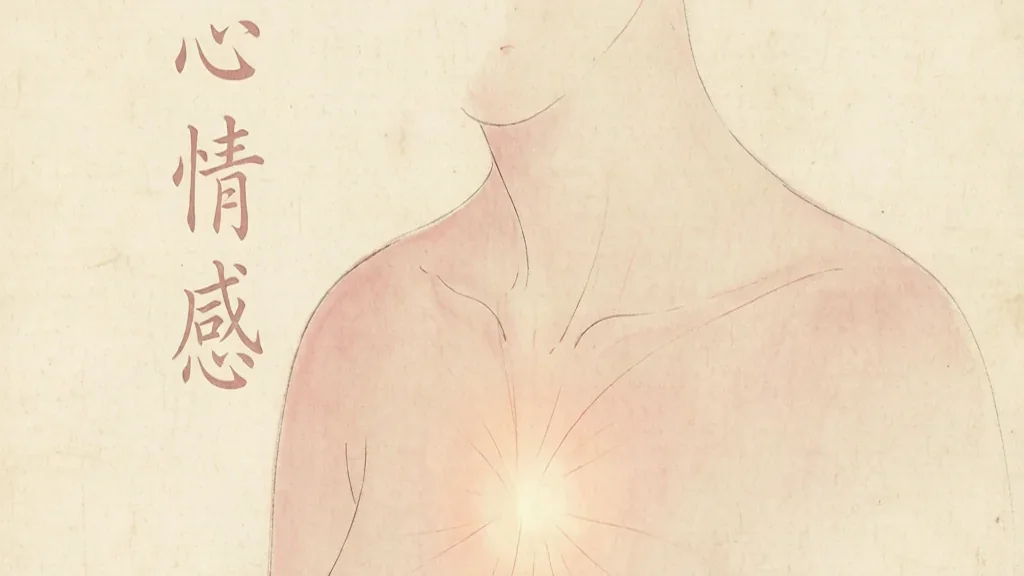
The heart radical, written 心 (xīn) and in its left-side variant as 忄, is one of the most revealing radicals in Chinese because it shows where the classical mind lived. In Chinese thought the heart, not the brain, was the seat of both feeling and thinking: to "think," "feel," "want," "remember," and "will" were all acts of the heart. Hundreds of characters for emotion, cognition, and moral character carry 心 or 忄—from 思 (to think) and 想 (to ponder) to 情 (feeling), 爱 (love), 怒 (anger), and 志 (will). Studying the heart radical is therefore a window into a whole psychology in which the heart reasons. This article surveys the heart radical's form and the inner life it writes into the script.
The shape and form of 心
心 (xīn) is a pictograph of a heart, with a central curve and two lobes suggesting the organ's shape. In compound characters it appears at the bottom as 心 (as in 思, 想, 念) and on the left as the "vertical heart" 忄, a shorthand of three strokes (as in 情, 怕, 快). Both forms declare that the character concerns the inner life.
Recognizing 忄 as "heart" is essential: a left-side 忄 character is almost always about an emotion, a mental state, or a moral quality, so the radical is a reliable guide through the large vocabulary of feeling.
The heart as seat of mind and emotion
The most distinctive fact about the heart radical is conceptual: classical Chinese located cognition in the heart. Where English splits "heart" (feeling) from "head" or "mind" (thinking), Chinese gathered both under 心. The heart was believed to house the spirit (神) and to govern perception, intention, and feeling together.
This is why so many "thinking" words use the heart radical. To analyze a Chinese emotion word is often to find a theory of mind disguised as a picture of an organ—a psychology written in strokes.
Thinking with the heart: 思, 想, 念
思 (sī, to think) places 心 under 田 (a field), often read as the heart working over a field of thought, or as a pictophonetic blend. 想 (xiǎng, to think of, to long for) puts 心 under 相 (appearance), suggesting the heart reflecting on what it sees. 念 (niàn, to miss, to recite) puts 心 under 今 ("now"), the heart holding the present moment in memory.
These three show the heart doing what we would call cognition: reflecting, remembering, yearning. The radical quietly insists that thought is felt, not cold.
Emotions: 情, 怒, 悲, 怕, 快
The heart radical heads the emotion vocabulary. 情 (qíng, feeling, emotion, circumstance) pairs 忄 with 青. 怒 (nù, anger) pairs heart with 奴 ("slave"), the heart enslaved by a passion. 悲 (bēi, sorrow) pairs heart with 非. 怕 (pà, fear) pairs heart with 白. 快 (kuài, quick/happy) pairs heart with 夬, originally "satisfied, pleased" before it meant "fast."
This family shows how Chinese named feelings as states of the heart: each emotion is the heart in a certain condition, a remarkably consistent model across the lexicon.
Love and desire: 爱, 恋, 怨
爱 (ài, love) in its traditional form 愛 encloses 心 within 夂 and 冖, "walking" with the heart—care in motion. 恋 (liàn, to love, to long for) stacks two 心-like elements, doubled feeling. 怨 (yuàn, resentment) pairs 忄 with 夗. Love and its shadows are all heart-matters in the script.
The presence of 心 inside 愛 is a favorite example of how the character literally "contains" the heart, making the etymology a small lesson in what love was taken to be.
Memory and forgetting: 忘, 悟, 感
忘 (wàng, to forget) puts 心 under 亡 ("lost"), the heart losing hold of something. 悟 (wù, to awaken, realize) pairs 忄 with 吾 ("I"), the heart attaining self-understanding—a key term in Buddhism and Daoism. 感 (gǎn, to feel, to be moved) pairs 忄 with 咸 ("all"), the heart responding to everything.
These characters extend the heart into memory, insight, and sensitivity, showing that the organ governs not only passions but the higher reaches of awareness.
Will and character: 志, 忠, 慧
Moral and volitional words also use the heart. 志 (zhì, will, ambition, aspiration) puts 心 under 士, the heart directed toward a goal. 忠 (zhōng, loyalty) puts 心 under 中 ("center"), a centered heart devoted to duty. 慧 (huì, wisdom) includes a heart component, wisdom as a quality of the aware heart-mind.
Because character was thought to reside in the heart, these words make ethics a matter of the inner organ—virtue is "heart-centered," exactly as 忠 depicts it.
Heart vs. brain in Chinese thought
The contrast with the brain is striking. While modern science locates thought in the brain, traditional Chinese attributed both reason and feeling to 心, and the brain (脑) was a later, more anatomical term. Even today, to say someone is "careful" or "interested" uses heart characters (小心, 关心), not brain ones.
This is not a "mistake" but a different model: the heart-mind (often translated as "heart-mind" or xin) is the unified center of personhood, and the script preserves that unity in every 心 and 忄 character.
Heart in medicine and physiology
In traditional Chinese medicine the heart is the "ruler" of the organs (君主之官) and the seat of the spirit (神). Excess emotion was said to "injure the heart," linking psychology directly to physiology. The heart radical thus appears in medical as well as emotional contexts.
This medical view reinforces the script's psychology: because the heart governed both feeling and spirit, characters for anxiety, joy, and memory all naturally took 心 as their root.
Heart in idiom and literature
The heart radical fills Chinese idiom and poetry. 一心一意 ("one heart one mind") means wholehearted devotion; 心心相印 ("heart hearts seal together") describes mutual understanding between lovers; 痛心 ("painful heart") means deep regret. Classical poetry speaks of 心事 (matters of the heart) and 心情 (heart-mood), treating inner life as a landscape.
Because the heart was the seat of the person, literature used 心 for conscience, intention, and authentic feeling. To read these phrases is to see the heart-mind at work—thought and emotion never separated, always one organ, one self.
Modern legacy
The heart radical is everywhere in daily speech: 心情 (mood), 心理 (psychology), 感谢 (to thank), 思想 (thought, ideology). Modern psychology borrowed 心理 (heart-principle) for its name, keeping the heart at the center of the mind even in scientific contexts.
For learners, the heart radical is a key to the emotional and intellectual vocabulary at once. To know 心 is to know that, in Chinese, to think and to feel have always been the same act.
❓ Frequently Asked Questions
Why do "thinking" words use the heart radical?
Classical Chinese located both thought and feeling in the heart (心), so words like 思 (think) and 想 (ponder) use it; the heart was the unified seat of the mind, not the brain.
What is the difference between 心 and 忄?
心 is the full heart character, used at the bottom of compounds (思, 想); 忄 is its three-stroke left-side shorthand for emotion words (情, 怕, 快). Both mean "heart."
How does 爱 (love) show the heart?
The traditional form 愛 encloses 心 within the character, depicting care as "walking with the heart," so the heart is literally contained in the word for love.
What did traditional medicine say about the heart?
It called the heart the "ruler" of the organs and the seat of the spirit (神), linking emotion and physiology so that strong feelings could "injure the heart."
Why is 心理 (psychology) built from 心?
Because the heart was the traditional seat of mind, the modern term for psychology kept 心 ("heart/mind") as its root even in scientific usage.
How does the heart radical help learners?
A 心 or 忄 character almost always concerns emotion, thought, memory, or moral character, so the radical reliably points to the inner-life vocabulary.