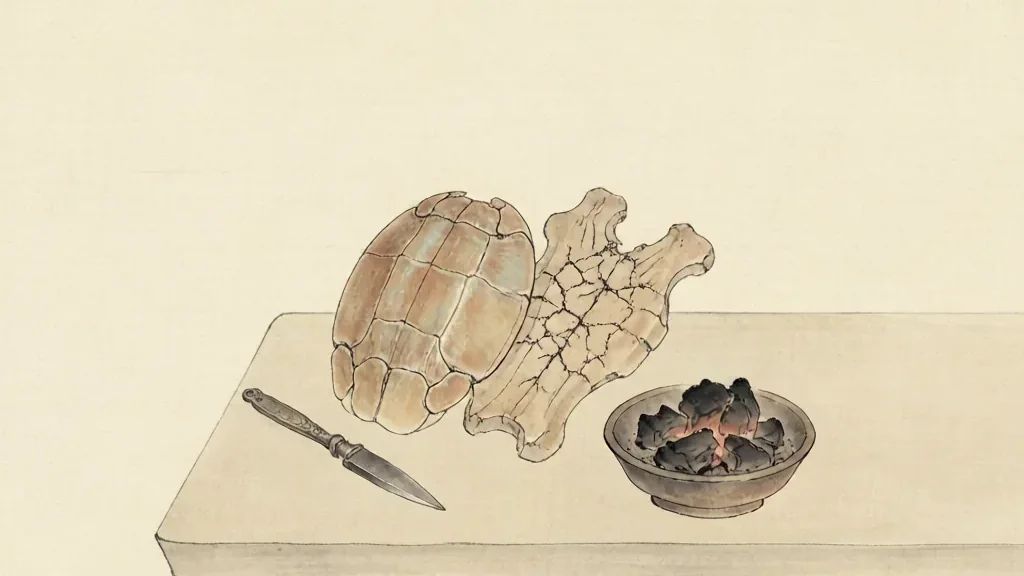
In the late nineteenth century, apothecaries in north China were grinding up fossilized "dragon bones" and selling them as medicine. Unknown to them, some of those bones carried the earliest decipherable writing on earth. When a scholar named Wang Yirong noticed carved marks on a "dragon bone" in 1899, he had stumbled into the royal archives of the Shang dynasty (商, Shāng). Those fragments — turtle shells and ox bones — preserve oracle bone script (甲骨文, jiǎ gǔ wén), the ancestor of every Chinese character in use today, and a direct voice from more than three thousand years ago.
What Were Oracle Bones?
Oracle bones were instruments of divination used by the Shang royal court, chiefly between about 1250 and 1050 BCE. The kings of the late Shang were anxious rulers who consulted their ancestors and the high god Di (帝, dì) before almost every major act — going to war, sowing the fields, building a capital, even whether a toothache would heal. To ask, a diviner polished a turtle plastron or an ox shoulder blade, drilled a shallow pit on the back, and applied a hot bronze pin. The bone cracked with a sharp sound, and the shape of the crack was "read" as a yes or no.
Before heating, the court scribe carved the question itself into the bone in tiny characters: "On the jiashi day, will it rain?" "If the king hunts at Zheng, will he capture?" After the event, a second inscription sometimes recorded what actually happened. The result is a unique record — not literature or law, but the raw ledger of a ruling family's hopes and fears, written in the hand of its own priests.
How the Script Was Read
The characters on the bones are already a mature writing system, not a primitive sketch. They mix pictographs that resemble their objects — the sun as a circle, a tree as a forked trunk — with more abstract signs. Around 4,500 different characters appear across the surviving corpus, of which roughly 1,500 have been deciphered with confidence. The rest resist reading because the inscriptions are repetitive: the same handful of topics recur so often that rare words may appear only once or twice in the whole record.
What makes oracle bone writing thrilling is its immediacy. These are not copies made centuries later but the original carvings of the people who asked the questions. Modern scholars can read the name of a Shang king, Wu Ding (武丁, wǔ dīng), and know it is his own priests who wrote it. The bones are, in effect, the oldest coherent "conversation" between a state and its gods anywhere in the world.
The Rediscovery at Anyang
For three thousand years the bones lay in the garbage pits of the Shang capital near modern Anyang (安阳, ān yáng) in Henan province, until farmers began unearthing them and selling them as "dragon bones" to druggists. The turning point came in 1899 when Wang Yirong, a scholar and antiquarian, fell ill, was prescribed the ground bone, and recognized the markings as ancient script. Within years, collectors and archaeologists descended on Anyang, and systematic excavation revealed the full plan of the Shang capital, including royal tombs filled with bronze.
The find did more than add a script to history; it proved the Shang dynasty was real. Before 1899, many scholars treated the early dynasties as legend. The oracle bones named Shang kings in an unbroken line that matched later histories, confirming the deep antiquity of Chinese civilization with hard evidence from the ground.
How Scholars Decipher the Bones
Reading oracle bones is a craft built on pattern and patience. Because the inscriptions are formulaic, a scholar rarely meets a sentence cold; instead he recognizes a familiar opening — "on the jiaxu day, divined by the king" — and fills unknown characters from parallel passages on other bones. The discipline, called jiaguwen (甲骨学, jiǎ gǔ xué), grew rapidly after 1899 as collections swelled, drawing historians, linguists, and chemists who dated the bones by radiocarbon and analyzed the ink. The bones preserve written forms of words whose later shapes had drifted, so they let philologists watch a character "in its youth," centuries before the bronze and seal stages smoothed it. A single new bone can settle old debates: when a previously unread sign recurs in a clear context, its meaning clicks into place and a whole family of related words suddenly makes sense. The corpus also yields the earliest known Chinese numerals, a working calendar, and even weather reports, turning fragile tortoise shell into a scientific archive of the Bronze Age.
The scale of the corpus is staggering: well over 100,000 inscribed bones and shells have surfaced, bearing perhaps 4,500 distinct graphs and millions of individual characters in total. Taken together they form the largest body of archival writing from the ancient world, far exceeding anything comparable from Egypt or Mesopotamia in sheer volume of connected text. Because the questions follow a template, scholars can compare the same query asked on different days and watch the court's concerns shift with the seasons — drought in spring, invasion in autumn, sickness in winter. The bones thus function as a diary of a dynasty, written by its own priests for its own gods. What began as a pharmacist's "dragon bone" has become the foundation of Chinese historical science, and each newly excavated pit still has the power to revise what we thought we knew about the birth of the written word.
Legacy of the First Script
Oracle bone script is the root from which all later Chinese writing grew. The logographic principle — a sign for a word or concept rather than a sound — was fixed from the start. Many individual characters can be traced in an unbroken chain from a bone scratch, through bronze and seal script, down to the printed forms of today. A reader of modern Chinese can often spot the family resemblance in a three-thousand-year-old sign.
The bones also opened a window onto daily life: we learn the Shang calendar, their ancestral cult, their concern with rainfall and harvest, and even the names of places that still exist. As both the world's earliest Chinese writing and its first great archive, oracle bone script remains the foundation stone of Chinese philology — the study of characters — and a reminder that writing began not with poetry but with a question asked of the dead.