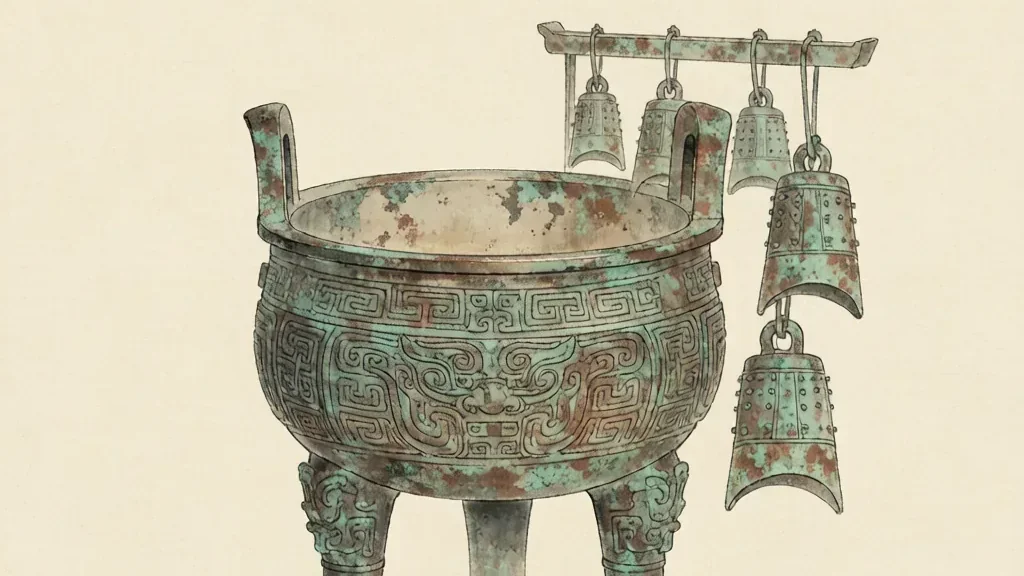
While the Shang kings whispered their questions to cracked bone, their successors on the Zhou throne (周, Zhōu) spoke in a louder, more lasting voice — by casting words into bronze. On the great bells and cauldrons of the early dynasties, the ruling families of China recorded land grants, oaths of loyalty, and prayers to the dead. These bronze inscriptions (金文, jīn wén), also called "bell-and-cauldron script" (钟鼎文, zhōng dǐng wén), mark the moment Chinese writing left the priest's shrine and entered the court, the family, and history itself.
From Bone to Bronze
Bronze inscriptions grew directly out of oracle bone script but changed its purpose. Oracle bones asked the spirits private questions; bronze vessels made public, permanent statements. A noble who received a fief or a royal command would commission a ritual vessel and have the event inscribed on it, then dedicate the vessel to an ancestor. The writing was not decoration but the vessel's reason for existing: a durable voice meant to be read aloud in the temple for centuries.
The technique shaped the look of the characters. Instead of cutting lines with a knife, the scribe pressed characters into a soft clay mold, from which molten bronze was poured. Released from the mold, the signs appear round, full, and symmetric — quite unlike the thin, nervous scratches of bone. This mellower, more monumental hand is the visual signature of the age.
What the Vessels Say
The contents of bronze inscriptions are a goldmine for historians. Many open with a date and a royal audience, then narrate a grant: the king awards the owner fields, slaves, bows, or the right to tax. Others record military merit or a covenant sworn between lords. Running through nearly all of them is the theme of xiao (孝, xiào) — filial devotion — expressed as a vow to "make this vessel for the eternal remembrance of my late father, that his virtue be not forgotten."
Some inscriptions are remarkably long. The Mao Gong ding (毛公鼎, máo gōng dǐng), a Western Zhou cauldron, carries 497 characters of royal admonition — among the longest continuous texts from before the empire. Such pieces let us hear Zhou kings lecture their ministers on duty and warning, in language close to the classical prose that later defined Chinese literature.
The Culture of the Vessel
To understand bronze script one must understand the vessel's place in Zhou society. Possession of a ritually inscribed bronze was proof of rank; the number and size of a family's vessels advertised its standing before both the living and the ancestors. An inscription was therefore a legal title and a spiritual act at once — a way to fix a family's honor in metal that outlasted its members.
This is why the characters matter culturally, not merely graphically. They show a society building its identity through written record: lineage, loyalty, and the bond between generations were literally cast in bronze. The script carries the values of an aristocratic age — reverence for elders, fidelity to the lord, the sacredness of the contract — encoded in the very objects used to worship the dead.
Famous Vessels and Their Finds
Some bronze inscriptions are so celebrated they have their own biographies. The San Family vessel (散氏盘, sàn shì pán) records a land dispute settled by treaty, effectively a bronze-age legal contract. The Yu ding (禹鼎, yǔ dǐng) narrates a rebellion and the king's vow to crush it. The Shi Qiang pan (史墙盘, shǐ qiáng pán) compresses the whole early Zhou lineage into a single basin, pairing the deeds of kings with those of the craftsman's own family — a miniature history of the dynasty in one object. These pieces rarely surfaced gently; many were dug from tombs looted across the centuries, and a few were nearly melted down for scrap before scholars rescued them. The study of such vessels, called jinwenxue (金文学, jīn wén xué), became a serious field precisely because the inscriptions often preserve earlier and more reliable wording than the later received classics. Where the bones told us what kings feared, and the histories what later writers claimed, the bronzes capture what the aristocrats themselves proudly proclaimed in metal.
What distinguishes bronze inscriptions from their bone predecessors is tone as much as form. Oracle bones whisper anxious questions to spirits; bronzes proclaim confident statements to descendants and rivals. A vessel was a family's loudspeaker, broadcasting its honor in metal that would outlast its owners, and the length of an inscription signalled the owner's importance. This is why the longest bronzes tend to come from the height of Zhou power, when great lineages competed to outdo one another in piety and pedigree. The script therefore preserves not only language but self-presentation — the way an elite wanted to be remembered. Reading jinwen, we hear not the king's fear but the aristocrat's pride, a different and fuller voice of the early Chinese world that the bones alone could never give us.
Bronze inscriptions also underwrote the first great dictionary. When the Han scholar Xu Shen compiled the Shuowen Jiezi around 100 CE, he frequently cited bronze forms to recover the original shape and meaning of a character that had been distorted by centuries of brush writing. Because bronzes preserved earlier, fuller graphs, they acted as a check against the drift of the handwritten line. In this way the vessels became a philological resource: a scribe in the Han could look at a Zhou cauldron and see his own characters a thousand years younger. The dialogue between bone, bronze, and dictionary is what lets us trace the script's genealogy at all. Without the bronzes, the chain from pictograph to abstract sign would have gaps we could never fill, and much of what we know about early Chinese law, kinship, and faith would remain silent.
Legacy of the Bronze Hand
Bronze inscriptions bridge oracle bone script and the later, more uniform seal script (篆书, zhuàn shū). They preserve thousands of characters in a form clearer and more developed than bone, and they supplied the standard shapes that Qin scribes would later regularize. For the philologist, they are a crucial middle step in tracing how a pictograph became an abstract sign.
Beyond the study of characters, the vessels are the documentary backbone of early Chinese history. Where the bones told us what kings feared, the bronzes tell us what they granted, promised, and remembered. Together they form the written memory of China's first millennium — words that were never meant to be read by us, yet survive to let us read the Zhou themselves.