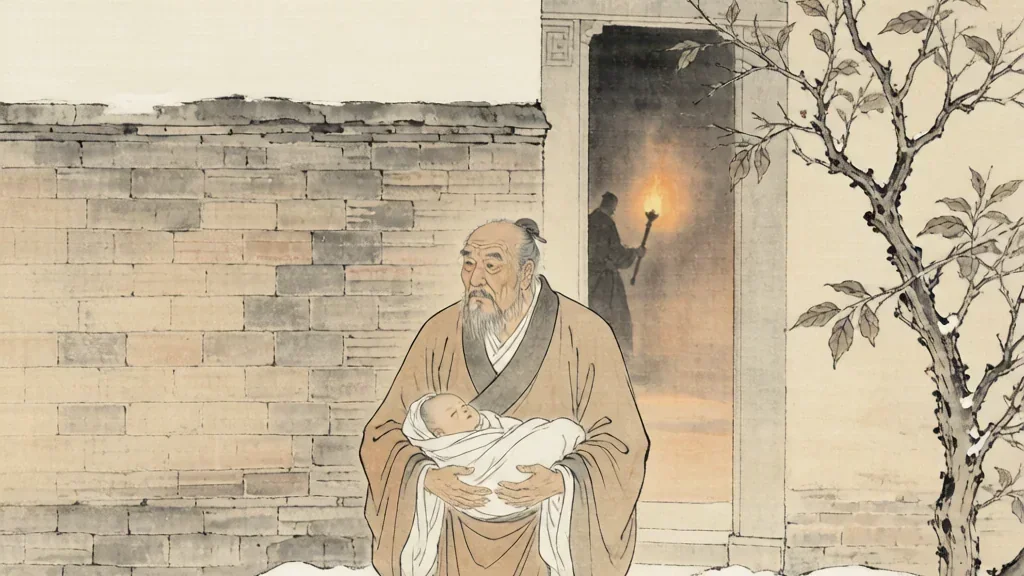
Revenge is a dish best served by a child who does not know he is the dish. Zhao Shi Gu Er, "The Orphan of Zhao," is the great tragedy of the Yuan stage and one of the few Chinese plays to conquer the Western theatre directly — Voltaire adapted it, and it reached Europe two centuries before most Chinese literature did. It is the story of a baby smuggled out of a massacre, raised by the enemy's household, and groomed to avenge his annihilated clan. For English readers it is China's "Hamlet" of loyalty and sacrifice: a play built on the question of what a person owes the family that died to save him.
The Historical Core
The tale rests on a real episode from the Spring and Autumn period recorded in the "Zuo Commentary" and the "Records of the Grand Historian." The Zhao clan, a powerful family in the state of Jin, was destroyed through the intrigue of a rival, Tu'an Gu (in drama), with only an infant heir surviving through the sacrifice of loyal followers. The historian Sima Qian tells of a general, Cheng Ying, who hides the child at enormous cost. The play keeps this skeleton but turns the chronicle into high tragedy, adding the moral weight of substitution and delayed revenge.
What history gives as a clan feud, the drama turns into a meditation on loyalty across classes. The survival of one bloodline becomes a testament to how far ordinary men will go for an idea of right.
The Plot: A Child Bought with Lives
A cruel minister, Tu'an Gu, annihilates the Zhao family and searches for the newborn orphan, the last of their line. The physician Cheng Ying smuggles the baby out of the palace at the cost of his own son's life — Tu'an Gu, told the orphan is dead, is given another infant (Cheng's own) to kill, believing he has finished the line. Cheng Ying then enters Tu'an Gu's service and raises the true orphan as the minister's adopted heir, biding his time. The boy grows up unaware that his "father" is his family's murderer and that his real protector is the man who lost a son for him.
When the orphan comes of age, Cheng Ying reveals the truth through a painted scroll. The young man turns on Tu'an Gu and destroys him, restoring the Zhao name. The play's power lies in the decades of concealment: an entire life built on a lie told to protect a greater truth, and a revenge that depends on the victim trusting his enemy as a father.
Themes: Loyalty, Sacrifice, and the Price of Survival
The play's emotional core is sacrifice. Cheng Ying gives his son; another loyalist, Gongsun, gives his life; the orphan's own mother dies so he may live. Each death is a stone in the foundation of the clan's survival. The drama asks whether any bloodline is worth such cost — and answers, in the Confucian key, that loyalty to the righteous order justifies even the slaughter of the innocent. Modern readers may wince at that calculus, which is part of the play's lasting tension.
There is also the theme of identity and deception. The orphan is raised inside the household of his enemy, fed the enemy's love, and only later told who he is. His revenge is thus a kind of self-betrayal of the only father he knew — a tragic knot the play stages without resolving comfortably. Loyalty and love pull in opposite directions, and the play lets us feel both.
Cheng Ying: The Reluctant Hero
The true protagonist is not the orphan but Cheng Ying, the man who pays for everyone's virtue. He is no warrior; he is a physician who must trade his own child for the clan's heir and then live as a traitor in his own eyes for twenty years. His heroism is passive, hidden, and unbearable — arguably the most interesting portrait of loyalty in Chinese drama. Voltaire renamed and simplified him, but the original's quiet agony is what gives the play its depth.
Cheng Ying's choice also raises the play's hardest question: is it right to sacrifice one innocent child to save a line of strangers? The drama affirms it; our age hesitates. That gap is why the orphan's story still provokes, centuries after the bows.
From Yuan Stage to European Enlightenment
"The Orphan of Zhao" was translated into French in 1731 and adapted by Voltaire as "L'Orphelin de la Chine" in 1755, making it among the first Chinese plays known in the West. European writers were fascinated by its gravity and its theme of virtuous revenge, though they often softened the infanticide. The play thus became an early bridge between Chinese and Western theatre, proof that China had tragedies to match the Greeks in moral weight.
Back in China it remained a staple of opera and drama, its scenes of sacrifice performed for their raw emotion. The orphan's story fit a culture that prized loyalty above life and saw the preservation of a righteous line as a sacred trust. Its export and survival show a work that belongs to everyone who values sacrifice.
Why It Still Matters
The play endures because it asks questions no society outgrows: how much should one life cost another, and what do we owe the dead who died for us? Cheng Ying's silence across twenty years is a portrait of loyalty as endurance, not glory. The orphan's revenge is less satisfying than it is necessary — a closing of a circle drawn in blood. For readers meeting Chinese drama in English, "The Orphan of Zhao" is the clearest proof that the traditional theatre could be as dark, as moral, and as unbearable as any in the world. It is a tragedy that trusts its audience to sit with the cost of loyalty, and to call that cost love.
The Scroll and the Reckoning
The play's turning point is quiet and theatrical: Cheng Ying, after twenty years, shows the grown orphan a painted scroll that tells his true story, and the young man's world turns over. This device lets the audience share the slow dawning, the father he trusted is his family's murderer, the man who raised him in grief is his savior. On the Yuan stage the scene was carried by a single actor's aria of revelation, and later opera traditions made it the emotional climax audiences came to see. The painted scroll matters because it stands for withheld truth: the whole plot rests on a story delayed, and its unveiling converts hidden loyalty into open action. It is a lesson in how Chinese drama could wring tragedy from information held just out of reach.
A Tragedy Measured Against the Greeks
When The Orphan of Zhao reached Europe it was hailed as proof that China possessed tragedy to rival the Greek stage, with a moral weight European readers found surprising in a tradition they had dismissed as merely ornamental. Voltaire and his contemporaries admired its gravity and its theme of virtuous revenge, though they trimmed the infanticide to suit Enlightenment taste. The comparison is apt: like Greek tragedy, the play pits loyalty and fate against personal happiness and asks what a person owes the dead. Yet it stays distinctively Chinese in its Confucian faith that preserving a righteous line justifies any cost, a calculus modern viewers may resist but cannot ignore. The orphan thus became an early bridge between theatres, showing two cultures that grief and duty make universal stories.
❓ Frequently Asked Questions
📝 Chinese Vocabulary
赵氏孤儿 — : The Orphan of Zhao, the great Yuan tragedy.
程婴 — : Cheng Ying, the physician who sacrifices his son to save the orphan.
屠岸贾 — : Tu'an Gu, the minister who massacres the Zhao clan.
孤儿 — : Orphan, the last heir hidden to survive.
忠 — : Loyalty, the virtue the play exalts above life itself.
公孙杵臼 — : Gongsun Chujiu, the loyalist who dies to protect Cheng Ying's plan.
赵武 — : Zhao Wu, the orphan who grows up to restore the clan.
搜孤救孤 — : Searching the orphan, saving the orphan, a stock title for the tale.
🎉 Fun Facts
- "The Orphan of Zhao" reached Europe in 1731 and was adapted by Voltaire, long before most Chinese works were known in the West.
- The historical core appears in Sima Qian's "Records of the Grand Historian."
- Cheng Ying sacrifices his own infant son so the enemy believes the Zhao line is extinct.
- The orphan is raised inside his family's enemy's household, unaware of the truth until he comes of age.
- Voltaire's 1755 version, L'Orphelin de la Chine, softened the infanticide and turned the story into a tale of civilized virtue triumphing over conquest.
- The tale became a favorite subject of Chinese opera, with the scene of Cheng Ying revealing the truth through a painted scroll a perennial stage highlight.