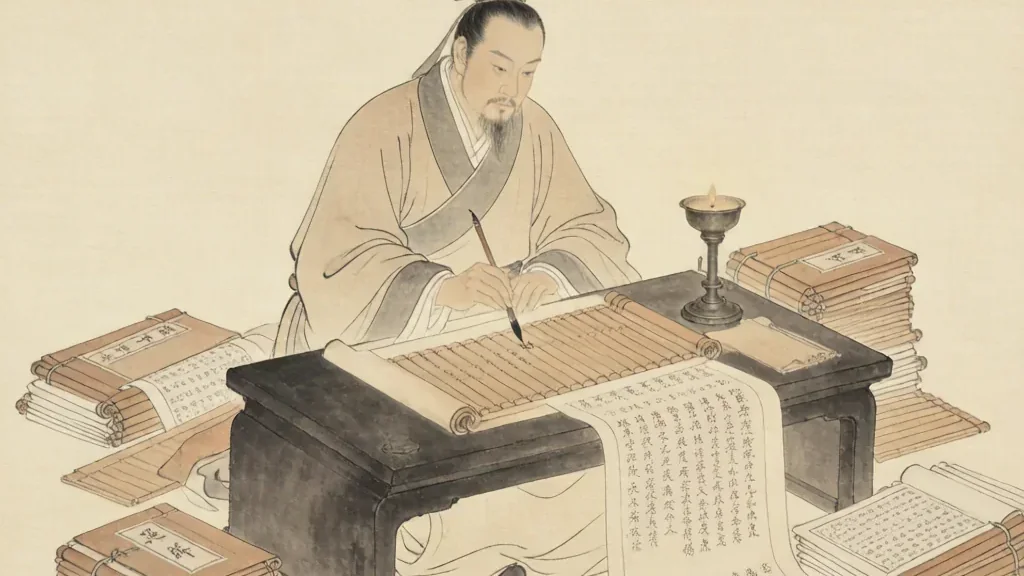
Everyone knows the novel, but few know the history beneath it. San Guo Zhi, "Records of the Three Kingdoms," is the official history of the turbulent era (220–280 CE) when China split into the rival states of Wei, Shu, and Wu. Written by Chen Shou in the third century and expanded with commentary by Pei Songzhi a century later, it is the sober source behind the romantic novel "Romance of the Three Kingdoms" that conquered East Asia. For English readers it is the place to meet the real Liu Bei, Cao Cao, and Zhuge Liang — sharper, pettier, and more interesting than their legend.
The Author: Chen Shou
Chen Shou (233–297) was a scholar-official of the Western Jin who had served the state of Shu before its fall and then lived under the victorious Wei-Jin order. That double loyalty gave him both intimate knowledge of Shu sources and the distance to write a unified history. He composed the Sanguozhi as a set of biographies grouped by state — Wei first as the legitimate successor, then Shu and Wu — a structure that let him preserve each kingdom's records while acknowledging the Jin court's claim to legitimacy. The book's restraint and precision made it one of the accepted "official histories."
Chen Shou's fairness is striking. Though writing under Wei-Jin, he gives Shu's leaders dignity and does not whitewash Cao Cao's ruthlessness. Later romanticizers would take sides; the historian simply recorded, as best he could, what happened.
What the Book Covers
The "Three Kingdoms" period followed the collapse of the Han. Out of the chaos rose three regimes: Cao Wei in the north, Shu Han in the southwest under Liu Bei, and Eastern Wu in the southeast. The Sanguozhi narrates their founders, battles, courts, and falls through biographies of emperors, generals, strategists, and ministers. Its famous figures — Cao Cao the pragmatic warlord, Liu Bei the would-be uncle of the Han, Sun Quan the southern ruler, Zhuge Liang the sage-chancellor — all appear here first as historical persons rather than novelistic types.
The work ends with the conquest of Shu and Wu by the Jin, restoring unity. Chen Shou thus frames the division as a tragic interval between Han and Jin, a view that served his patrons but also matched the era's own longing for order.
Pei Songzhi's Commentary
A century later, the official Pei Songzhi (372–451) found Chen Shou's text too terse and supplemented it with a massive commentary quoting lost histories, anecdotes, and alternative accounts. Pei's notes often run longer than the original text and are indispensable: they preserve material from histories that otherwise vanished and let readers weigh conflicting stories. The Sanguozhi we read today is really Chen Shou plus Pei Songzhi, a layered document where the margin is as valuable as the page.
This commentary tradition shows Chinese historiography's strength: history was not one voice but a conversation across centuries, each generation annotating the last. The reader is invited to judge the sources, not just receive a verdict.
The History vs. the Romance
The gap between the Records and the later "Romance of the Three Kingdoms" is the book's great teaching tool. The novel (14th c.) turns Cao Cao into a villainous usurper, Liu Bei into a flawless sage, and Zhuge Liang into a near-magical strategist. The history is more ambiguous: Cao Cao was a brilliant, literary, and often merciful unifier; Liu Bei was brave but sometimes indecisive; Zhuge Liang was a capable administrator whose northern campaigns failed. Knowing the history frees the reader from the romance's moral cartoon.
That contrast also explains the book's enduring appeal. The facts are thrilling enough — red cliffs, oaths of brotherhood, last stands — without the embellishment, and the real people are more instructive because they are inconsistent. History, here, is better than legend.
Themes: Legitimacy and the Cost of Division
A quiet theme is the problem of legitimacy. Which state was the true heir of Han? Chen Shou's structure (Wei first) answers politically; later Confucian readers often preferred Shu for its Han pedigree. The debate shaped a thousand years of commentary and shows how history is also a moral argument about who may rule. The book thus sits at the center of a question every Chinese dynasty had to answer.
Another theme is the human cost of fragmentation. Behind the grand strategy are exhausted soldiers, betrayed trusts, and short-lived regimes. The Sanguozhi, for all its brevity, accumulates a sense of loss — the sense that the division, however heroic its figures, was a wound in the body of the realm.
Legacy and Why Read It
The Sanguozhi is one of the Twenty-Four Histories, the canonical official histories of China, and the foundation of the most popular historical novel in East Asia. To read it is to meet the source — to see how a careful third-century historian, and a fifth-century commentator, remembered a fractured age. For readers coming through the novel or film, the Records is the corrective and the reward: the real three kingdoms, where the heroes are complicated and the ending is not justice but the slower return of unity.
It endures because it does what great history should — gives us the past without flattering our judgments, and trusts us to find the lesson in the mess. The romance will always be more fun; the Records will always be more true. Both belong to the story of China, and the Records is where the story actually happened.
The Annal-Biographical Structure
The Sanguozhi follows the annal-biographical form pioneered by Sima Qian's Shiji: each state is presented through its own basic annals and a series of ranked biographies of its ministers, generals, and thinkers. This structure lets Chen Shou preserve the records of all three kingdoms while still implying a hierarchy among them. Within a single biography the reader meets a life from youth to death, with battles, counsel, and downfall set in order, while the annals supply the political backbone against which those lives unfold. The method was so successful that every later official history copied it. For the reader, the form means the Three Kingdoms are not one story but three overlapping perspectives, each kingdom writing its own memory of the same fractured age.
The Records and Chinese Historical Method
The Sanguozhi exemplifies the Chinese belief that history is a layered, annotated conversation rather than a single voice. Chen Shou's base text is terse by design, a skeleton of events, and Pei Songzhi's commentary restores the flesh by quoting lost histories, anecdotes, and conflicting accounts. The reader is thus invited to weigh sources and judge the past, not merely receive a verdict. This practice of commentary upon commentary became a hallmark of Chinese historiography, in which later scholars keep talking back to earlier ones across centuries. The result is a document that is also a method: history as careful, sourced, self-correcting inquiry, a standard that shaped how East Asian courts and scholars recorded their own ages long after the Three Kingdoms ended.
❓ Frequently Asked Questions
📝 Chinese Vocabulary
三国志 — : Records of the Three Kingdoms, the official history.
陈寿 — : Chen Shou, the original author of the Records.
裴松之 — : Pei Songzhi, who added the crucial commentary.
魏蜀吴 — : The three states of Wei, Shu, and Wu.
正史 — : "Official history," the canonical historiographic category the work belongs to.
二十四史 — : The Twenty-Four Histories, the canonical sequence of official dynastic histories of China, of which the Sanguozhi is one.
纪传体 — : The annal-biographical structure, organizing history by reign annals and ranked biographies, established by the Shiji and used here.
注 — : Commentary, the annotated layer Pei Songzhi added to Chen Shou's terse base text, often longer than the original.
🎉 Fun Facts
- The Sanguozhi is one of China's Twenty-Four Histories, the canonical official histories.
- Pei Songzhi's commentary often runs longer than Chen Shou's original text.
- The novel "Romance of the Three Kingdoms" turned the history's Cao Cao into a villain and Liu Bei into a sage.
- Chen Shou had served the state of Shu before writing its history under the rival Jin court.
- Together with the Shiji, Hanshu, and Hou Hanshu, the Sanguozhi forms the Four Histories, the four early dynastic histories most esteemed by traditional scholars for their narrative quality.
- Later historians praised Chen Shou's fairness: the Tang critic Liu Zhiji noted that the Sanguozhi achieved rare impartiality given that its author served the fallen Shu before writing under the rival Jin.