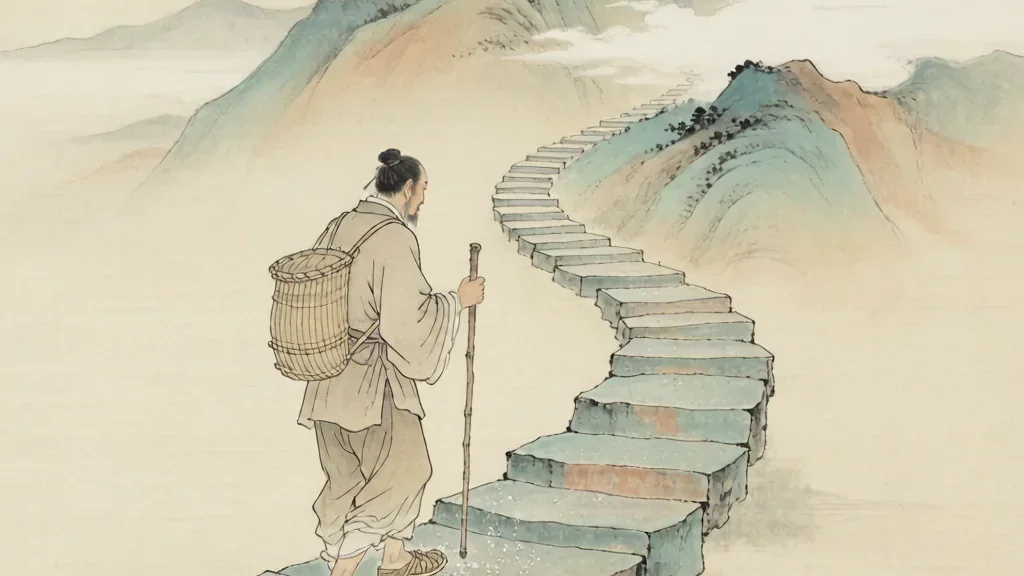
Some of the most practical advice in the Chinese tradition was written by its most mystical philosopher. In the 道德经 (Dàodéjīng), the Daoist sage 老子 (Lǎozǐ, Laozi) offered a line that has outlived every dynasty: 千里之行,始于足下 (qiān lǐ zhī xíng, shǐ yú zú xià) — "a journey of a thousand lǐ begins beneath the feet." The saying does something deceptively simple: it takes a goal so large it feels paralyzing and roots it in an action so small it is unavoidable. For over two millennia, the st it has been the Chinese answer to procrastination, the cure for being overwhelmed, and a quiet reminder that the grandest undertaking is really just a sequence of footsteps. To understand it is to learn how Chinese thought turns philosophy into motion.
Literal Meaning and the Measure of Distance
The proverb is a single balanced clause. 千里 (qiān lǐ) is "a thousand lǐ," where a 里 (lǐ) is a traditional Chinese unit of distance of roughly 500 meters — so a "thousand lǐ" is about 500 kilometers, an evocative stand-in for any vast distance. 行 (xíng) means "travel" or "journey." 始于 (shǐ yú) is "begins at," and 足下 (zú xià) literally "beneath the foot" means the spot right under your feet where a step lands. The image is concrete and bodily: no matter how far the destination, the journey always starts from the ground your foot already touches.
What makes the saying useful is its honesty about scale. It does not pretend the thousand lǐ is short; it acknowledges the immensity and then neutralizes it by pointing to the one step you can take now. The geography is real, the starting point is here, and the rest takes care of itself one stride at a time.
Origin in the Daodejing
The line sits in chapter 64 of the Dàodéjīng, a chapter devoted to the wisdom of beginning small and acting before a problem grows. Around it Laozi places kindred images: "A tree that fills a man's arms grew from a downy sprout; a nine-story tower rises from a heap of earth; the journey of a thousand lǐ begins beneath the feet." All three make the same argument from nature — greatness is cumulative, and the cumulative always starts tiny.
In its original Daoist context the point is also about 无为 (wú wéi, "non-forcing"): do not strain after the huge result; attend to the small, timely action, and the large thing unfolds by itself. The proverb is therefore not only about effort but about the right relationship to effort — steady, unhurried, present to the step in front of you rather than anxious about the horizon.
Cultural Context: Accumulation as a Way of Life
The idea of 积累 (jīlěi, accumulation) runs deep in Chinese culture, showing up in proverbs about dripping water wearing stone and iron rods ground into needles. 千里之行 belongs to this family, but it adds a spatial, almost meditative dimension: the journey is external, yet it begins internally, with the decision to move. This resonates with the Confucian habit of 践行 (jiànxíng, putting learning into practice) — knowledge that does not become action is incomplete.
The saying also fits the Chinese comfort with long time horizons. A civilization that thinks in dynasties and genealogies naturally values the slow buildup, and the thousand-lǐ image gives that patience a memorable shape. It is why the proverb feels at home equally in a general's tent, a scholar's study, and a parent's kitchen.
How It Is Used Today
Modern usage is everywhere a big task looms. Language learners quote it when the vocabulary seems endless; founders invoke it when a startup feels impossible; patients lean on it during long rehabilitation. The proverb's genius is that it dissolves anxiety by redirecting attention from the destination to the next step. "How do I write a novel?" — you write one sentence. "How do I walk a thousand lǐ?" — you take one step. The structure of the advice is identical.
It also appears in education and productivity literature, often alongside "eat the frog" or "the two-minute rule," though it is gentler: it does not demand the hardest task first, only the first task. In a culture of instant results, 千里之行 is a counterweight, dignifying the small beginning as the only real beginning there is.
The Step and the Horizon
The proverb's quiet genius is that it never denies the distance; it simply refuses to let the distance paralyze the start. A thousand lǐ is real, and Laozi does not pretend otherwise. What he offers is a shift of attention: from the frightening far end to the near, manageable beginning. This is why the saying pairs so well with patience practices — meditation, craft, long study — where progress is invisible day to day and only the next small action is ever within reach. The horizon gives direction; the foot gives motion; together they complete the journey.
It also gently corrects a modern impatience for results. We are tempted to abandon a project because the终点 (zhōngdiǎn, endpoint) feels impossibly far, forgetting that no one ever arrives except by accumulating steps. The proverb returns us to the only thing we can control — the placement of the next foot. In that sense it is less advice about journeys than a philosophy of attention: be here, take the step, and trust the road to lengthen behind you.
A marathon runner lives this truth with every stride: the finish line is irrelevant to the step being taken now, and thinking about it helps nothing. The thousand-lǐ image simply scales that runner's discipline to a lifetime. Whether the "journey" is mastering a craft, healing a relationship, or building a career, the proverb insists the same mundane magic applies — one honest step, repeated, eventually becomes the distance you once thought impossible.
Legacy and Closing
千里之行,始于足下 has traveled far beyond Daoism because its truth is portable across every human project. It honors both ambition and humility: ambition enough to set a thousand-lǐ goal, humility enough to begin with a single step. Laozi's line is less a command than a permission — permission to start small, to be where you are, to trust that movement breeds movement. To live by it is to stop waiting for the perfect moment or the full map, and simply to place your foot where it already is, and begin.