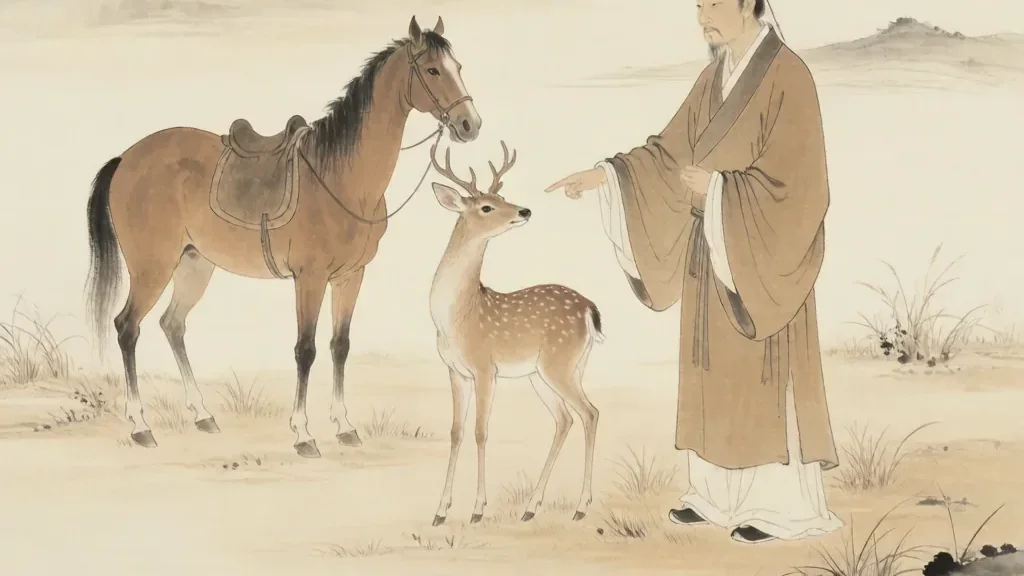
前事不忘,后事之师 — "the past not forgotten is the teacher of the future" — urges people and rulers to learn from history rather than repeat its errors. The line appears in the Strategies of the Warring States and has become a standard plea for memory as a guide to policy. It honours experience as a living instructor and warns that amnesia is itself a danger.
Source in the Warring States
The saying is found in the Zhanguo Ce, a collection of persuaders' speeches from the fractious Warring States period. An adviser uses it to remind a lord that earlier lessons remain useful for later decisions.
In that context it is pragmatic, not scholarly. The speaker wants the ruler to avoid a known mistake, and cites memory as the cheapest counsel available.
Because the work gathers political argument, the line entered Chinese statecraft as a tool for advising the powerful.
The Logic of Learning From Error
The proverb assumes that events leave lessons. A failure, if remembered clearly, becomes a kind of teacher who costs nothing to consult and nothing to ignore at one's peril.
It treats history not as dead weight but as instruction. The "teacher" is not a person but the pattern of what already happened, available to anyone who recalls it.
This reframes memory as responsibility: forgetting is not neutral, it is a fresh chance to blunder.
Contrast With "Forgetting the Past"
The saying's force comes from the negative it resists. To forget the past is, implicitly, to lose the teacher and to court the same trouble again.
It therefore sits near other warnings that those who ignore history are doomed to repeat it, a sentiment found in many cultures and echoed here in compact form.
The Chinese wording is gentler than a doom-saying; it simply points to the past as a ready instructor, waiting to be consulted.
Use in Governance and Policy
Officials and historians have long quoted the line when urging caution or reform. A dynasty's collapse becomes the "past event" that should instruct the next regime's conduct.
It supports the keeping of records, annals, and frank memorials, since a future teacher is useless if the lesson was never written down.
In modern policy talk it appears whenever someone argues that a prior failure should shape a new plan rather than be politely buried.
In Historiography
Chinese historiography has often seen itself as a moral mirror, and this proverb fits that self-image. The recorded past instructs the present by example, good and bad.
Standard histories were organised to let later readers draw lessons, and sayings like this one justified the enormous labour of compiling them.
The phrase thus helped sustain a culture that valued continuity of memory across dynasties.
Use in Education
Teachers use it to explain why students study history: not to memorise dates alone, but to meet the "teacher" that prior experience offers.
It also counsels learning from one's own small mistakes. A pupil who recalls a past error and avoids it is applying the proverb personally.
In this way the grand statecraft line scales down to everyday self-improvement.
Personal and Family Wisdom
Families pass the saying along as advice to the young: remember what went wrong before, and let it guide the next choice. Experience, even painful, is inheritance.
It can comfort as well as warn — the past that taught you a hard lesson is also the past that made you steadier.
The "teacher" metaphor keeps the tone respectful toward experience, as one honours a mentor.
Modern Application
Today the phrase shows up in speeches about reform, in articles about economic cycles, and in ordinary talk about not repeating a personal folly.
It also serves as a quiet corrective to fads that dismiss all precedent. The proverb asks only that the past be kept in view, not worshipped.
Its endurance suggests a steady cultural belief that memory is a practical asset, not a nostalgic one.
Nuances and Limits
A subtlety is that "not forgetting" must be accurate. Selective memory can turn the teacher into a propagandist, so honest recall matters as much as recall itself.
Another limit: the past does not always repeat, and clinging to an old lesson can misfire when conditions have truly changed.
Heard fairly, the saying asks for mindful memory — keeping the teacher close, but judging when the old lesson still fits.
In Military Strategy
Strategists study old campaigns to avoid repeating defeat. The fallen army of one age becomes the cautionary instructor of the next, exactly as the proverb says.
Treatises compile victories and blunders so commanders may consult them before committing troops. The past, kept in view, spares the living the cost of rediscovery.
Used in war and its avoidance, the saying is blunt: memory is a weapon, and amnesia on the battlefield is paid for in blood.
Drill and rehearsal are the peacetime form of the proverb, rehearsing old lessons so that, when crisis comes, the body remembers what the mind was taught.
In Proverbs and Folk Wisdom
The line joins a store of folk sayings that urge heeding experience. Elders' warnings are framed as the voice of what already happened, worth more than clever novelty.
It also appears in rhymes and maxims passed without writing, where a single remembered failure teaches a whole village what not to do again.
In this oral company the proverb is democracy of memory: not only rulers but common folk keep a teacher in the events they refuse to forget.
Grandparents' cautionary tales — about hard years, lost chances — are the family's version of the warring-states line, keeping a private teacher close at hand.
In Art and Calligraphy
Painters and writers study masters of the past as instructors, copying old works to absorb their strengths before seeking a personal style. The predecessor is the teacher.
Calligraphers trace modelled strokes precisely so the hand learns from achieved excellence. To ignore that inheritance is to lose a free school of method.
Here the proverb is aesthetic discipline: the artist who remembers and learns from what came before stands on the shoulders of a long line of teachers.
To break from tradition well, the masters also teach, one must first know it; only a worker who has learned from the past can later surpass it with authority.
❓ Frequently Asked Questions
What does the proverb mean?
Remembering the past makes it a teacher for the future; do not forget earlier lessons.
Where does it come from?
It appears in the Zhanguo Ce, a collection of Warring States political speeches.
How is it used in governance?
Rulers and officials cite it to argue that prior failures should guide later policy.
Is it only about big history?
No; it also applies to personal mistakes and family advice to the young.
What is its main warning?
That forgetting the past removes a free teacher and invites repeating old errors.
Does it have limits?
Yes; memory must be honest, and old lessons may not fit changed conditions.