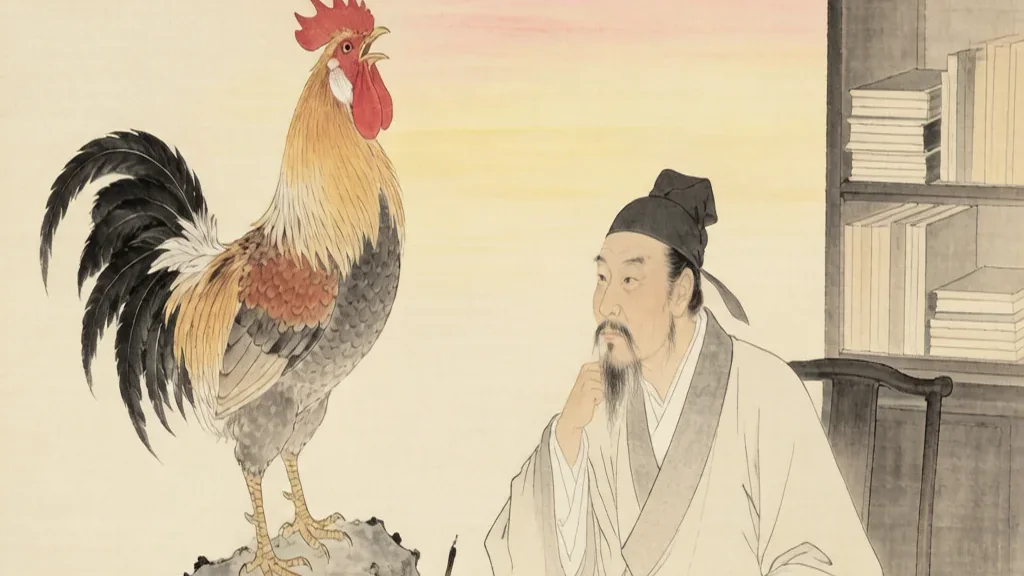
Before electric lights and 24-hour convenience stores, Chinese farmers structured their entire existence around the rising sun — a field weeded at dawn yielded far more than one tended at noon. The proverb 一日之计在于晨 (yī rì zhī jì zài yú chén) distills this agrarian wisdom: plan the day at dawn and the rest will follow.
Agricultural Origins
The proverb emerged from the practical observation that a well-used morning multiplies the productivity of the entire day. Chinese agricultural manuals from the Ming dynasty explicitly advised completing the heaviest labor before the morning meal. The two-hour period of 辰时 (chén shí, 7–9 AM) was considered the most auspicious window for starting any important task.
The saying uses a grammatical form that generalizes from specific cases to absolute truth — the kind of certainty that only generations of farming experience can produce. Farmers who ignored this principle found their fields overrun by weeds by midday, when the sun made extended labor punishing and inefficient.
Impact on Chinese Education
Chinese students internalize this saying from their first year of school. Morning study sessions (早读, zǎo dú) are a fixture of Chinese education, where students arrive as early as 6:30 AM to recite texts aloud before formal classes begin. The belief is that the mind is freshest after sleep and that material learned at dawn sticks longest.
Imperial examination candidates took this to extremes — historical records describe scholars rising at the fourth watch (about 3 AM) to begin memorizing Confucian classics by candlelight. Competition for government posts was so fierce that every hour of morning study was considered a decisive advantage.
Comparison with Western Wisdom
The English saying 'The early bird catches the worm' expresses a similar idea but focuses on reward rather than planning. Benjamin Franklin's 'Early to bed and early to rise makes a man healthy, wealthy, and wise' is the closest parallel, connecting morning discipline to comprehensive success.
Japanese culture has 早起きは三文の徳 (Early rising brings three pennies of virtue), which like the Chinese version emphasizes the inherent moral value of waking early. Both East Asian sayings reflect Confucian values that prioritize self-discipline as a good in itself.
Modern Scientific Validation
Modern chronobiology confirms much of this ancient wisdom. Circadian rhythm research shows that cognitive performance for most people peaks in the late morning, around 9:30 to 11 AM. Cortisol levels are naturally elevated upon waking, providing a biochemical boost to concentration that tapers off through the afternoon.
A 2014 study in the Journal of Applied Psychology found that employees who started work earlier reported higher productivity and less procrastination. Neuroscientists have identified that the prefrontal cortex — responsible for planning and decision-making — is most active about two to three hours after waking.
Modern Applications
Many successful Chinese entrepreneurs credit this proverb as a guiding principle. Jack Ma mentioned that Alibaba's early morning meetings were inspired by his father's habit of quoting 'morning is the plan' before dawn. The proverb has become a management cliché in Chinese tech companies, with entire time-management systems built around it.
The phrase has found new relevance in remote work culture. Chinese career coaches advise maintaining a 'fake morning commute' — a ritual walk or exercise session before starting work — to preserve the psychological boundary that the proverb's wisdom requires.
Cultural Significance and Contemporary Relevance
The proverb 一日之计在于晨 has transcended its original context to become a deeply embedded element of Chinese cultural consciousness. It appears in educational materials, political speeches, business communications, and everyday conversation, demonstrating how ancient wisdom continues to shape modern Chinese discourse. The proverb's endurance across millennia speaks to its fundamental truth about human experience.
In contemporary China, this proverb is taught to children in elementary school as part of language and moral education curricula. Parents invoke it when guiding their children's behavior, and teachers use it to illustrate important life lessons. The proverb's integration into daily life ensures that each new generation inherits the wisdom it contains.
The proverb has also found expression in Chinese popular culture. It appears in song lyrics, film dialogue, television dramas, and social media memes. Artists have created calligraphy works featuring the proverb, and it is commonly printed on decorative scrolls displayed in homes and offices. This cultural saturation ensures that the proverb remains living wisdom rather than a historical artifact.
Comparative Perspectives Across Cultures
The insight captured by this Chinese proverb has parallels in many other cultural traditions around the world. Comparative study reveals that similar observations have been independently discovered by different civilizations, suggesting that the proverb touches on universal aspects of human experience that transcend cultural boundaries.
The existence of similar sayings in other languages demonstrates both cultural specificity and universal human concerns. While the imagery and metaphors differ, the underlying wisdom often converges. Understanding these cross-cultural parallels enriches appreciation of the Chinese proverb while revealing common threads in human moral reasoning.
Practical Applications in Daily Life
In modern Chinese households, this proverb frequently appears in conversations about work, study, and interpersonal relationships. The concise and memorable nature of the proverb makes it a convenient shorthand for communicating complex life lessons. When grandparents quote the proverb to grandchildren, they are transmitting not just words but generations of accumulated experience.
The proverb is also regularly employed in Chinese workplace culture, where it appears in team meetings, performance evaluations, and corporate training materials. Managers use it to motivate employees, while colleagues invoke it to encourage each other during challenging projects. The proverb provides a culturally resonant frame for understanding workplace challenges.
In educational settings, teachers use this proverb to help students understand abstract concepts through concrete examples. The visual imagery contained in the proverb makes it particularly effective for younger learners who may struggle with theoretical explanations. Learning the proverb and its associated story is considered an essential part of Chinese cultural literacy.
❓ Frequently Asked Questions
📝 Chinese Vocabulary
一日之计在于晨 — : The plan for the day lies in the morning
早读 — : Morning reading session in Chinese schools
辰时 — : Morning hours (7–9 AM) in the traditional Chinese time system
黎明即起 — : Rise at dawn; a related idiom about early rising
计 — : To plan, the key verb in the saying's warning to plan the day at dawn
时辰 — : The traditional two-hour unit of the Chinese time system
一年之计在于春 — : The plan of a year lies in spring, the saying's extension to the seasons
一生之计在于勤 — : The plan of a life lies in diligence, the saying's extension to a lifetime
🎉 Fun Facts
- The proverb is so well-known that Chinese alarm clock apps often display it alongside the wake-up time.
- A 2019 survey found that 78% of Chinese parents use the phrase regularly with their children.
- The Chinese characters of this proverb are commonly studied in calligraphy classes as they include several standard stroke patterns.
- The proverb is traditionally the first line taught in many primary-school essay openers about a student's daily routine.
- In traditional households, rising at dawn was part of family instructions that bound the saying to household discipline.
- Some Chinese fitness apps award a 'morning person' badge themed around the proverb to encourage dawn workouts.