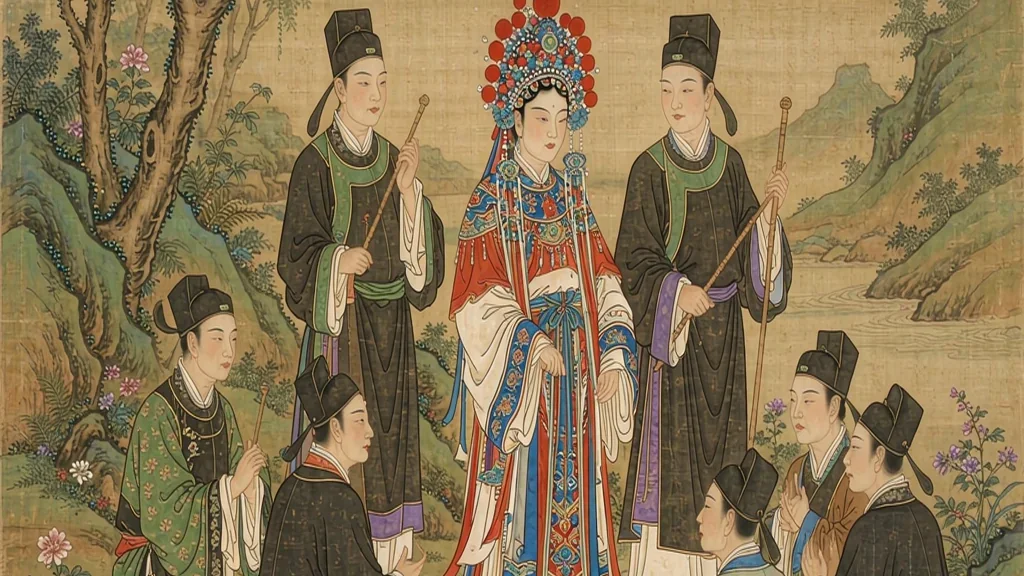
The Dong surname, written 董 and romanized as Dǒng, is an ancient Chinese family name whose origin legend reaches back to the mythological ruler Zhuanxu and to a dragon raising official who served the sage king Shun. Across the imperial millennia the name was borne by philosophers who shaped state ideology, by painters and calligraphers of the highest reputation, and by modern political founders, making it one of the more illustrious surnames in the cultural record. As with other old surnames, Dong combines a mythic founding tale with a documented trajectory of clan migration, commandery identity, and adaptation to changing regimes. This article explores the origins of the Dong surname, the meaning and form of its written character, its clan homeland, and the notable figures who carried the name from antiquity into the present.
The Dragon Keeper Dong Fu and the Zhuanxu Line
The classic origin story of the Dong surname centers on a figure named Dong Fu who lived in the distant past and was renowned for his skill in rearing dragons. According to traditional accounts preserved in early compilations, Dong Fu was a descendant of the mythical emperor Zhuanxu through the Ji surname line, and his unusual talent brought him to the attention of the sage king Shun. Pleased with his service, Shun granted him the surname Dong and a fief, thereby creating the founding ancestor of the lineage.
The detail of dragon rearing is more than a colorful folktale; in early Chinese political symbolism, dragons were associated with water, rainfall, and royal authority, and a specialist who tended them held a prestigious ritual office. By attributing the surname to a dragon keeper rewarded by Shun, the Dong origin narrative ties the clan to the foundational mythology of Chinese kingship. Such stories encode the idea that a surname was a gift of legitimate power rather than a mere label.
Scholars treat the Dong Fu tale as a mix of folklore and genuine memory of an office holding family, but its cultural function is clear: it supplied the Dong lineage with a noble and even supernatural founding. Genealogies repeated the story to affirm that the surname was conferred by a sage ruler, which lent the clan a dignity comparable to lines descended from dukes and kings. The persistence of the tale across regional Dong registers shows its centrality to clan self understanding.
The Ji Surname Background and Early Lineage
Behind the Dong Fu narrative lies the broader claim of descent from Zhuanxu via the Ji surname, one of the great ancestral surname groupings of high antiquity. The Ji surname is famously associated with the Zhou royal house, but the term spans multiple early lineages, and the Dong line is counted among the branches that traced themselves to Zhuanxu's posterity. This dual anchoring, both to a mythic emperor and to an ancient surname clan, is typical of the deepest layers of Chinese onomastic tradition.
The mechanism by which a surname was granted for service, as in the Dong Fu case, differs from the toponymic pattern seen in many other names, yet both routes fed the same surname system. An office or skill could become the seed of a hereditary name, especially when a ruler formalized the grant. The Dong example thus preserves a memory of how expertise and royal favor combined to create enduring family identities in the early polity.
Over the Eastern Zhou and imperial periods, the Dong surname developed from this mythic beginning into a documented clan with branches across the north. Local histories record Dong families holding office, owning land, and maintaining the ritual life of ancestral worship. The transition from legend to archive is visible in the way later genealogies cite Dong Fu as a fixed point before launching into the verifiable succession of more recent ancestors.
Written Form and Pronunciation of Dong
The character 董 is built from the grass radical 艹 above a phonetic element, and in modern Chinese it functions primarily as a surname, though it also appears in words meaning to supervise or rectify, such as in the verb form associated with stewardship. Its third tone pronunciation, Dǒng, places it firmly in the Mandarin phonological system, and the character is instantly read as a name by literate speakers.
In southern dialects the name carries local tonal and initial variations, and overseas records may show the spelling Tung or Dong without tone marking, a legacy of older romanization conventions from Cantonese and other languages. The written graph remains uniform, however, which preserves recognition across regions. For researchers, the combination of the character and the dialect reading helps confirm that seemingly different spellings refer to the same lineage.
The secondary meaning of supervision embedded in the character adds a subtle cultural resonance, since many Dong bearers served as officials and managers whose roles involved oversight and rectitude. While this semantic link is a coincidence of the script rather than a determinant of behavior, it has occasionally been noted by clan writers as a fitting attribute for a family associated with disciplined public service.
The Longxi Commandery and Clan Homeland
The Dong surname is traditionally linked with the Longxi commandery, situated in the northwest in present day Gansu, as one of its ancestral seats, and some branches also identify with the Jiyin area. The Longxi connection situates the clan among the noted gentry families of the northwest, a region famed in surname lore for producing martial and scholarly lineages alike. Clan halls and genealogies invoke these homelands to establish a credible point of origin.
The junwang system, by which a surname claimed a specific commandery, allowed the Dong clan to maintain solidarity across dispersal. Even branches that had long since moved south could declare the Longxi origin and thereby assert kinship with strangers of the same name. The commandery thus operated as a portable homeland, carried in registers and recited at rituals, binding far flung families into one imagined ancestral geography.
In the material culture of the lineage, the Longxi identity appeared on hall names, ancestral tablets, and the couplets that adorned lineage buildings. To be a Longxi Dong was to claim a particular moral and historical pedigree rooted in the northwestern heartland, and that claim structured how the clan presented itself in local society wherever it settled.
Dong Zhongshu and the Rise of Imperial Confucianism
The most consequential early bearer of the name is Dong Zhongshu, a Han dynasty thinker whose proposals helped elevate Confucianism to the position of state orthodoxy. Living in the second century BCE, he synthesized classical learning with cosmological argument and is traditionally credited with advocating that the ruler honor the Confucian tradition above rival schools. His writings on the correspondence between heaven and the human realm became influential templates for imperial ideology.
Dong Zhongshu's thought exemplifies the marriage of scholarship and statecraft that defined the official class for two millennia. By framing moral order as reflecting cosmic order, he supplied rulers with a rationale for virtuous government and supplied officials with a vocabulary for remonstrance. The resonance of his ideas through the Tang and Song examination systems ensured that the Dong name would be remembered wherever Confucian learning was taught.
For the Dong surname, the association with Dong Zhongshu is a source of profound prestige, since he shaped the intellectual foundation of imperial China. Genealogists regularly cite him as the lineage's foremost philosopher, and his example illustrates how a single ancestor's ideas can become a permanent part of a surname's cultural capital. His legacy also shows the surname participating at the level of grand civilization building rather than merely local affairs.
Dong Qichang and the Arts of the Ming Era
In the field of art, the Ming dynasty painter, calligrapher, and theorist Dong Qichang stands as one of the most influential figures in the history of Chinese literati painting. He articulated theories of Northern and Southern schools of painting that shaped critical discourse for centuries, and his own brushwork was admired and imitated by later masters. His writings on method and connoisseurship remain reference points for the study of Chinese art.
Dong Qichang's career combined the roles of high official and leading aesthetic authority, a pairing typical of the scholar official ideal. His albums and handscrolls circulated among collectors, and his judgments about style carried weight in the art market of his time and after. The Dong surname thereby gained a strong association with refined visual culture and with the theoretical side of painting practice.
The complexity of his reception, including debates about his social conduct, reflects the fuller truth that famous ancestors are rarely simple paragons. Yet his artistic achievements are secure, and his name anchors the Dong lineage in the history of Chinese aesthetics. For readers interested in how surnames intersect with culture, Dong Qichang is a vivid example of a name carried into the realm of enduring beauty.
Dong in the Modern Political Era
In the twentieth century the Dong surname appeared among the founders of the modern republic and the subsequent state, with figures who participated in the revolutionary movements that reshaped China. These modern bearers continued the pattern of public service associated with the name, moving from the examination hall and the scholar's studio into the new arenas of party, army, and government. Their prominence placed the surname within living political memory.
The transition from Dong Zhongshu the Han philosopher to modern revolutionary statesmen shows the adaptability of an old lineage across radically different regimes. A surname survives precisely because it can be worn by Confucian officials, Ming aesthetes, and modern politicians without losing its identity. The Dong name thus serves as a thread linking classical statecraft to contemporary history.
For diaspora families and domestic bearers alike, the modern chapter of the surname adds a layer of civic significance to the older myths and arts. The name is no longer only about dragons and sage kings or about paintings and philosophies; it is also about the making of the modern nation, a reminder that surname histories are continually extended by the achievements of the present generation.
Distribution and Cultural Memory Today
Today the Dong surname is found across China and in overseas communities, with a distribution shaped by both ancient northern roots and later southern and maritime migration. It ranks among the several hundred common surnames, recognizable to any Chinese speaker through its distinctive character and its roster of famous bearers. Regional Dong associations continue to preserve genealogies and to celebrate clan identity through festivals and reunions.
Contemporary interest in roots has encouraged the digitization of Dong genealogies and the reconstruction of family trees that link diaspora members to ancestral villages in the mainland. Online surname culture platforms compile the origin tales, junwang information, and notable figures associated with the name, making the clan's heritage accessible to younger bearers who may live far from the Longxi homeland.
The endurance of the Dong surname across myth, philosophy, art, and politics testifies to the remarkable capacity of Chinese family names to accumulate meaning over time. Whether one meets the name in a Han dynasty treatise, a Ming album, or a modern history book, it carries the weight of a continuous lineage whose story began, according to legend, with a dragon keeper favored by a sage king.
❓ Frequently Asked Questions
What is the origin of the Dong surname?
The classic story credits a dragon raising official named Dong Fu, a descendant of the mythic emperor Zhuanxu, who was granted the surname by the sage king Shun for his service.
What does the character 董 mean?
The character pairs a grass radical with a phonetic element and is used mainly as a surname, though it can also mean to supervise or to rectify.
Who was the most influential Dong?
Dong Zhongshu, a Han dynasty thinker whose advocacy helped establish Confucianism as the imperial state orthodoxy, is generally regarded as the name's most consequential bearer.
What is the Dong clan homeland?
The Dong surname is traditionally associated with the Longxi commandery in the northwest, with some branches also citing the Jiyin area.
How is Dong pronounced?
In Mandarin pinyin it is Dǒng with the third tone; older overseas romanizations may appear as Tung without tone marks.
Is Dong a common surname?
It is among the several hundred common Chinese surnames, found across China and in overseas communities, with a notable roster of historical figures.