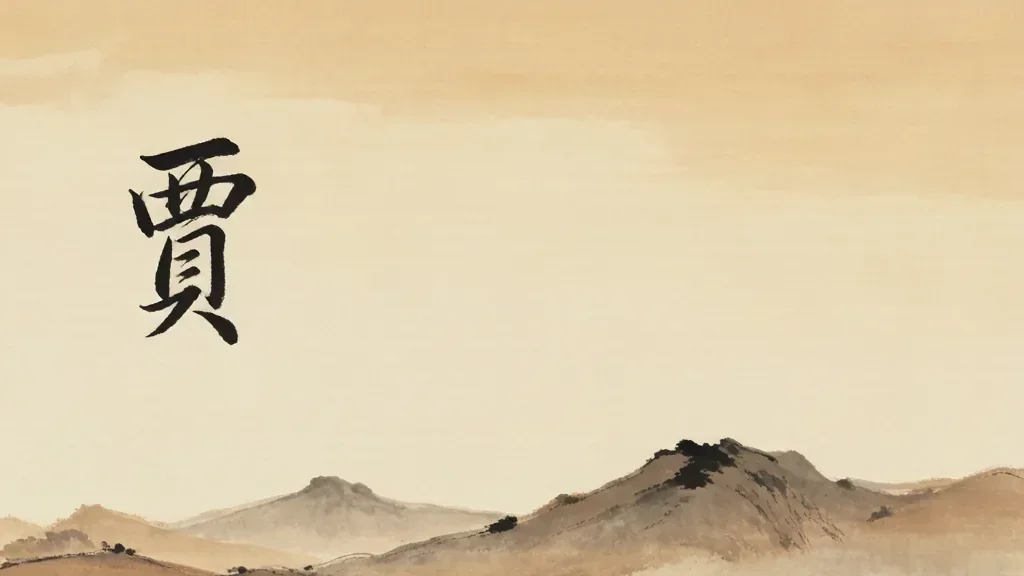
Jia means 'merchant.' It originated from the state of Jia.
Ancient Origins of the Jia Clan
The 贾 surname traces its lineage to the earliest periods of Chinese civilization. It originated during the Zhou dynasty when the feudal system created noble clans associated with territories and titles. The earliest ancestor of the 贾 clan was enfeoffed with land and adopted the territory name as the clan surname, following the ancient tradition of using place names as family identifiers.
The surname character 贾 (Jia) appears in ancient Chinese texts from the Shang dynasty oracle bones, showing its extraordinary antiquity. The clan maintained genealogical records for over 3,000 years, meticulously documenting births, deaths, marriages, and achievements across countless generations. These records were considered sacred possessions and were stored in the ancestral hall.
Ancient naming practices placed the surname before the given name, reflecting the priority of family over individual identity. The 贾 clan's founding ancestor established the rituals and traditions that would define the family for millennia. Oral traditions about the clan's origins were later written down during the Han dynasty, when genealogical record-keeping became standardized across Chinese society.
Migration and Geographic Distribution Through History
The Jia family spread across China through centuries of migration driven by war, famine, and economic opportunity. Major waves included the southward exodus during the Jin dynasty (4th century CE), when northern China fell to nomadic invasions and entire clans relocated to the Yangtze River basin. The Tang dynasty saw further expansion into the south and southwest as the empire extended its reach.
During the Song dynasty (960–1279), when northern China was again lost to invading forces, massive population movements carried the 贾 surname into Fujian, Guangdong, and Jiangxi provinces. Many 贾 families established ancestral halls in these new locations, creating branch lineages that maintained connections to the original homeland through genealogical records.
Today, the 贾 surname is found throughout China with particular concentrations in provinces that received the largest migration waves. The global Chinese diaspora has carried the name to every continent, with significant 贾 communities in Southeast Asia, North America, Europe, and Australia. Each diaspora community maintains its own clan associations that preserve the family heritage.
Notable Historical Figures Bearing the 贾 Name
Throughout Chinese history, individuals bearing the 贾 surname have made significant contributions in government, military, literature, and the arts. Many rose through the imperial examination system to become prominent officials, serving as governors, ministers, and occasionally as advisors to emperors. The name appears in the official histories of every Chinese dynasty.
In the literary world, 贾 surname writers have produced poetry, essays, and novels that form the backbone of Chinese classical literature. Caligraphy masters with the 贾 name developed distinctive styles that were studied and imitated for centuries. Military leaders bearing the surname commanded armies in some of China's most decisive battles.
The imperial examination system, which selected officials based on merit rather than birth, allowed talented individuals from 贾 families of modest means to rise to the highest levels of government. Many 贾 clan genealogies proudly record the names of ancestors who passed the jinshi examination, the highest level of the imperial civil service.
The 贾 Surname in Modern Times
In contemporary China, the 贾 surname continues to be carried by millions of people across all social strata and professions. Clan associations organize genealogical research conferences, publish family histories, and coordinate cultural events that maintain connections across the global diaspora.
Modern bearers of the 贾 name include leaders in business, science, technology, and the arts. Chinese entrepreneurs with the 贾 surname have founded major corporations, while scholars have contributed groundbreaking research in fields from physics to medicine. The surname's continued prominence demonstrates the enduring legacy of the family traditions that have been maintained for over three millennia.
DNA genealogy has opened new avenues for 贾 clan research. Y-chromosome studies of men with the 贾 surname have confirmed many traditional genealogical claims about common ancestry, while also revealing previously unknown connections between different branches of the family. These scientific approaches complement the traditional genealogical methods that have preserved the clan's history.
Cultural Traditions of the Jia Family
Ancestral halls maintained by the 贾 clan house the memorial tablets of ancestors and serve as ritual sites during Qingming Festival and other important occasions. These buildings are architectural treasures, often featuring intricate wood carvings, stone lions at the entrance, and decorative paintings depicting scenes from the clan's history.
The genealogical records of the 贾 family, spanning over a hundred generations, are among the longest continuously maintained family trees in human history. These records preserve not just names and dates but stories of ancestors' achievements, moral teachings, and the values that the family has transmitted across millennia. In traditional times, the genealogies were updated every generation by the clan elders.
Distinctive 贾 family traditions include specific rituals for weddings, funerals, and ancestral worship that differ from those of other clans. Some branches of the 贾 family maintain unique culinary traditions, dialect variations, or folk practices that trace back to their particular origin region. These traditions give each branch of the family its distinctive character while maintaining the overall clan identity.
Challenges and Preservation of the Jia Heritage
The 20th century presented severe challenges to traditional clan structures. Many 贾 families lost irreplaceable records and artifacts during this period. Some families buried their genealogies or hid them behind walls to preserve them.
Since the 1980s, there has been a remarkable revival of clan activities across China. 贾 families have rebuilt ancestral halls, reprinted genealogies from surviving fragments, and reestablished annual gatherings. This revival represents not just nostalgia but a genuine reconnection with traditional values of family continuity and mutual support.
The 贾 surname diaspora has created unique challenges and opportunities for heritage preservation. 贾 communities overseas have established clan associations that sometimes preserve traditions lost in the homeland. International gatherings of 贾 descendants have become regular events, connecting branches of the family that have been separated for centuries.
Why Jia Means Merchant
The character Jia does double duty in Chinese: it is both a surname and a common word meaning merchant or to engage in trade. This overlap is why the name is sometimes nicknamed the merchant's name, and why Jia bearers appear in old stories as canny traders as well as scholars and officials. The surname itself arose from the State of Jia, a fief granted to a younger son of the ruling house of the State of Jin in the north, and descendants kept the name after the state was absorbed. Far from being limited to commerce, Jia families produced poets, painters, and court officials across many dynasties. The merchant association is a colorful accident of the written language rather than a restriction on the clan's occupations, and modern bearers work in every field.
Genealogy and Generation Names
Jia genealogies are among the many family records that Chinese clans have kept for centuries, often beginning with the ancestral seat and then listing generations in order. A distinctive feature of these records is the generation poem, a short verse in which each line supplies one character to be shared by all given names of a single generation. Two Jia strangers who meet can therefore compare the character in their given names and instantly know which one is senior. In the north, where the surname first took root, branch lineages still gather to revise the genealogy every generation or two, copying the old pages and adding the new. These books are treated as treasures, since they are the bridge between a living person and a documented line of ancestors.
❓ Frequently Asked Questions
📝 Chinese Vocabulary
贾 — : The Jia family surname
姓氏 — : Family name; surname
家谱 — : Genealogical records; family tree
宗亲会 — : Clan association; family organization
祠堂 — : Ancestral hall; clan temple
祖先 — : Ancestors; forefathers
堂号 — : A clan hall name displayed above ancestral halls and printed in genealogies.
辈分 — : Generational rank, marked by a shared character in the given names of a lineage.
🎉 Fun Facts
- The Chinese character 贾 is one of the oldest surname characters still in continuous use in China today, appearing in oracle bone script.
- Famous historical and contemporary figures with the 贾 surname represent every field of human endeavor across three thousand years of history.
- The 贾 surname has its own distinct cultural traditions and family legends passed down through generations that distinguish it from other Chinese surnames.
- Some branches of the 贾 family maintain annual gatherings that have been held continuously for over 500 years.
- The character Jia doubles as a common word meaning merchant or to trade, which is why the surname is sometimes nicknamed the merchant's name.
- The surname arose from the State of Jia, a fief granted to a younger son of the ruling house of the State of Jin in the north, and later bearers spread across north China.