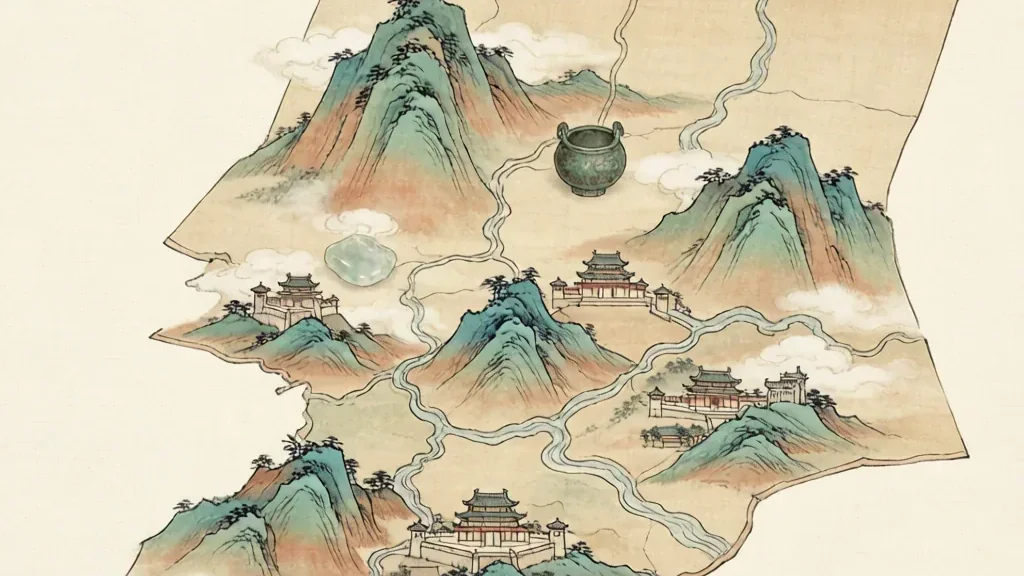
Two strangers named Li meet for the first time. Before asking where the other lives, a traditional Chinese gentleman might ask a different question: "Which Li are you — the Li of Longxi, or the Li of Zhao commandery?" This is the logic of junwang (郡望, jùn wàng) — the "commandery glories." More than a birthplace, a junwang was a surname's ancestral hall of fame, the district whose name conferred status on every branch of a clan that claimed it. To know a person's junwang was to know their standing in the subtle aristocracy of names.
What a Commandery Was
The jun (郡) was a commandery, a prefecture-level district used from the Qin (秦) through the Tang as a basic unit of administration. China was carved into scores of these districts — Langya, Longxi, Pei, Qinghe, Boling, and so on — each with its own history and local families. When a clan's most eminent members came from a particular commandery, that place became the clan's junwang, its "renowned commandery."
The system grew out of a simple fact: a surname alone was too common to be meaningful. With millions of Wangs and Lis, a Wang needed to say which Wang he was. The junwang supplied that distinction, turning geography into a ranking of clans.
Over time the system grew so elaborate that reference works listed the ranked junwang of every major surname, and a well-read gentleman could place a stranger's clan at a glance. The information functioned like a social directory encoded in two characters. For the elite, knowing the right junwang was as useful as a business card today; it told a listener your region, your lineage's standing, and your literary pedigree before you spoke a word. In a vast, loosely governed empire, that compact signal was worth a great deal.
So deeply was the habit ingrained that even outsiders learned to use it; foreign envoys at the Tang court were often recorded by their people and their "commandery of origin," as if every clan on earth must have one. The junwang had become, by then, a universal grammar of status.
The commanderies themselves were not abstract. Each was a real place with a real history — a fertile plain, a strategic pass, a famous mountain — and the clans that rose there advertised their locale as proof of refinement. To be "of the Qinghe Zhang" implied not merely a surname but a geography of cultivation: the Zhangs of that district were known for learning, just as the Wangs of Langya were known for statesmanship. The junwang thus fused place, family, and reputation into a single portable claim.
The Rise of Clan Prestige
The junwang idea took shape under the Han but reached its height in the turbulent Wei, Jin, and Northern and Southern dynasties (魏晋南北朝, 3rd–6th centuries), when powerful gentry clans dominated politics. A clan's standing was measured by the glory of its commandery, and marriage alliances were arranged between equals in junwang prestige. Official histories such as the Book of Wei (魏书, Wèi shū) even include "registries of surnames and commanderies" (氏族志, shì zú zhì) ranking the great houses.
To be "of the Langya Wang" (琅琊王, Lángyá Wáng) or "the Qinghe Zhang" (清河张, Qīnghé Zhāng) was to announce refined, old, and influential stock. These phrases appeared on tomb inscriptions, in prefaces to poetry, and in the formal self-introductions of scholars — a compact social certificate passed down the generations.
Cultural Meaning: Status Written in Place
The genius of junwang is that it made status portable. A Li family that had migrated a thousand miles from Gansu to Fujian could still call itself "Longxi Li," borrowing the lustre of the original homeland without ever returning. The junwang was less a map coordinate than a brand — a claim of descent from the most celebrated branch of one's surname.
This is why junwang names survive in the "hall names" (堂号, táng hào) painted above clan ancestral halls and printed on genealogy books. Even today, overseas Chinese clan associations often style themselves by their junwang, keeping alive a geographic identity that may be a millennium old. The system reveals how deeply Chinese culture ties prestige to place, and how a surname could carry an entire landscape of meaning.
The prestige was measured, above all, against other clans. A "superior" junwang outranked an "inferior" one of the same surname, and families guarded the distinction jealously. Genealogy prefaces routinely opened by stating the clan's junwang before anything else, because that single phrase placed the family on the social map. In a society without hereditary titles for most people, the junwang was the nearest thing to a coat of arms — inherited, displayed, and defended.
Famous Examples and Bearers
Many surnames boast multiple celebrated junwang. The Li (李) clan is split between 陇西李 (Lǒngxī Lǐ, "Longxi Li") and 赵郡李 (Zhào jùn Lǐ, "Zhao-commandery Li"); the Tang emperors claimed Longxi, instantly crowning it the most prestigious Li seat. The Wang (王) clan is famous for 琅琊王 (Lángyá Wáng) and 太原王 (Tàiyuán Wáng). The Zhang (张) clan honors 清河张 (Qīnghé Zhāng), and the Cui (崔) clan is synonymous with 博陵崔 (Bólíng Cuī), one of the most esteemed northern houses.
These homelands shaped literati self-presentation for over a thousand years. When the poet Du Fu (杜甫) signed himself "the Du of Jingzhao," or a statesman quoted his "commandery of origin" in a memorial, they were performing the same social grammar that the junwang system encoded: in China, where your name is from can matter as much as the name itself.
Junwang and the Marriage Alliance
Nowhere was junwang prestige more consequential than in marriage. Among the gentry, unions were negotiated between clans of comparable junwang standing; a match with a "superior commandery" clan raised a family's standing, while a mismatch could be seen as downward. The great surname books therefore listed not only a clan's ancestry but its marriage-worthiness, functioning almost like a hereditary social register.
This explains why the junwang outlasted the commanderies themselves. Long after the old administrative districts had been redrawn or abolished, the clan names attached to them lived on as badges of rank, recited at weddings and inscribed on gates. The homeland had become a title — and in the Chinese imagination, a title written into a name is a title that never quite expires.