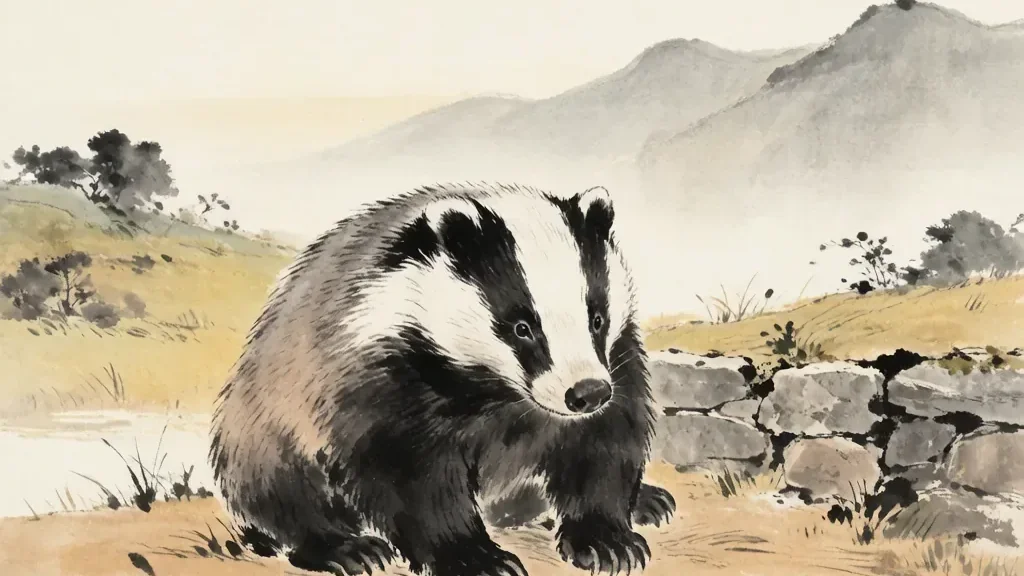
Among the smaller mammals of the Chinese countryside, the badger (獾, huān) holds an unusual position: it is a creature both hunted and honored, eaten and worshipped. The badger's nocturnal habits, its powerful digging claws, and its distinctive black-and-white facial markings made it a creature of mystery in traditional China, associated simultaneously with wealth (because of its burrowing, which was thought to uncover hidden treasure) and with danger (because of its fierce bite and its tendency to carry rabies). The badger's Chinese name is a homophone for "joy" or "happiness" in certain contexts, and its image appears in Chinese folk art as a symbol of good fortune. Yet the badger also suffers from its unfortunate physical resemblance to the weasel and the ferret, animals with which it is often confused in Chinese folk classification, and its reputation varies dramatically from one region to another.
The Badger in Chinese Folk Classification
Chinese folk taxonomy distinguishes several types of badger-like animals, though the distinctions are not always consistent with modern biology. The zhū huān (猪獾, "pig badger") refers to the hog badger, a species with a pig-like snout that is common in central and southern China. The gǒu huān (狗獾, "dog badger") refers to the Eurasian badger, which has the classic black-and-white striped face. Both are considered huān in Chinese, and both are treated similarly in folklore and medicine. The Chinese also recognize the mì huān (蜜獾, "honey badger") — though this is a modern term introduced from Africa — and classify it alongside the native badgers based on behavioral similarity.
The badger belongs to the group of animals known in Chinese folk religion as the "five great immortals" (wǔdà xiān), alongside the fox, the weasel, the snake, and the rat. These animals were believed to be capable of spiritual cultivation and to possess supernatural powers that could either bless or curse human beings. The badger's status within this group was ambiguous: some regions worshipped it as a wealth-bringing deity, while others feared it as a carrier of disease and misfortune. This regional variation reflects the badger's own ecological adaptability — it thrives in environments ranging from mountain forests to suburban gardens, and human attitudes toward it have always been shaped by local encounters.
The Badger and the Chinese Language
The badger's most significant contribution to Chinese culture is the idiom 一丘之貉 (yī qiū zhī hé), which means "jackals of the same lair" — people who are equally bad. The character hé (貉) in this idiom refers to the raccoon dog, a canid often confused with the badger in Chinese texts, but the idiom is frequently misapplied to badgers in popular usage. The confusion is revealing: the badger, the raccoon dog, and the weasel form a semantic cluster in Chinese, all representing species that are neither fully wild nor fully domestic, neither wholly useful nor wholly harmful.
A more directly positive reference appears in the badger's homophone relationship. The character for badger (獾) sounds identical to the character for "joy" or "elation" (欢), both pronounced huān. In the Chinese tradition of rebus writing — using images of objects to represent homophonous words — the badger can stand for happiness. New Year prints sometimes depict a badger alongside a magpie (another happiness symbol) or under a blossoming plum tree, creating a visual pun that wishes the viewer happiness in the coming year.
Badgers in Chinese Medicine and Cuisine
Badger fat (huān yóu) has been used in traditional Chinese medicine for centuries, particularly for treating burns, frostbite, and skin conditions. The fat is rendered and applied topically, believed to promote healing and reduce scarring. In rural China, badger fat was a standard household remedy, valued for its availability and perceived efficacy. Badger meat is also consumed in some regions, particularly in the northeast and southwest, where it is stewed with medicinal herbs and consumed as a tonic. The meat is classified as "warm" in Chinese medicine, recommended for people with "cold" constitutions who need to build strength.
The medicinal and culinary use of badgers has contributed to population declines, though the species is not currently endangered. The hog badger is classified as Vulnerable by the IUCN, threatened by habitat loss and hunting pressure. The Eurasian badger is more numerous but faces similar pressures. Chinese wildlife protection laws regulate badger hunting seasonally and by quota, but enforcement is inconsistent, and badger products continue to be sold in traditional medicine markets across the country.
The Badger in Chinese Folktales
Chinese folktales featuring badgers are less common than those featuring foxes or snakes, but they follow recognizable patterns. In one story from Shandong province, a badger repays a farmer's kindness by digging up a buried treasure beneath his courtyard, making him wealthy. The badger then disappears into the hills, having fulfilled its obligation. This tale reinforces the badger's association with hidden wealth: its digging, which farmers saw as destructive, is reinterpreted as a search for treasure that the badger shares with those who treat it well.
A darker story from Jiangxi tells of a badger that enters a village carrying rabies, biting both humans and livestock before it is killed. The outbreak is blamed on a local woman who is accused of being a badger-spirit, and she is driven from the village. This story reflects the real danger of rabies transmission from badgers to humans — a risk that was well understood in traditional China, though the disease was attributed to supernatural rather than viral causes. The badger's ambiguous status is captured perfectly in these paired tales: it can bring wealth or death, and the difference depends on factors that human beings cannot fully control.
Badgers in Contemporary Chinese Culture
The badger has not achieved the celebrity status of the panda or the golden monkey, but it maintains a steady presence in Chinese nature writing and wildlife photography. Badger-watching has become a niche tourism activity in certain nature reserves, and badger burrows are studied by Chinese biologists interested in the animal's complex social structure and its role as an ecosystem engineer. The badger's habit of digging extensive tunnel systems — which can include multiple entrances, nesting chambers, and latrines — makes it an important species for soil aeration and seed dispersal.
On Chinese social media, the badger has gained modest popularity through videos of badgers eating, grooming, and playing. The contrast between the badger's fierce appearance — its striped face and visible teeth — and its often comical behavior has made it a favorite subject of "cute animal" accounts. The badger's shift from a feared or exploited creature to an object of digital affection is a microcosm of the broader transformation of Chinese attitudes toward wild animals, though the badger's association with traditional medicine and cuisine ensures that its older meanings persist alongside the newer ones.
Badger Hair and the Calligrapher's Craft
Chinese brush makers have long valued badger hair for its unusual combination of stiffness and spring. A badger-hair brush was traditionally used for bold, forceful strokes, prized by painters of orchids and bamboo who needed a resilient tip that snapped back after each stroke. Because a single brush required hair from many animals, badger bristles were sorted by region and quality, and the best came from northern badgers with coarser, stronger hair. The trade connected rural hunters, town markets, and studio artists in a small but durable craft economy. While weasel and goat hair eventually dominated the mass market, badger-hair brushes survived as a specialist tool favored by practitioners of vigorous, expressive styles. The badger's contribution to Chinese writing thus runs deeper than folklore: it helped shape the physical act of brush and ink that defines the art.
The Badger in Northern Hunting Traditions
Across the North China plain and the northeastern forests, the badger was a familiar quarry in winter hunting. Villagers trained compact, fearless dogs to enter the sett and drive the animal out, then dug it from the tunnels by hand. The hunt supplied fat for medicine, meat for the table, and pelt for clothing, making the badger a practical resource rather than a mere symbol. Local gazetteers from the Qing dynasty describe seasonal badger hunts as a community event that tested courage and teamwork in the cold months. These traditions faded in the twentieth century as firearms, habitat loss, and wildlife protection changed rural life. Yet the badger's place in northern folk memory persists in proverbs and children's tales about the striped-face animal that digs faster than any dog can follow.
Badgers in Chinese Ecological Observation
Chinese farmers and naturalists observed badgers as neighbors in a shared landscape long before modern ecology. The animal's setts were read as signs of healthy, undisturbed ground, and its taste for rodents, insects, and grubs made it a quiet ally of the fields. Because badgers are mostly nocturnal and tidy diggers, they rarely clashed with human routine, earning a reputation as harmless, even helpful, wild neighbors. Traditional almanacs noted the badger's autumn fattening and winter torpor as a cue for seasonal change. Today, as farmland expands and wild corridors shrink, conservationists track badger populations as one indicator of landscape health in northern China. The badger's steady, unglamorous presence thus connects old rural observation with current efforts to keep farmland and wildlife in balance.
❓ Frequently Asked Questions
📝 Chinese Vocabulary
獾 — : badger; the general term.
猪獾 — : hog badger; a badger species with a pig-like snout.
狗獾 — : dog badger; the Eurasian badger.
獾油 — : badger fat; used in traditional Chinese medicine for burns and skin conditions.
欢 — : joy, happiness; a homophone of huān (badger), used in rebus symbolism.
鼬獾 — : ferret-badger; a small, slender badger species found in the forests of southern China.
獾毫 — : badger-hair; the bristle used to make resilient Chinese calligraphy and painting brushes.
獾皮 — : badger pelt or skin, traditionally used for clothing and for the fat rendered from it as medicine.
🎉 Fun Facts
- The badger's Chinese name huān is a perfect homophone for the word meaning "joy" or "elation," making it a popular visual pun in New Year prints and folk art.
- A Eurasian badger's burrow system — called a "sett" — can contain dozens of entrances and extend for hundreds of meters underground, with multiple generations using the same system for centuries.
- The hog badger has a snout so tough and muscular that it can root through frozen ground and termite mounds in search of food, functioning like a biological jackhammer.
- Badger hair is prized for high-quality Chinese brushes because its bristles are springy and hold ink well; traditional brush-making manuals list the badger-hair brush as a specialist tool for bold, forceful strokes.
- In northern hunting culture, compact fearless dogs were bred to flush badgers from deep setts, a winter sport that also supplied fur and fat and is recorded in Qing-era local gazetteers.
- The badger's black-and-white striped face made it a recognizable figure in Chinese children's stories as a stubborn or comical neighbor, distinct from the fox's cunning and the rabbit's timidity.