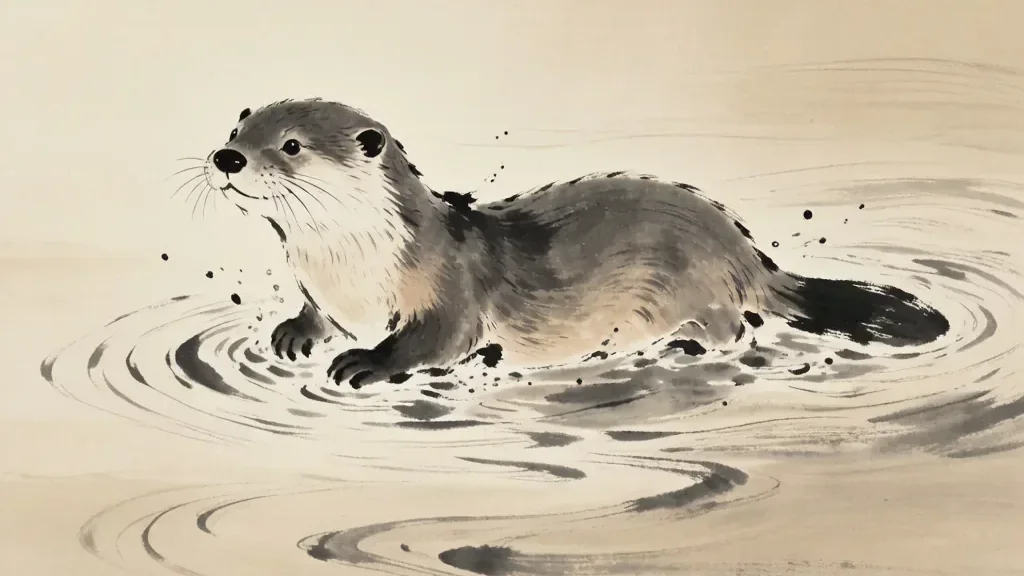
The otter (水獭, shuǐtǎ) glides through Chinese culture as silently as it glides through the rivers of the Yangtze basin — a creature more often sensed than seen, its existence marked by fish bones left on riverbanks and by the fishermen who once trained it as a working partner. In classical Chinese texts, the otter is a figure of methodical competence: the Book of Rites notes that otters arrange their catch on the riverbank before eating, a behavior that the Chinese interpreted as a form of ritual offering. The otter's ability to catch fish with uncanny efficiency made it a symbol of prosperity and resourcefulness, but its nocturnal habits and amphibious nature also gave it an aura of mystery. Like the otter itself, the otter's place in Chinese culture is neither at the center nor at the margin but in the in-between spaces where land meets water and wildness meets domestication.
Otters and Chinese Fishermen
Chinese fishermen have used trained otters for fishing for over a thousand years, a practice documented in Tang dynasty texts and illustrated in Song dynasty paintings. The cormorant is more famous as a Chinese fishing animal, but the otter was considered superior in certain respects: it could work at night, it was less affected by water temperature, and it was more selective about the fish it caught. A trained otter would dive from the boat, chase fish into the fisherman's net, and sometimes catch fish directly with its mouth, delivering them to the boat before diving again.
The practice of otter fishing was most common in the lakes and rivers of Hubei, Hunan, and Jiangxi provinces, where the Asian small-clawed otter was the preferred species. The otters were captured as cubs, trained over several months, and kept in semi-captivity on the fishing boats. The relationship between fisherman and otter was characterized by mutual dependence: the otter received food and protection, while the fisherman gained access to fish that would otherwise be difficult to catch. Otter fishing has declined dramatically since the mid-twentieth century due to overfishing, pollution, and the otter's endangered status, but it survives in a few remote communities and is preserved as a cultural heritage practice.
Otters in Chinese Art and Literature
The otter appears in Chinese painting primarily in scrolls depicting river scenes or the products of the hunt. A hanging scroll from the Ming dynasty — "Fisherman with Otter" by the artist Li Zai — shows the animal perched on the edge of a boat, its sleek body poised to dive, creating a composition of extraordinary tension. The otter's curved line echoes the curve of the fisherman's back and the hull of the boat, binding the three elements into a single visual unit. The painting is as much about the relationship between human and animal as it is about either subject individually.
In Chinese literature, the otter is most memorably evoked in the Chuci (Songs of Chu), where the great poet Qu Yuan uses the otter as an image of untrustworthiness: "The otter does not eat what it catches in one place / It moves from pool to pool, never satisfied." The poet contrasts the otter's restless appetite with his own unwavering loyalty to his lord. This negative characterization — the otter as faithless consumer — coexists with more positive assessments in other texts, reflecting the otter's irreducibly ambiguous nature. A creature that is neither fully wild nor fully domestic, neither entirely beneficial nor entirely harmful, the otter resists the clear categorization that Chinese culture so often demands.
The Otter in Chinese Folklore and Folk Religion
Chinese folklore attributes to the otter the ability to transform into a beautiful woman, much like the fox and the snake. The otter-spirit (shuǐtǎ jīng) is typically a river-dwelling seductress who lures men to their deaths by drowning. These stories were particularly common in the lake regions of central China, where drowning was a real and frequent danger, and they served as warnings about the unpredictable dangers of the water. The otter's graceful movements in the water — which from a distance could appear humanlike — likely contributed to these legends, as did the otter's habit of swimming upright when carrying its young.
In Chinese folk religion, the otter is associated with the Dragon King and the water deities who control rainfall and river flow. Fishermen and boatmen offered sacrifices to the otter before embarking on dangerous passages, hoping to secure the good will of the water realm. Otter pelts were considered powerful talismans against drowning, worn by sailors and ferry passengers. The otter's ability to move freely between land and water made it a mediator between two worlds, a role that Chinese folk religion recognized and exploited in its ritual practices.
Otters and Chinese Ecology
Three species of otter are native to China: the Eurasian otter (Lutra lutra), found across northern and central China; the Asian small-clawed otter (Aonyx cinereus), the smallest otter species, found in southern China; and the smooth-coated otter (Lutrogale perspicillata), found in Yunnan and the far south. All three species have suffered catastrophic population declines due to habitat destruction, water pollution, overfishing of their prey, and hunting for their pelts. The Eurasian otter is classified as Near Threatened globally but is considered endangered in China; the Asian small-clawed otter is Vulnerable; the smooth-coated otter is also Vulnerable.
Chinese conservation efforts for otters have focused on protecting wetland habitats and reducing pollution in major river systems. The otter has benefited from the broader ban on wildlife consumption implemented after the COVID-19 pandemic, though it continues to be threatened by habitat loss from dam construction and agricultural expansion. In some areas, beaver-like reintroduction programs have been proposed, though otters are more difficult to breed in captivity than many other endangered species. The otter's survival in China depends on the restoration of the river ecosystems that have been degraded by decades of rapid industrialization.
The Otter in Contemporary Chinese Culture
The otter has achieved a new kind of fame in contemporary Chinese digital culture. Videos of otters playing, swimming, and interacting with humans are popular on Chinese social media platforms, and the otter's charming appearance — the round eyes, the expressive whiskers, the playful behavior — has made it a favorite subject of wildlife accounts. Otter cafés have appeared in some Chinese cities, where patrons can interact with captive otters — a practice that has raised concerns about animal welfare but that also reflects the otter's growing status as a desirable animal companion.
In Chinese environmental discourse, the otter has become an indicator species for river health. The presence of otters in a waterway is taken as evidence of clean water and abundant fish, while their absence signals ecological degradation. Environmental organizations use the otter as a flagship species for freshwater conservation campaigns, deploying its charisma to raise awareness about issues that might otherwise seem abstract or remote. The otter thus serves as a bridge between the traditional Chinese appreciation for this resourceful animal and the contemporary need for effective environmental advocacy.
The Otter in Classical Observation
The earliest Chinese writers treated the otter less as a symbol than as a behaviour worth noting. The ritual classics describe it laying out fish on the shore, and scholars read discipline into what was really instinct. Qu Yuan turned the same image into a jab at faithless officials, proving the animal could carry moral meaning in either direction. These texts gave the otter one of the oldest literary footprints of any Chinese river creature.
Between Wild and Domestic
Trained otter fishing placed the animal in a strange middle space, neither fully wild nor fully tame. The fisherman fed and protected the otter, and the otter delivered fish it might have eaten, a compact of mutual use. Villagers along the Yangtze and the central lakes lived with this partnership for centuries, so the otter was a working neighbour rather than a distant legend. Its ambiguous status matches the creature itself, at home in both river and boat.
Protector Against the Water
Folk religion gave the otter a protective office over the dangerous river. Boatmen offered small sacrifices before rough passages and wore otter pelt as a charm against drowning, trusting the animal's mastery of the water to shield them. The otter-spirit tales warned of the same water's lethality even as the pelt promised safety. In this double role the otter mediated between human travellers and the unpredictable realm beneath the surface.
❓ Frequently Asked Questions
📝 Chinese Vocabulary
水獭 — : otter; literally "water otter."
水獭精 — : otter-spirit; a shapeshifting water creature in Chinese folklore.
水獭捕鱼 — : otter fishing; the traditional practice of using trained otters to catch fish.
欧亚水獭 — : Eurasian otter; the most widely distributed otter species.
江獭 — : smooth-coated otter; literally "river otter."
小爪水獭 — : the Asian small-clawed otter, the species most used in traditional otter fishing
獭祭 — : the otter's offering, the classical name for its habit of lining up caught fish
水獭皮 — : otter pelt, once a valued and heavily traded fur
🎉 Fun Facts
- The Asian small-clawed otter — the smallest otter species in the world — is the species most commonly used in traditional Chinese otter fishing because of its manageable size and dexterous paws.
- Qu Yuan's comparison of the otter to an unfaithful official in the Songs of Chu is the earliest known literary reference to the animal in Chinese.
- Otters have the densest fur of any mammal — up to 140,000 hairs per square centimeter — which made their pelts extremely valuable in the Chinese fur trade.
- Otters can seal their ears and nostrils shut, letting them hunt underwater without water entering the head.
- The phrase about the otter sacrificing fish records an early Chinese observation of the animal's tidy, deliberate behaviour.
- Otter cafes have appeared in several Chinese cities as a recent, controversial consumer trend.