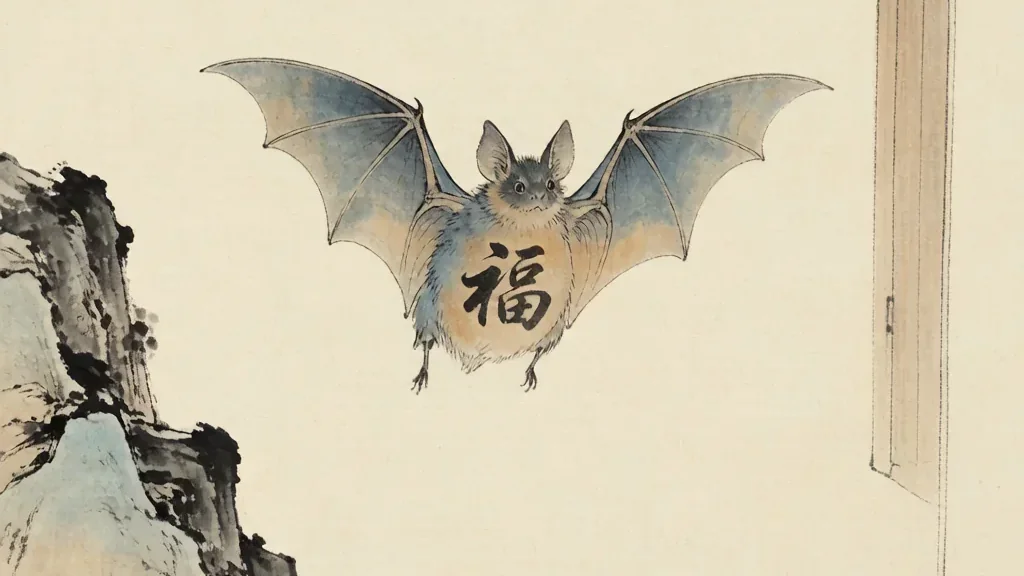
In the West the bat is a creature of caves and dread, but in China it is welcome at the door. The reason is a pun. The word for bat, biānfú (蝙蝠), sounds almost exactly like biàn fú — and crucially its second syllable, fú (福), is the word for good fortune and blessing. Once sound and sense were linked in people's minds, the bat stopped being spooky and became a charm. To this day a bat on a bowl or a beam is not a warning but a wish, and the animal that the West shunned became one of China's favourite bringers of luck.
The Bat in Nature
Bats are the only mammals that fly, and China is home to a great many species, from tiny insect-eaters to the large fruit bats of the south. They roost in caves, old temples, and the eaves of houses, emerging at dusk to feed. Their quiet, hidden life and their longevity — some bats live thirty years or more — gave them an air of mystery that fitted neatly with ideas about long life and the unseen workings of fortune.
Biologically the bat is a friend to farmers, eating vast numbers of night-flying insects, but that practical role hardly registered in symbolism. What mattered was the name, and the name was destiny.
A Homophone for Fortune
Chinese culture delights in wordplay, and matches of sound are treated as matches of fate. Because fú (福) means blessing, any word sharing that sound can stand in for it. The bat joined a whole family of lucky homophones: the magpie for joy, the carp for gain, the bat for fortune itself. A picture of a bat is therefore not a picture of an animal but a written wish spelled in wings.
This turned the bat into a kind of visual character. Where a Western viewer sees a silhouette, a Chinese viewer reads "luck." The gap between the two readings is the whole story of how culture can rewrite a creature's meaning.
The bat was not alone in this wordplay, but it was the boldest case. The magpie carried joy, the carp carried gain, and the bat carried fortune itself — the widest of the three. A bat in a design could stand for the whole family of blessings at once, which is why it so often heads the composition, with the other lucky creatures arranged beneath it like attendants. In a culture that treated a picture as a spoken wish, the bat was the loudest wish of all, and its upside-down flight only added to the charm, since "upside down" (倒, dào) sounds like "arrive" (到, dào) — a bat hanging head-down means fortune has arrived.
The Five Bats and the Five Blessings
The most common bat design is the wǔfú (五福), the Five Bats. Five bats circle a character for long life (寿, shòu) or a peach of immortality, standing for the Five Blessings named in the ancient "Great Oath" chapter of the Book of Documents: longevity, wealth, health, love of virtue, and a peaceful death in old age. The compact pattern packs a whole philosophy of the good life into five small bodies.
On Qing-dynasty porcelain and court robes the Five Bats appear in blue and white or in gold, and on birthday gifts they wish the receiver not merely money but a full and balanced fortune. The bat, in other words, was the emblem of fortune in its widest, wisest sense.
Bats in Art, Porcelain, and the Home
Bats decorate almost everything meant to carry a blessing. They appear on lacquer boxes, embroidered wedding chests, palace ceilings, and the red enclosed panels (影壁, yǐng bì) that shield northern courtyards from the street. The Qing "Bat Jar" is a celebrated piece of porcelain whose body is covered in bats among clouds. A bat clutching a coin means "fortune with wealth"; a bat above a doorway asks luck to fly in.
Architecture picked up the motif too. Carved bats sit on roof beams and window lattices, and pairs of bats flank the central character on festival lanterns. Because the wish is silent and always on display, the home itself becomes a small machine for broadcasting good fortune.
The Bat in the Imperial Court and on Charms
The bat's favour reached the highest level. On the beams and coffered ceilings of the Forbidden City, bats are carved and gilded among clouds, and the Qing emperors received birthday gifts covered in wǔfú patterns — five bats circling a character for long life — as the standard wish for the ruler's fortune. Court robes and imperial porcelain carried the bat alongside the peach and the deer, the trio meaning longevity, fortune, and rank together. What began as a pun had become official emblem of the state's blessings.
The bat also migrated onto lucky coins and trinkets. Charm coins (厌胜钱, yā shèng qián) were cast with a bat on one side and a coin on the other, to be hung in the home or given to children. Small jade bats were carved as belt hooks and hairpins, and a bat pressed into a cake at New Year carried the same silent wish as the grandest ceiling. The democracy of the symbol is striking: the bat blesses the palace and the peasant's kitchen alike, because luck, unlike rank, is meant for everyone.
Myths of the Long-Lived Bat
Daoist lore gave the bat a second life as an ageless being. Bats roost in caves — the dark, hidden wombs of the earth that Daoist alchemy linked to the source of long life — and legend spoke of the "bat of ten thousand years" (万年蝠, wàn nián fú) that had absorbed the essence of the mountains. The Queen Mother of the West is sometimes attended by bats, and the creature's night-flying, unseen nature made it a fitting servant of the immortals.
So the bat wears two blessings at once: the spoken luck of its name and the silent luck of its long, hidden life. Few animals show more clearly how a single sound can lift a creature from dread to delight, and how China turned even the night's small flyer into a friend.