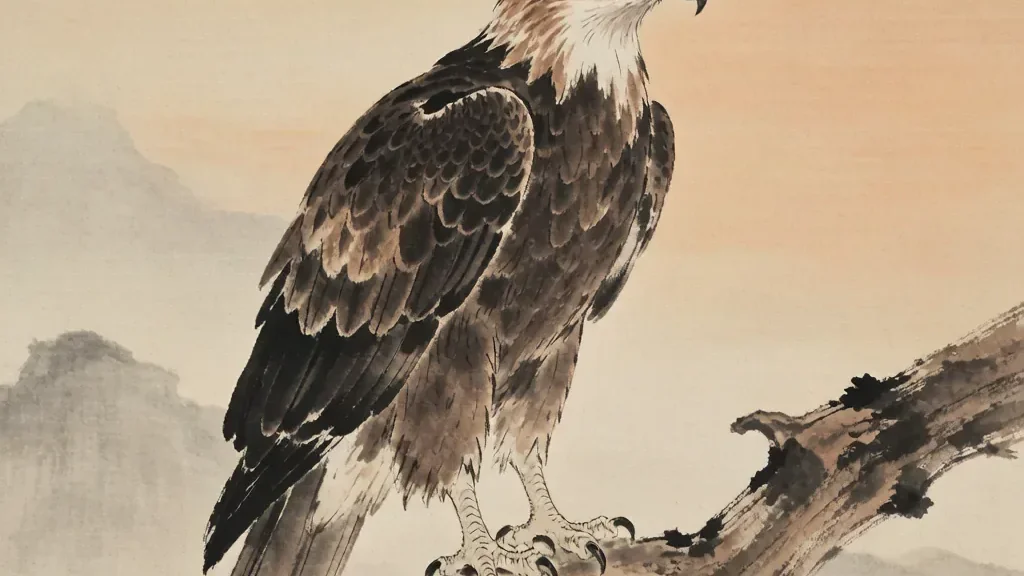
The eagle (鹰, yīng) commands the Chinese sky with a majesty that no other bird can match. Its ability to soar at altitudes beyond the range of human vision, to strike with devastating precision, and to fix its prey with an unblinking gaze made the eagle a symbol of the supreme power — of the emperor, of the general, of the sage who sees all things from a superior perspective. In Chinese culture, the eagle is the bird of war and the bird of vision, associated with the military virtues of courage, decisiveness, and strategic clarity. But the eagle also has a dark side — its predation on smaller birds and domestic animals made it a figure of oppression in Chinese folk tradition, and its fierce independence made it difficult to incorporate into the Confucian system of mutual obligation and social harmony.
The Eagle in Chinese Military Culture
The eagle was the most important bird symbol in Chinese military culture. The Zhouli (Rites of Zhou) specifies that the eagle feather was used on the banners of the highest-ranking generals, and that the "eagle banner" (yīng qí) was carried at the head of the army on campaign. The eagle's image was embroidered on the uniforms of elite troops, and the eagle's hunting technique — circling, observing, then striking at the precisely right moment — was studied as a model of military strategy. The phrase 鹰扬 (yīng yáng) — "eagle soaring" — appears in Chinese military texts to describe the ideal posture of an army on the offensive: elevated, vigilant, and ready to fall on the enemy.
The most famous Chinese military use of the eagle was in falconry, a sport and military training method practiced in China for over two thousand years. The golden eagle was the preferred species for hunting wolves and foxes on the steppe, and the techniques of eagle falconry were passed down through generations of Central Asian and Mongol warriors who served in Chinese armies. The Qing dynasty emperors, particularly Kangxi and Qianlong, were avid eagle falconers, and their hunting expeditions with eagles were documented in court paintings that survive in the Palace Museum collection.
The Eagle in Chinese Poetry
The eagle appears in Chinese poetry as a figure of solitary grandeur, often contrasted with the social birds (sparrows, swallows, geese) that travel in flocks. The Tang poet Li Bai wrote of an eagle that had been tamed and trained for falconry, a poem that serves as an allegory for the poet's own relationship with imperial power: "The golden eagle, captured and chained / Cannot forget the sky / Its keeper feeds it well / But it longs for the wind." The eagle in Li Bai's poem represents the spirit that cannot be domesticated, the wildness that persists even in the heart of the tamed creature.
A contrasting tradition uses the eagle as a symbol of the oppressive powerful who prey on the weak. The poet Du Fu, in a poem about a village that has been plundered by tax collectors, compares the collectors to eagles: "The eagle drops from the sky / Takes the chicken and flies away / The farmer raises his fist / But the eagle is already high." Dufu's eagle is not majestic but predatory, and the poem invites the reader to identify not with the eagle but with the farmer who can only watch helplessly as the bird — or the tax collector — takes what it wants.
The Eagle in Chinese Art
The eagle was a favorite subject of Chinese painters, particularly during the Ming and Qing dynasties when the bird-and-flower tradition expanded to include a wider range of bird species. The eagle was typically painted perched on a rock, its head turned to the side, its beak curved and ready. The pine tree was the preferred perch for the painted eagle, combining two symbols of endurance and strength — the pine that survives the winter and the eagle that survives by its own prowess. A painting of an eagle on a pine was a gift appropriate for a military officer, a tribute to his strength and his steadfastness.
The Ming painter Lin Liang was the most famous specialist in eagle painting, and his "Eagle and Pheasant" (now in the National Palace Museum in Taipei) is considered one of the masterpieces of Chinese bird painting. The painting shows an eagle perched on a rock, looking down at a frightened pheasant in the brush below. The composition captures the relationship between predator and prey with an intensity that the Chinese call "the battle of life." Lin Liang's eagle paintings were so influential that they established the standard for eagle depiction in Chinese art for the next three centuries.
The Eagle in Chinese Language and Idiom
The Chinese language preserves the eagle's association with vision and power in numerous expressions. 鹰眼 (yīng yǎn) — "eagle eye" — describes sharp vision and keen observation, used both literally and figuratively. 鹰爪 (yīng zhǎo) — "eagle claw" — describes a powerful, gripping hand and is also a term for a type of Chinese martial arts grappling technique. 鹰犬 (yīng quǎn) — "eagles and dogs" — refers to hired thugs or henchmen, derived from the use of eagles and dogs in hunting.
The idiom 鹰击长空 (yīng jī cháng kōng) — "eagle strikes the vast sky" — describes the soaring ambition of a person who aims high and acts decisively. Another expression, 鹰视狼步 (yīng shì láng bù) — "eagle's gaze, wolf's gait" — describes someone with a fierce, predatory appearance, often used in Chinese literature to describe villains or warriors.
Eagle Conservation in China
The golden eagle and the white-tailed eagle are among the most prominent eagle species found in China, both classified as protected species. The golden eagle inhabits the mountainous regions of western and northern China, from the Tibetan plateau to the Altai Mountains. The white-tailed eagle, one of the largest eagles in the world, is found along the coast of northeastern China and around the lakes of the Yangtze basin. Both species have declined due to habitat loss, pesticide poisoning, and persecution by farmers who see them as threats to livestock.
Chinese conservation programs for eagles include captive breeding, habitat protection, and public education campaigns aimed at reducing persecution. The use of eagles in falconry, once a popular practice among ethnic Kazakh and Mongol communities in Xinjiang and Inner Mongolia, is now regulated, and the capture of wild eagles for training requires government permits. The traditional Kazakh practice of eagle hunting — in which golden eagles are trained to hunt foxes and wolves — has been recognized as a National Intangible Cultural Heritage, acknowledging both the cultural value of the practice and the need to ensure its sustainability. The eagle's future in China depends on balancing the preservation of traditional practices with the protection of the birds themselves.
The Mythic Roc and Eagle in Chinese Thought
Chinese imagination pairs the real eagle with a far greater bird. In the Zhuangzi, the roc is a colossal creature whose back spans the sky and who rises on the wind to journey beyond the clouds, contrasting with small birds content in a bush and never lifting their gaze. Later writers borrowed this image of supreme, effortless ascent to praise lofty ambition, and the eagle, as the largest bird of the Chinese heavens, became its earthly stand-in within poetry and painting. The result is a layered symbol: the eagle of the battlefield and the roc of the philosopher both figure the same ideal of rising above the small and the near, whether in strategy, poetry, or the pursuit of freedom. When a statesman spoke of 'riding the wind like the roc,' he was really claiming the eagle's sharp eye and the roc's reach at once, fusing myth and nature into a single soaring ambition.
Eagles in the Cultures of China's Minorities
The eagle's meaning varies across China's peoples. Among the Kazakh and Kyrgyz of Xinjiang, the golden eagle is a partner in a hereditary hunting tradition and a source of communal pride, celebrated in festivals where eagles are shown off, raced, and released to the delight of crowds. Mongolian horizons carry the eagle as a marker of the open steppe and the horseman's world, and eagle imagery appears on stamped leather and saddle cloth. In Tibetan regions the bearded vulture and eagles are respected as birds of the high country and as agents in sky burial, carrying the dead toward the heavens. Even in the far northeast, small peoples read the eagle as a clan ancestor. These living traditions give the eagle a social and ritual depth that the Han literary symbol of solitary grandeur only partly captures, rooting the bird in living communities rather than only in verse.
The Eagle in Modern Chinese Symbolism
The eagle has adapted readily to modern uses. Sports teams and athletic brands adopt it for speed and dominance, and corporate logos invoke it to suggest vision and reach across markets. In contemporary film and fiction the eagle often marks a character of fierce independence or strategic brilliance, echoing its older martial meaning, and military insignia still borrow the eagle for rank and honor. Even environmental campaigns use the eagle as a flagship for protecting mountain and grassland predators, framing conservation in terms of national strength. The bird thus remains what it long was: a flexible emblem of power, now redirected from the imperial banner toward national pride, enterprise, and the defense of wild places. As an emblem it travels easily across contexts, so the same silhouette that once topped a general's standard now tops a start-up's homepage, unchanged in what it promises.
❓ Frequently Asked Questions
📝 Chinese Vocabulary
鹰 — : eagle; the general term.
金雕 — : golden eagle; a large eagle used in traditional falconry.
鹰眼 — : eagle eye; sharp vision.
鹰击长空 — : "eagle strikes the vast sky"; describing soaring ambition.
鹰犬 — : "eagles and dogs"; hired thugs or henchmen.
大鹏 — : the great roc; the colossal mythic bird in the Zhuangzi that soars beyond the clouds.
苍鹰 — : the goshawk; a powerful hawk-eagle long used in Chinese falconry.
雄鹰 — : valiant eagle; a phrase praising a person of heroic ambition.
🎉 Fun Facts
- The Kazakh eagle hunters of Xinjiang use golden eagles that can weigh up to 6 kilograms and have a wingspan of over 2 meters — large enough to take down a fully grown fox.
- The phrase "eagle and dogs" (yīng quǎn) was used in imperial China to describe the secret police and informants who enforced the emperor's will, hunting down dissent like trained animals.
- In Chinese martial arts, the "eagle claw" style (yīng zhǎo quán) is a hard, external style that emphasizes powerful gripping techniques, joint locks, and bone-breaking strikes.
- The golden eagle's eyesight is estimated at four to eight times sharper than a human's, letting it spot small prey from over a kilometer away.
- A Kazakh golden eagle may hunt alongside its human trainer for ten years or more before being set free to breed.
- In traditional falconry ranking, the eagle was prized above the falcon as the noblest of hunting birds in Chinese courts.