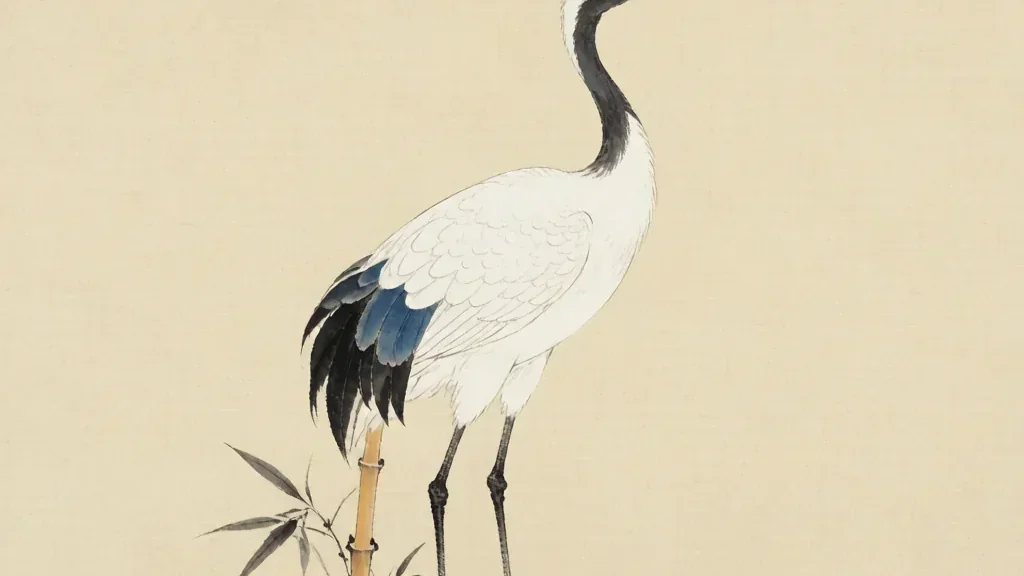
Among the birds of China none carries more weight than the crane. With its snow-white body, black neck trim, and a crown of bare red skin, the red-crowned crane (丹顶鹤, dān dǐng hè) walks the wetlands of the northeast with a poise that early observers read as pride held in check. For two thousand years the Chinese have treated the crane not merely as wildlife but as a moral and spiritual figure — the very picture of a long life well lived and of a gentleman who keeps his distance from the mud of the world. To understand the crane is to understand how the Chinese turned a real animal into a lesson about how to grow old and how to stay noble.
The Crane in Nature
The red-crowned crane stands about one and a half metres tall and is one of the heaviest flying birds alive. It pairs for life, performs slow, bowing courtship dances, and voices a far-carrying trumpet call that carries for miles across marsh and reed bed. These traits — lifelong partnership, measured movement, and a cry that seems to come from nowhere — fed directly into its symbolism. Several crane species migrate through China, and the sight of a skein flying in a neat line against the autumn sky became a standard image of order and travel.
Because cranes are long-lived, with wild birds reaching thirty years and captive ones past sixty, people naturally projected a thousand-year lifespan onto them. Their habit of standing on one leg, motionless, suggested meditation; their preference for clean water and open marsh suggested purity. Nature supplied the raw material, and culture did the rest.
The Emblem of Longevity
The single strongest association of the crane is with a long life. A common birthday wish pairs the crane with the pine: 松鹤延年 (sōng hè yán nián), "may the pine and crane prolong your years." The pine stays green through winter, the crane lives long, and together they promise endurance. On birthday scrolls, on the embroidered panels of elderly people's robes, and on the porcelain sent as anniversary gifts, the crane repeats the same blessing.
This link runs deep into legend. The Crane Boy tales tell of boys who serve the immortals by tending cranes, and of mortals who, after a single day among the cranes, return to find the world has aged centuries. The bird marks the boundary between the mortal span and the immortal one, and crossing that boundary is exactly what Daoist practice hoped to achieve.
Daoism, Immortals, and the Soul's Escort
In Daoist mythology the crane is the mount of the xian (仙), the transcendents who have left the dusty world behind. The Queen Mother of the West keeps cranes in her western paradise, and the souls of worthy dead are said to ride a crane upward at the moment of passing. This gives the crane a double duty: at a funeral it appears as the gentle escort of the spirit; at a birthday it appears as the promise of more years. Few animals span both ends of life so neatly.
The philosopher Zhuangzi, asked how he could be so calm at his own wife's death, answered with a image of the cosmos as a great furnace and the soul as a thing that takes new form — and later Daoist art simply put that liberated soul on a crane's back. The crane thus became the visual shorthand for freedom from the body and from worldly care.
The Crane in Painting, Idiom, and Rank
In the bird-and-flower painting tradition the crane is a favourite subject, painted alone by a moon, standing in a pine, or flying above waves. A crane with a turtle forms gui he tong chun (龟鹤同春), a wish that spring and good fortune last as long as they do. The white body against black water makes an ideal ink subject, and masters from the Song court painters to the literati of the Ming used it to show restraint and refinement.
The bird also entered the language. Fenhao (焚藁) — burning the crane — warns against spoiling something fine through impatience, from a tale of a host who kept opening the oven and ruined his crane meat. And on the ranked court robes of the Ming and Qing, a single crane stood for the top civil grade, outranking the peacock and the leopard, so the bird also signalled the scholar-official at his most honoured.
The Crane and the Literati Ideal
The crane also became the companion of the Chinese recluse and the retired scholar. The Song-dynasty hermit Lin Bu (林逋, Lín Bū) lived alone by the West Lake and famously kept plum blossoms as his "wife" and a crane as his "son" — méi qī hè zǐ (梅妻鹤子) — walking the crane on the shore while he wrote poetry. When a guest came, the boy at home would release the crane, which flew to Lin Bu in the hills as a living doorbell. The story fixed the crane as the sign of a free, unworldly life, the bird of the man who has left office and fame behind.
Poets returned to this again and again. Bai Juyi spoke of "a crane in the courtyard" as the only luxury a poor official needed; Su Shi, in exile, consoled himself with the crane's calm. Because the crane stands on one leg and watches, it mirrored the seated meditator, and because it flies high and alone, it mirrored the liberated mind. The bird was not merely decorative; it was a portrait of the inner life the literati most admired — aloof, unhurried, and untouchable by the mud below.
A Living Symbol Today
The red-crowned crane is now endangered, and its image has taken on new meaning as a conservation emblem in the wetlands of the northeast. Yet the old meanings persist: at New Year, crane motifs still appear on cards and lanterns as a wish for the year to come, and the phrase he fa tong yan (鹤发童颜) — "crane hair and child face" — describes a happy old person whose white hair sits on a smooth, youthful face. The crane remains what it has always been in China: proof that to grow old can be a kind of grace, and that nobility is a matter of how one carries oneself, not of rank.