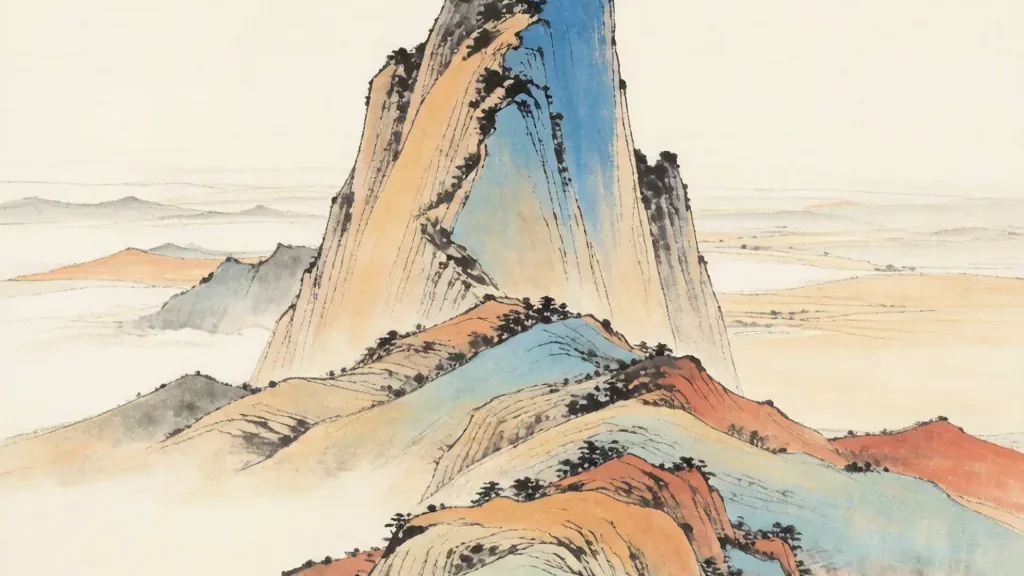
Towering above the plains of central China with a sheer, knife-edged profile, Mount Hua — 华山 (Huà Shān), "the Flower Mountain" — has been called the most precipitous mountain in the country. For centuries its narrow ridges and vertiginous stairways tested the courage of pilgrims and poets, and its summits, linked by paths that cling to the cliffs, offer some of the most breathtaking and alarming views in all of China. Hua is a mountain that does not merely invite admiration; it demands respect.
The Most Dangerous Mountain in China
Mount Hua rises in Shaanxi Province, not far from the ancient capital region of Chang'an, and its granite peaks are renowned for their steepness. Unlike rounded hills, Hua's five main summits are sharp and separated by narrow ridges, and the routes between them often require climbing stone steps cut into the rock or, in places, edging along planks bolted to the cliff face. The mountain's reputation for danger is ancient and well earned.
This difficulty was once a feature, not a flaw. The very inaccessibility of Hua made it a fitting place for retreat and devotion, where only the determined could reach the shrines at the top. In the modern era, safety measures such as chains, railings, and a cable car have made the mountain far more approachable, but the sense of exposure remains, and the views from the ridges are correspondingly sublime.
One of the Five Sacred Mountains
In the traditional geography of China, five mountains were sacred, each guarding a direction. Hua is the Western Peak, associated with the element of metal and with the autumn, and it held a special place in the state rituals of successive dynasties. Emperors came to offer sacrifice at its foot, and the mountain was woven into the cosmological order by which the Chinese world understood itself.
To be one of the Five Great Mountains was to be a pillar of the realm, a point where the human order touched the natural and the divine. Hua's role as the western guardian gave it both political and spiritual weight, and its temples and inscriptions record centuries of official and personal devotion.
The Five Peaks and the Plank Walk
Hua's five summits — the East, West, South, North, and Central peaks — each have their own character, and the classic climb links them along ridges that dip and rise between buttresses of rock. The South Peak is the highest, and from it on a clear day the plains stretch to the horizon. The most famous thrill is the "plank walk," a series of wooden boards fixed to a vertical cliff, where visitors are harnessed and must inch along a precipice with the ground far, far below.
Even the ordinary paths are dramatic. Stone steps ascend through clefts in the granite, past pine trees that grow improbably from crevices, and the constant presence of the void gives every viewpoint a charge of exhilaration. Hua rewards the climber not with ease but with the rare feeling of having earned the summit.
Temples, Taoism, and Hermits
Mount Hua has long been a site of Taoist practice, and several temples and hermitages cling to its slopes and peaks. The mountain's solitude and difficulty made it attractive to those seeking retreat from the world, and legends tell of immortals and adepts who cultivated the Way among its crags. The blend of perilous beauty and spiritual quiet is central to Hua's identity.
At the foot of the mountain lies a major Taoist monastery that has served for centuries as the gateway for pilgrims. From there the ascent begins, moving from the ordered calm of the temple into the escalating drama of the cliffs. The mountain thus frames a journey from the worldly to the transcendent, written in stone and air.
Hua in History and Legend
Hua appears throughout Chinese culture as a symbol of steadfastness and peril. It features in tales of martial artists who trained among its peaks, and in historical accounts of the routes that connected the capital with the west. The mountain was also a strategic point, its narrow paths making it naturally defensible, and stories tell of a handful of guards holding the way against armies.
The inscriptions, pavilions, and repaired paths across the mountain are a record of continuous human attention across more than two thousand years. To climb Hua is to walk a route that emperors, monks, poets, and soldiers all walked, each leaving a mark on the living rock.
Seeing Hua Today
Modern visitors reach Hua by train and cable car, and many now climb at night to witness the sunrise from the East Peak, a spectacle that draws crowds in every season. The mountain has become both a pilgrimage site and an adventure destination, its danger tamed enough to be enjoyed yet preserved enough to still thrill. Lanterns along the night paths turn the ascent into a glowing ribbon up the dark face of the granite.
Even so, Hua has not lost its essence. The wind at the summits, the drop of the cliffs, and the first light spilling over the plain remind every visitor why this mountain was honored as a guardian of the west. Courage, here, is not bravado but the quiet willingness to meet the height on its own terms.
The Ridges and the Black Dragon
What sets Hua apart is not any single cliff but the chain of ridges that link its five peaks. The most notorious is the Black Dragon Ridge, a narrow crest of weathered granite with steep drops on both sides, where the stone steps seem to hang in the air. Crossing it demands focus and a steady grip on the chains, and yet the view from its spine, the plains falling away, the other peaks rising like blades, is among the finest in China. The ridges are the mountain's signature: not a dome to walk up but a serrated line to traverse. Modern rails and cables have tamed the worst of the exposure, but the essential drama remains, and every visitor feels the same truth the ancients did, that Hua is climbed one careful breath at a time.
Hua in Story and Screen
Mount Hua has long lived in Chinese story as much as in stone. In the wuxia novels and films beloved across the Chinese-speaking world, Hua is the headquarters of a martial sect and the stage for sword contests and tests of courage, its cliffs the perfect backdrop for feats of skill. This popular image draws on older Taoist lore of immortals who cultivated the Way among its crags, and on the real history of hermits who sought solitude on its peaks. Travel writers and painters, too, have made Hua a byword for perilous beauty. The mountain thus speaks to a cultural idea as much as to geology: that height and danger, met with calm, can refine the spirit. To climb Hua is to step into a legend that ordinary visitors now share.
❓ Frequently Asked Questions
📝 Chinese Vocabulary
华山 — : Mount Hua, the "Flower Mountain" and western sacred peak.
山 — : mountain, a sacred height.
险 — : precipitous or dangerous, Hua's defining quality.
道教 — : Taoism, the faith long practiced on the mountain.
日出 — : sunrise, the reward of the night climb.
西岳 — : Western Peak, Mount Hua's title among the Five Sacred Mountains.
苍龙岭 — : The Black Dragon Ridge, a famously narrow and vertiginous crest on the climb.
长空栈道 — : The sky plank road, the cliff-edge walkway bolted to the rock face.
🎉 Fun Facts
- Mount Hua is considered one of the most precipitous mountains in China, with paths that cling to vertical cliffs.
- It is the Western Peak among the traditional Five Great Mountains of China, linked to the element of metal.
- Many visitors now climb Hua at night to reach the East Peak for sunrise, turning the trail into a ribbon of lanterns.
- Mount Hua's five summits each have a character: the West Peak is shaped like a lotus flower, the South Peak is the highest, and the East Peak is the classic spot to watch the sun rise.
- Legend ties Hua to the Taoist sage Chen Tuan and to tales of sword debates among martial artists who trained on its cliffs, adding a mythic layer to its perilous paths.
- A cable car now carries visitors to the North Peak, cutting hours off the ascent and letting even casual travelers reach the high ridges that once deterred all but the devoted.