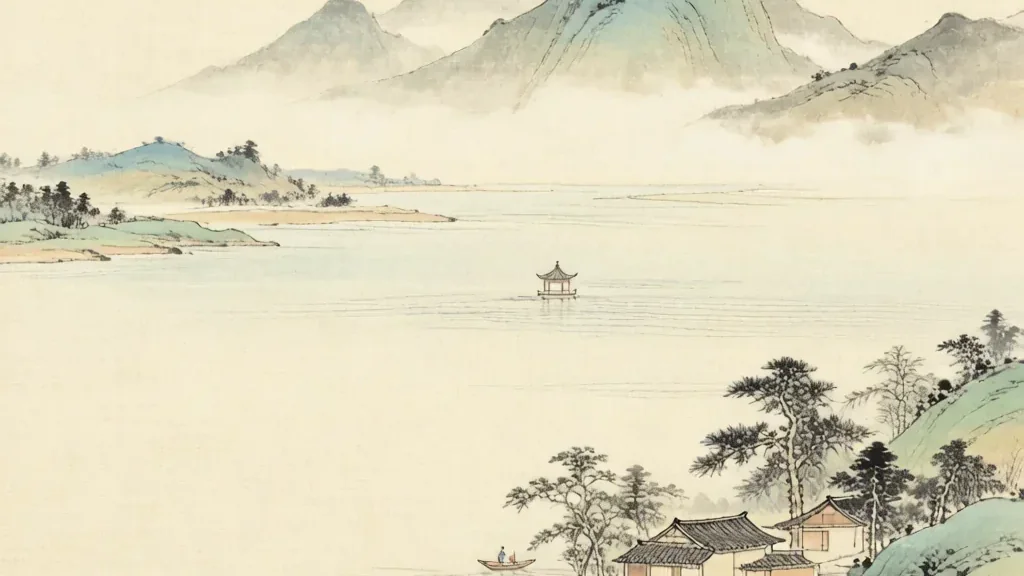
Poyang Lake, situated in the northern part of Jiangxi province in the basin of the middle Yangtze River, is the largest freshwater lake in China and one of the most important wetlands in East Asia. Unlike the enclosed, salty Qinghai Lake, Poyang is a dynamic, open lake that connects to the great Yangtze through a single outlet and expands and contracts with the rhythm of the seasons, swelling to a broad inland sea in summer flood and shrinking to a chain of channels and mudflats in winter. This dramatic pulsing makes it a critical refuge for migratory birds, above all the endangered Siberian crane, and a historic hub of fishing, farming, and flood control. In recent years the lake has also become a focus of national concern because its low-water season has extended and intensified, exposing the fragility of the Yangtze system and the landscapes that depend on it.
Location in the Yangtze Basin
Poyang Lake lies in a lowland basin north of the rugged mountains of Jiangxi, fed by five major rivers of the province, the Gan, Fu, Xin, Rao, and Xiu, which gather the rainfall of the region and pour it into the lake before it drains north through a short outlet into the Yangtze. This position makes the lake the great collecting basin of Jiangxi and a regulator of the Yangtze's flow.
Because it is linked to the Yangtze rather than closed, the lake's level is governed by the interplay of its own tributary inflow and the stage of the great river. When the Yangtze is high in summer, it can back up into the lake; when the river falls in winter, the lake drains freely and shrinks, exposing vast flats.
The lake's setting amid the hills and rice country of the south gives it a scenery of water, reed, and distant mountain, and its shoreline has long been settled by fishing and farming communities who read the water's rise and fall as a calendar of livelihood.
The Seasonal Flood and Drain Cycle
The defining feature of Poyang Lake is its extreme seasonality. In the summer flood, swollen by the monsoon rains and by the Yangtze's high stage, the lake can spread across several thousand square kilometers, a huge, shallow sheet of brown water dotted with fishing boats and carrying sediment from the whole basin.
In winter the opposite happens: the tributaries slacken, the Yangtze drops, and the lake drains to a fraction of its summer area, leaving mudflats, reed beds, and a network of channels where fish concentrate and birds feed. The difference between the two states can be a tenfold change in area, one of the great natural rhythms of the Chinese heartland.
This pulse is the ecological engine of the lake, creating the wet and dry habitats that successive waves of life require through the year. It also dictates human activity, with fishing and reed-cutting timed to the water and farming pressed into the briefly exposed margins.
The Five Rivers of Jiangxi
The lake is the meeting point of the five rivers that drain nearly all of Jiangxi, each bringing its own character: the Gan, the longest, runs north through the provincial capital Nanchang; the Fu and Xin lie to the east; the Rao feeds the northeastern arm; and the Xiu enters from the northwest, its valley leading toward the mountain of Lushan.
Together these rivers deliver the rain of a populous, hilly province into the single basin of Poyang, making the lake the natural sink and outlet of the whole region. Their sediment and nutrients enrich the lake but also, when the Yangtze backs up, can be trapped and redistributed across the floodplain.
Control of these rivers, through levees and reservoirs upstream, affects the timing and volume of what reaches the lake, so the health of Poyang is tied to the management of the entire Jiangxi river system. The lake is, in effect, the downstream expression of the province's water.
A Haven for Migratory Birds
Each winter, when the lake shrinks and exposes its mudflats and shallows, it becomes one of the most important gathering places for waterbirds in the world, a stopover and wintering ground on the East Asian-Australasian flyway. Hundreds of thousands of birds of many species arrive from the cold north to feed on the lake's fish, mollusks, and plants.
The star of this assembly is the Siberian crane, a tall, white bird whose entire migratory population depends heavily on the wetlands of Poyang, making the lake indispensable to the survival of the species. Other cranes, geese, swans, and rare birds also rely on the habitat, drawing biologists and conservationists from around the globe.
To protect these visitors, large parts of the lakeshore were set aside as a nature reserve, and restrictions on hunting and reed-cutting were imposed during the critical winter months. The lake's value as a bird sanctuary is now a central reason for its protection and careful management.
Fish, Reeds, and Lake Livelihood
For the communities around Poyang, the lake has long been a larder and a livelihood, yielding fish in abundance during the closed, low-water season when they concentrate in the channels, and reeds whose stems are cut for weaving, roofing, and paper. The seasonal exposure of the flats also allows limited farming of the rich, moist soil.
Fishing on the lake follows the ancient pattern of the pulse, with boats working the open water in summer and the narrow channels in winter, and with nets and traps suited to the shifting depths. The reed beds, apart from their economic use, shelter wildlife and stabilize the shoreline against wave erosion.
In recent years, concern over depleted fish stocks and the need to protect spawning led to seasonal fishing bans on the lake and the Yangtze, a difficult but necessary step for communities whose identity is bound to the water. The question of how to let the lake feed people while letting it heal is the local dilemma.
Lushan and the Lake Shore
To the northwest of the lake rises Lushan, one of China's most famous mountains and a summer retreat celebrated for its cool air, waterfalls, and clouds, whose streams feed the Xiu River and therby the lake. The mountain's cultural fame, as a place of poets, monks, and modern conferences, adds a literary frame to the Poyang landscape.
The lake and the mountain together form a classic pairing of water and peak, and the views across the water to the misty hills have inspired painters for centuries. The shore near the outlet also holds historic towns and temples that grew wealthy on the lake trade.
This cultural layer, of retreat, poetry, and pilgrimage, sits atop the working lake of fishers and farmers, so that Poyang is at once a productive wetland and a composed element of the Jiangxi imagination, a place where utility and beauty share the same shore.
Flood Control and the Yangtze System
Because Poyang drains into the Yangtze, it acts as a giant sponge for the middle river, storing summer floodwater and releasing it later, which helps dampen the great floods that threaten Wuhan and the lower Yangtze plain. The lake's capacity to expand is therefore a public good far beyond Jiangxi.
When the Yangtze itself is in extreme flood, however, the river can reverse the flow and push water back into the lake, worsening local inundation, a reminder that the lake and the river are one coupled system. Managing the outlet and the surrounding levees is thus a matter of basin-wide strategy.
The delicate role of Poyang in flood control has gained urgency as the Yangtze system is stressed by dams, levees, and changed rainfall, making the lake a key piece in the puzzle of how to live with the great river without being drowned by it.
Drought, Low Water, and Concern
In the last two decades the lake has drawn alarm because its dry season has deepened and lengthened, with record-low water exposing the lakebed months earlier than in the past and stranding fish and cracking the mud. The causes are debated but include upstream dams that hold water, reduced rainfall, and sand mining that may have deepened the outlet.
The low water harms the birds that need the shallows, stresses the fish, and disrupts the communities that depend on navigation and fishing, while also exposing the lakebed to the growth of invasive grass that can alter the wetland. The sight of a shrunken Poyang became a symbol of the Yangtze's strain.
Authorities have responded with measures to protect the lake's ecology, including fishing moratoria, limits on sand mining, and studies of how to keep enough water in the system. The fate of Poyang is now watched as a signal of the health of the whole middle Yangtze.
Conservation and the Nature Reserve
Poyang Lake and its wetlands are protected as a national nature reserve and are recognized under international agreements for the birds that depend on it, with managed areas where human access is limited during the wintering season. Research stations monitor water level, bird counts, and fish stocks to guide policy.
Conservation here must reconcile the needs of wildlife with those of people, a task made harder by poverty and by the deep cultural attachment to fishing. Education, alternative livelihoods, and enforced bans are used together to ease the pressure on the lake's living resources.
The reserve stands as a test of whether a heavily used freshwater lake in a crowded country can be both a working landscape and a sanctuary for global biodiversity. Its partial successes with the Siberian crane offer hope that careful stewardship can preserve the pulse.
Culture, Legend, and Local Identity
The people of the Poyang shore have a culture of the water, with boat songs, flood lore, and a cuisine built on the lake's fish and reed shoots, and with a practical philosophy shaped by living at the edge of a lake that is sometimes friend and sometimes flood. The rhythm of rise and fall is woven into local identity.
The lake also figures in broader Chinese history as a stage of naval battles and as the southern mirror of the Yangtze heartland, and its name is familiar to every schoolchild as the largest freshwater lake of the land. To know Poyang is to know a living piece of the national geography.
As the climate and the river change, the communities of the shore adapt as they always have, reading the water and adjusting their lives to its mood. The lake remains, in all its pulsing extent, one of the great natural wonders of the Chinese south.
❓ Frequently Asked Questions
Where is Poyang Lake?
It lies in northern Jiangxi province in the middle Yangtze basin, fed by five provincial rivers and draining north through a single outlet into the Yangtze.
Why does the lake change so much in size?
It is an open lake linked to the Yangtze, so summer monsoon rains and the high river swell it to a vast sheet, while winter drainage shrinks it to channels and mudflats.
Which birds depend on it?
Hundreds of thousands of migratory waterbirds winter there, most famously the Siberian crane, whose population relies heavily on the lake's wetlands.
How does it help flood control?
By storing summer floodwater and releasing it later, the lake dampens peaks on the middle Yangtze, though extreme river floods can back up into it.
Why is low water a concern?
A longer, deeper dry season exposes the lakebed early, harming birds and fish, disrupting fishing and navigation, and signaling stress in the Yangtze system.
How is the lake protected?
It is a national nature reserve with limited access in winter, fishing bans, and sand-mining limits to safeguard its birds, fish, and wetland ecology.