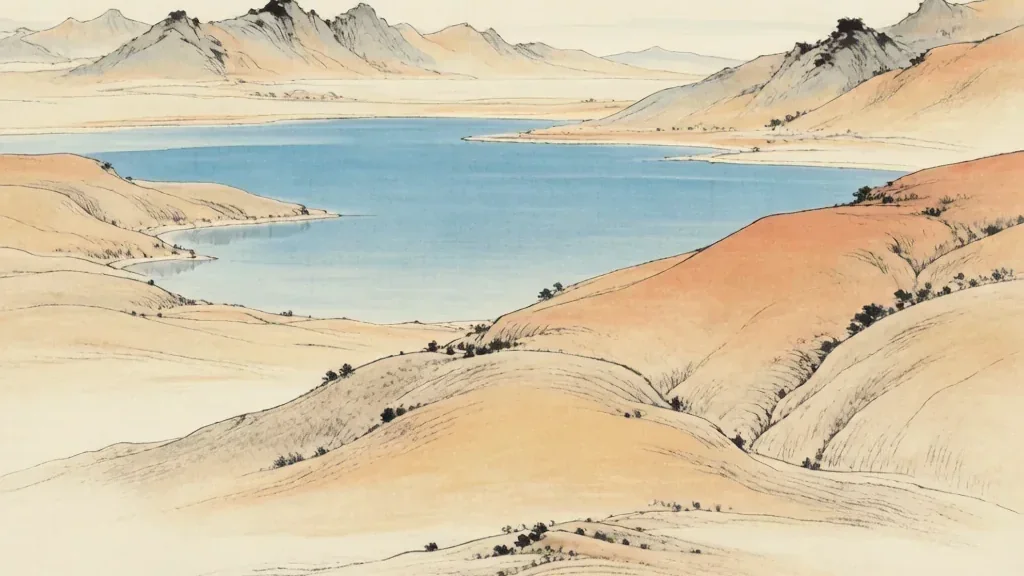
Qinghai Lake, called Qinghai Hu in Chinese and Koko Nor in older accounts, is the largest lake in China and a vast, brackish, endorheic body of water set high on the northeastern Tibetan Plateau in Qinghai province, at an elevation of more than three thousand two hundred meters above sea level. Unlike the great rivers that drain the plateau, Qinghai Lake has no outlet to the sea; its waters are trapped by surrounding mountains, and it loses volume only by evaporation, which makes it saline and sensitive to climate. For centuries it was a sacred landmark on the border between the Tibetan cultural world and the pastures of the Mongol and Tibetan herders, and today it is a protected haven for migratory birds, most famously the bar-headed goose and vast flocks that nest on its islands. Its shimmering blue expanse against rolling grassland has made it both a natural wonder and a barometer of the changing high plateau.
Location on the Tibetan Plateau
Qinghai Lake lies in a closed structural basin on the northeastern margin of the Tibetan Plateau, enclosed by the Datong, Qilian, and Qinghuan mountain ranges that shelter it from the harshest winds. Its surface sits at more than three thousand two hundred meters, making it one of the highest large lakes in the world, and its surrounding terrain is a rolling mosaic of alpine meadow and steppe.
Because it is endorheic, the lake's level depends entirely on the balance between the meltwater and rain that flow in from the surrounding mountains and the water lost to the thin, dry mountain air by evaporation. Small rivers and seasonal streams feed it, but no channel carries its water away, so the chemistry of the lake is shaped by what the inflow leaves behind.
The plateau setting gives the lake a stark, open grandeur: immense skies, long sightlines, and a shoreline where water meets grass and then distant snow-streaked peaks. This combination of altitude, isolation, and scale is central to its power as a landscape.
An Endorheic Saline Lake
An endorheic lake is one with no natural outlet, and Qinghai Lake is the largest such lake in the country. Over time the accumulation of dissolved minerals from the inflow, with no river to flush them out, has made the water brackish, less salty than the ocean but distinctly undrinkable and unsuited to most fish except a few hardy native species.
The chemistry and level of the lake are sensitive indicators of regional climate. When inflow rises, the lake expands and its salinity falls; when drought or reduced snowmelt lowers inflow, the lake shrinks and grows saltier. For this reason scientists monitor it closely as a signal of change on the high plateau.
In recent decades the lake's area has fluctuated, at times contracting sharply and at other times recovering as precipitation patterns shifted. These changes ripple through the wetland ecosystems that depend on stable water levels, making the lake a focus of both scientific study and conservation concern.
Climate of the High Plateau
The lake region has a cold, dry, highland climate, with short, cool summers and long, bitter winters in which the surface can freeze and ice may cover parts of the water for months. The air is thin and clear, the wind persistent, and the daily temperature swing large, all typical of the elevated plateau.
Precipitation is modest and falls mainly in summer, much of it as rain fed by the Asian monsoon that reaches this far onto the plateau, while the mountains catch snow that later melts to feed the lake. The cold limits what plants and animals can thrive, but it also preserves the clarity of the environment and the openness of the grassland.
This harsh but clean climate is precisely what makes the lake a refuge for certain birds and a place of solitude for travelers. The very severity that deters settlement protects the ecological character that draws scientists and nature lovers.
Bird Island and Migratory Birds
The most celebrated feature of Qinghai Lake is its Bird Island, actually a peninsula and adjacent islets where tens of thousands of birds congregate to breed each spring and summer. The lake sits on a major migratory route between Central Asia and the Indian subcontinent, and its wetlands offer food and safe nesting at a critical stopover.
Among the throngs are bar-headed geese, which migrate over the Himalayas, together with cormorants, gulls, and many species of duck and wader that blanket the shores in a chorus of calls. At the height of the season the island is one of the great avian spectacles of Asia, a dense, shifting carpet of birds.
Because of its global importance, the area was made a nature reserve, and access to the breeding grounds is restricted during the nesting season to protect the colonies from disturbance. The success of this protection has made Qinghai Lake a model of high-altitude wetland conservation in China.
Fish and the Naked Carp
The lake's only native fish is a species of naked carp, a slender, scaleless relative of the crucian carp adapted to the cold, saline water, which has sustained local fisheries and the birds that feed on it for centuries. The fish spawns in the freshwater inflows, undertaking mass migrations up the streams in early summer in a remarkable natural event.
Traditionally the carp was harvested modestly by local herders and monks, and it held cultural as well as dietary value, but overfishing and the disturbance of spawning streams once reduced its numbers severely. Conservation measures, including seasonal bans and protected spawning channels, have helped the population recover.
The health of the naked carp is tightly linked to the health of the whole lake, since it sits at the center of the food web that supports the birds. Protecting the fish therefore protects the lake's celebrated bird life as well, a neat illustration of how the plateau ecosystem is woven together.
Cultural and Sacred Significance
For the Tibetan and Mongol peoples of the plateau, Qinghai Lake has long been a sacred place, a dwelling of lake deities honored through prayer, offerings, and circumambulation. Pilgrims have for centuries walked or prostrated themselves around its shores, and festivals held at the lakeside blend Buddhist devotion with the older practices of the pastoralists.
The lake also marked a frontier in imperial history, a boundary between the Tibetan cultural sphere to the southwest and the Mongol and Chinese spheres to the north and east, and it gave its name to the province of Qinghai itself. Caravans and armies crossed its northern shore, and it appears in the records of early travelers to the plateau.
This layered meaning, as a holy water, a borderland, and a namesake, gives Qinghai Lake a cultural weight beyond its size. To the peoples who live nearby, it is not merely a lake but a presence that watches over the grassland.
Surrounding Grassland and Herding
The shores and hinterland of the lake are grassland used by Tibetan and Mongol herders for grazing yaks, sheep, and horses, a way of life adapted to the short growing season and the need to move animals to fresh pasture. The meadow blooms briefly with alpine flowers in summer, painting the shore with color.
Herding here follows ancient rhythms, with winter and summer pastures and a deep knowledge of where water and grass can be found on the highland. The herders' lives are tied to the lake's watershed, since the health of the grassland depends on the same precipitation that feeds the water.
Modern pressures, including fenced land, settlement programs, and the effects of climate variability on the pasture, have changed this life, but the image of yurts, flocks, and a vast blue lake remains the defining picture of the Qinghai Lake region and a touchstone of plateau identity.
Environmental Change and Protection
Like many high-plateau systems, Qinghai Lake has shown the marks of environmental stress, including periods of shrinkage, grassland degradation around its margins, and the drying of some inflow streams. These changes were linked to regional warming, reduced snowmelt, and intensified land use in the watershed.
In response, the government established a nature reserve, restricted grazing near the shore, banned fishing in season, and invested in wetland restoration, measures that have coincided with a stabilization and even expansion of the lake's area in some recent years. Monitoring stations track water level, salinity, and bird numbers to guide management.
The lake thus stands as a test case for protecting a fragile highland ecosystem in a warming world. Its partial recovery shows that concerted stewardship can buffer even sensitive plateau waters, though the underlying climate trend remains a long-term uncertainty.
Travel and the Modern Reserve
Today Qinghai Lake is a destination for travelers drawn by its scale, its birds, and the surrounding grassland, reached by road from the provincial capital Xining within a few hours. The loop road around the lake offers views of shore, island, and mountain, and the area hosts cycling events that use the high, open highways.
Visitor facilities are balanced against protection, with viewing areas set back from the breeding colonies and the sacred sites respected by local custom. The combination of accessibility and wildness makes the lake unusual, a place where one can stand at the edge of a vast, ancient water and feel the plateau's silence.
As both a natural laboratory and a beloved landscape, Qinghai Lake carries the story of the Tibetan Plateau into the present, a shimmering mirror of sky and grass that continues to teach those who study and wander its shores.
❓ Frequently Asked Questions
Where is Qinghai Lake?
It lies on the northeastern Tibetan Plateau in Qinghai province, enclosed by mountains at an elevation above three thousand two hundred meters, the largest lake in China.
Why is the lake salty?
It is endorheic with no outlet, so minerals from inflow accumulate as water evaporates, making the water brackish rather than fresh.
What birds live at the lake?
Bird Island hosts tens of thousands of migratory birds including bar-headed geese, cormorants, and gulls on a major Central Asian flyway.
What fish is native to the lake?
A scaleless naked carp is the only native fish, spawning in freshwater streams and forming the base of the lake's food web.
Why is the lake environmentally important?
Its level and salinity track plateau climate change, and its wetlands shelter globally significant bird populations, so it is a monitored nature reserve.
What is the lake's cultural role?
It is sacred to Tibetan and Mongol peoples, a site of pilgrimage and festival, and the namesake of Qinghai province on a historic frontier.