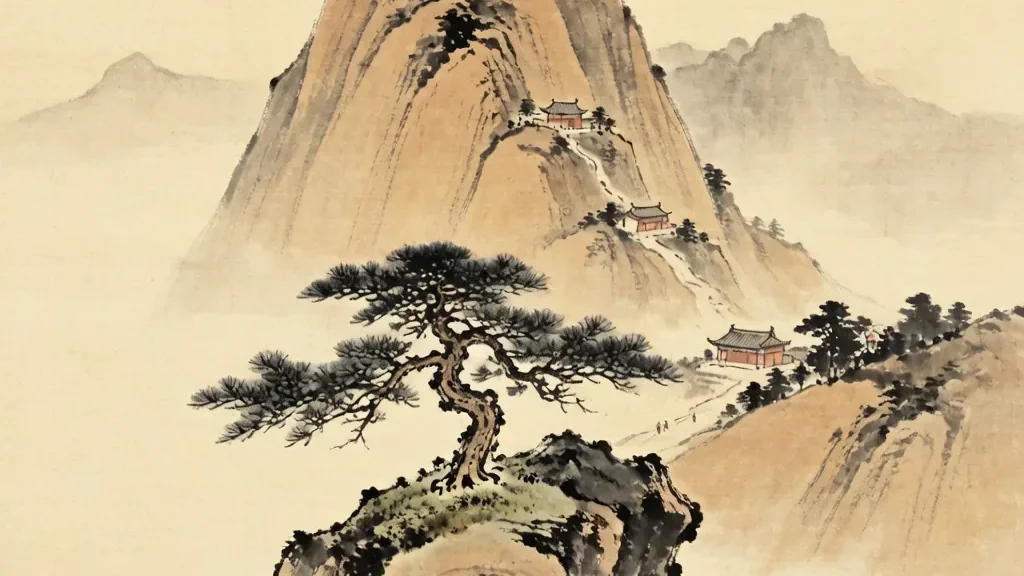
Mount Tai (泰山) in Shandong is the most sacred of the Five Peaks, the eastern mountain where emperors ascended to report to Heaven and where the sun is born.
Geology and Physical Features
Mount Tai is composed primarily of ancient granite and gneiss, with some of the oldest exposed rock in China — the Archen basement rocks are over 2.5 billion years old. The mountain rises abruptly from the North China Plain, creating a spectacular visual contrast. Its main summit, Jade Emperor Peak (玉皇顶), reaches 1,545 meters above sea level.
The mountain features 12 major peaks, 6 natural caves, and numerous springs and waterfalls. The eastern face is particularly dramatic, with sheer cliffs dropping hundreds of meters. The famous "18 Bends" (十八盘) section of the climbing path consists of 1,827 stone steps cut into the cliff face.
Imperial Worship and the Fengshan Ceremony
Mount Tai was the site of the most solemn ceremony in imperial China: the Fengshan sacrifices (封禅). The Feng ceremony was performed at the summit, where the emperor reported his achievements to Heaven. The Shan ceremony was performed at the base, where he reported to the Earth. Only the most accomplished emperors — those who had unified the realm and brought peace — dared to perform it.
The first historical Fengshan was performed by Qin Shi Huang, the First Emperor, in 219 BCE. He left a stele on the summit declaring his achievements — the earliest surviving imperial inscription on the mountain. Subsequent emperors, including Han Wudi, Tang Gaozong, and Kangxi, all made the pilgrimage. In total, 72 emperors are recorded as having performed the ceremony, though the historicity of the earliest is uncertain.
The Architecture of Sacred Space
The mountain is adorned with over 20 temples, 2,200 stone tablets, and countless pavilions and archways. The most important temple is the Dai Temple (岱庙) at the mountain's foot in Tai'an city. Built in the Han dynasty and expanded over centuries, it is one of China's three great ancient architectural complexes, alongside the Forbidden City and the Temple of Confucius in Qufu.
The temple complex covers 96,000 square meters and features the magnificent Hall of Heavenly Blessings (天贶殿), which houses a massive Song dynasty mural depicting the emperor of the Eastern Peak (Dongyue Dadi) making an inspection tour. The temple's 2,100-year-old cypress trees, said to have been planted by Emperor Han Wudi, are living witnesses to imperial history.
The Sunrise and the Sea of Clouds
The most celebrated experience on Mount Tai is watching the sunrise from Jade Emperor Peak. On clear mornings, the sun rises above a sea of clouds, creating a spectacle that has inspired countless poems and paintings. The "Four Wonders of Mount Tai" are the sunrise, the sunset, the sea of clouds, and the golden belt of the Yellow River seen from the summit.
Religious Syncretism: Buddhism, Daoism, and Folk Religion
Mount Tai has never belonged to a single religious tradition. Daoist temples dot the slopes, dedicated to gods like Bixia Yuanjun (碧霞元君), the Goddess of the Dawn, who is the mountain's most popular deity. Buddhist temples, including the Puzhao Temple and the Lingyan Temple, have existed on the mountain since the fourth century.
Folk religion is equally vibrant. The mountain is considered the dwelling place of the god of Mount Tai (泰山神, Taishan Shen), who judges the dead and determines their fate in the afterlife. The belief is so deeply embedded that "Mount Tai" became a euphemism for death in classical Chinese.
Climbing the Mountain: The Pilgrim's Path
The traditional ascent begins at the Dai Temple and follows the East Route, a 9-kilometer path of 6,293 stone steps. The climb takes 4–6 hours for an average hiker. Along the way, pilgrims pass through the Gate of the First Mountain, the Gate of Heaven Number One, the Middle Heavenly Gate, and finally the South Heavenly Gate — the dramatic archway perched at 1,460 meters that marks the entrance to the summit area.
Historical Development
The history of this topic spans thousands of years of Chinese civilization. Early records from ancient texts provide glimpses into its origins. Over successive dynasties the subject evolved significantly absorbing influences from different regions.
During the Tang and Song dynasties this field experienced a golden age. Scholars and practitioners refined techniques established standards and created works that influenced generations. The imperial court often patronized this art elevating its status.
The Ming and Qing dynasties saw further refinement. Increased trade brought new ideas from beyond Asia. This cross-cultural fertilization enriched the tradition while maintaining its Chinese character.
In the modern era efforts have been made to preserve traditional practices. The government has designated many related crafts as Intangible Cultural Heritage ensuring their survival.
Regional Variations
Different regions of China have developed their own distinctive styles. Northern styles emphasize bold forms and practicality reflecting harsh climates. Southern styles are more refined and decorative.
Eastern coastal regions developed interpretations influenced by maritime trade with Japan and Korea. Western regions with diverse ethnic populations incorporated elements from minority traditions.
Central China as the historical heartland represents the most classical forms. Many standard techniques were established here and spread to other regions.
Modern Applications
Today this tradition continues to evolve. Contemporary practitioners experiment with modern materials while respecting traditional forms. This creative tension between innovation and tradition drives the field forward.
International interest in Chinese culture has created global markets. Exhibitions and workshops have introduced these traditions to worldwide audiences fostering cross-cultural appreciation.
Educational institutions offer programs training the next generation. These combine traditional apprenticeship with modern approaches ensuring effective knowledge transmission.
Cultural Significance
This subject embodies core Chinese values. Its symbolism draws from Confucian ethics Daoist cosmology and Buddhist spirituality creating layers of meaning that reward deeper study.
Materials colors and forms all carry specific meanings. Motifs represent longevity prosperity happiness or spiritual protection. These choices reflect deliberate artistic and cultural decisions.
Rituals and ceremonies associated with this subject connect practitioners to centuries of tradition serving as living links to the past.
❓ Frequently Asked Questions
📝 Chinese Vocabulary
泰山 — : Mount Tai; the most sacred of China's Five Great Mountains.
封禅 — : Fengshan; the imperial sacrifice ceremony performed on Mount Tai.
玉皇顶 — : Jade Emperor Peak; the highest summit of Mount Tai at 1,545 meters.
岱庙 — : Dai Temple; the grand temple complex at the foot of Mount Tai.
十八盘 — : 18 Bends; the famous steep section of 1,827 stone steps.
东岳 — : Eastern Sacred Peak; the honorific title of Mount Tai among the Five Great Mountains.
碧霞元君 — : Bixia Yuanjun, the Goddess of the Dawn, the most popular deity worshipped on Mount Tai.
五岳 — : the Five Great Mountains, the sacred peaks of which Mount Tai is the foremost.
🎉 Fun Facts
- Confucius is said to have climbed Mount Tai and famously remarked, "The world is small" — a quote that captures the mountain's sweeping views.
- Mount Tai was designated a UNESCO World Heritage Site in 1987, making it one of the first Chinese sites to receive this honor.
- More than 2,200 stone inscriptions survive on Mount Tai, including works by emperors, poets, and calligraphers spanning over 2,000 years.
- The full pilgrimage from the Dai Temple to Jade Emperor Peak climbs roughly 6,600 stone steps over about 7 kilometers.
- The Dai Temple at the mountain's foot is counted among China's three great ancient architectural complexes, alongside the Forbidden City and Qufu's Temple of Confucius.
- Mount Tai's 'Sea of Clouds,' when mist fills the valleys below the summit, has moved poets and pilgrims for over a thousand years.