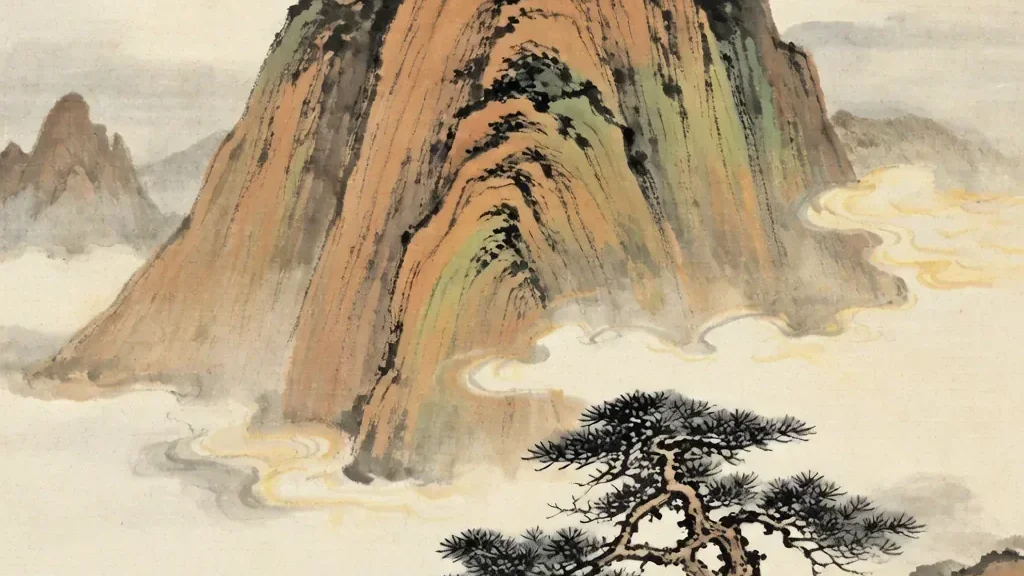
Hengshan, honored as the Southern Mountain of the Five Sacred Mountains, is a forested granite ridge in Hunan Province in south-central China, rising near the city of Hengyang. Known by the affectionate title Nanyue, the Southern Peak, it is the gentlest and greenest of the five sacred mountains, celebrated in Chinese tradition as the one that stands alone in its elegance, the phrase 南岳独秀, the Southern Mountain’s solitary beauty. Its highest point, Zhurong Peak, reaches only about thirteen hundred metres, modest beside the lofty summits of the north, yet the mountain has for nearly two thousand years been one of the great pilgrimage centres of Chinese religion, shared by both Daoists and Buddhists. With its evergreen forests, misty ravines, and the vast Nanyue Temple at its foot, Hengshan embodies a softer, more luxuriant face of sacred geography than its sterner sibling peaks.
One of the Five Sacred Mountains
The Five Sacred Mountains, the Wuyue, are a set of peaks in the cardinal directions that the Chinese imperial system adopted as earthly correlates of heaven’s order, each associated with a season, a color, and one of the five phases. Hengshan is the southern member, paired with the element fire, the color red, and the season of summer. The other four are Tai in the east, Hua in the west, Heng in the north, and Song in the centre, and together they framed the ritual landscape of the realm.
Emperors and local officials offered sacrifices at the sacred mountains to secure harmony between heaven and earth, and Hengshan’s southern position tied it to rites concerned with warmth, growth, and the fire that sustains life. Although it is the lowest of the five in absolute height, its religious stature was never in doubt, and imperial envoys traveled to Hunan specifically to perform the ceremonies proper to the southern peak.
The mountain’s inclusion among the Wuyue also fixed it in the literary and painterly imagination as a type of the southern sublime, less about terrifying height than about verdant abundance. This distinction explains why Hengshan is remembered not for conquest of the summit but for the pleasure of wandering among trees, springs, and temples.
Zhurong Peak and the Seventy-Two Peaks
Hengshan is not a single peak but a range of ridges running roughly northeast to southwest, traditionally enumerated as seventy-two named peaks. The highest and most sacred is Zhurong Peak, at about thirteen hundred metres, named for Zhurong, the mythical lord of fire and the southern direction, who is said to have dwelt or been honored there. On a clear day the summit offers views over the Xiang River basin and the hills of Hunan.
The seventy-two peaks are a mnemonic as much as a survey, a way of organizing the mountain into a legible set of named places, each with its own spring, cliff, or temple. Pilgrims and poets moved from one to another, composing verses at each, so that the list of peaks functions like a table of contents to a long devotional book written on the landscape itself.
Because the range is long and low, the walking is less arduous than on the northern sacred mountains, and the experience is one of continuous woodland rather than a single vertical ascent. The highest peak is the goal, but the journey through the lesser peaks is the substance of a Hengshan visit, a gradual immersion in forest and water.
The Nanyue Temple at the Foot
At the southern foot of the mountain stands the Nanyue Temple, one of the largest and best-preserved temple complexes in southern China. Its layout follows the model of an imperial palace, with a series of courtyards, halls, and gates aligned on a central axis, flanked by side wings for the many deities enshrined there. The buildings are red-walled and tiled in the manner of court architecture, a visual claim that the southern peak held a status comparable to the capital’s own altars.
The temple serves both Daoist and Buddhist worship and has done so for centuries, a rare instance of the two traditions sharing one great institution without rigid separation. Pilgrims enter through the outer gates, pass the Hall of Heavenly Kings, and proceed to the main hall where the southern sacred mountain is honored, often leaving incense and petitions for health and fortune.
Architecturally the complex has been rebuilt many times after fire and war, yet it preserves the scale and ceremony of the imperial-era mountain cult. For most visitors the temple is the starting point of the ascent, a place to pay respect before climbing, and its size signals that Hengshan is as much a religious institution as a physical mountain.
Daoism, Buddhism, and Shared Shrines
Hengshan is unusual among the sacred mountains for the depth of its dual religious life. Daoist hermits and adepts settled the ravines early, drawn by the mountain’s qi, its auspicious southern orientation, and the association with fire and transformation. Buddhist monastics arrived later and built monasteries on the same slopes, so that a single day’s walk can pass a Daoist observatory, a Buddhist hall, and a shared shrine without any sense of contradiction.
The coexistence was practical as well as theological. The mountain’s many peaks offered room for separate communities, and the shared goal of ritual efficacy encouraged tolerance. Local belief blended the two, so that a villager might burn incense to a Buddhist bodhisattva in the morning and consult a Daoist fortune at the temple in the evening, all within the same sacred geography.
This mixed heritage made Hengshan a living museum of Chinese popular religion, where imperial state ritual, monastic discipline, and village custom overlapped. The result is a mountain whose spiritual identity is plural rather than sectarian, a quality visitors still sense in the overlapping incense smoke and chanting that rise from different courtyards at once.
Forests, Mist, and the Southern Climate
What sets Hengshan apart visually is its vegetation. Situated in the humid subtropics of Hunan, the mountain carries dense evergreen forest, with stands of pine, cypress, and broadleaf trees clothing the ridges in green year round. The phrase that praises its solitary beauty refers precisely to this luxuriance, the way the mountain stays lush while its northern counterparts are barer and more severe.
The climate sustains the forest through abundant summer rain and mild winters, and the humidity produces frequent mist that settles in the ravines and softens the light. The combination of water, green, and cloud gives Hengshan its reputation as a place of refreshment, a mountain to be enjoyed rather than endured, suited to scholars and pilgrims alike.
The forest is also a managed landscape. Centuries of pilgrimage and timber use thinned the original cover, but temple lands and later conservation efforts protected the slopes, so that today the mountain presents a continuous canopy broken only by paths, cliffs, and the occasional vista. The greenness is thus partly natural and partly the product of long stewardship by the religious communities who owned the mountain.
Pilgrimage, Emperors, and the Fire God
The cult of the southern peak centered on Zhurong, the fire god, and on the general blessing of the southern direction. Emperors dispatched officials to Hengshan to offer sacrifices for rain, harvest, and the stability of the realm, and the mountain answered a ritual need distinct from the martial north. The recorded visits of imperial envoys form a thread of state attention running from the Han through the Qing.
Pilgrims came not only from Hunan but from across the south, walking the steps to Zhurong Peak to burn incense at the summit temple, especially during the busy festival seasons of spring and autumn. The ascent was and is an act of merit, and the tea houses and lodges along the route exist to serve this steady devotional traffic rather than casual tourists.
The fire god connection also linked Hengshan to themes of light, warmth, and renewal, making it a favored destination for prayers concerning family continuity and the turning of the year. The southern peak thus carried a domestic, life-affirming charge that complemented the awe-inspiring severity attributed to the other sacred mountains.
Literature and the Southern Sublime
Poets of the Tang and later dynasties wrote of Hengshan in a vein different from their northern verse. Where Tai Mountain inspired vertigo and humility before imperial height, Hengshan inspired poems of leisure, of mist in the pines, of a friend met at a mountain inn, of the quiet of a Buddhist hall. The southern mountain became a topos for retirement and friendship rather than for confrontation with the sublime.
The scholar-official culture of the Yangtze south adopted Hengshan as a nearby refuge, a place to compose, drink, and debate away from court. Its relative accessibility compared with the remote northern peaks made it a practical destination for the literary classes of Hunan and adjacent provinces, and the resulting body of verse is large and intimate.
In painting, too, Hengshan appears as soft blue-green hills rather than stark black monoliths, fitting the southern school’s preference for atmospheric distance over dramatic mass. The mountain’s cultural image is therefore coherent: a green, misty, sociable sacred place, the friendly face of Chinese mountain religion.
Modern Hengshan as a Scenic and Religious Site
Today Hengshan is both a protected scenic area and an active religious centre. The cable car and paved paths make the summit reachable by most visitors, while the Nanyue Temple remains a working place of worship that draws crowds during traditional festivals and holidays. The mountain’s management balances access with the preservation of its forests and temples.
The religious life has revived strongly in recent decades. Monks and nuns have returned to restored monasteries, pilgrims again climb for the summer and autumn festivals, and the incense trade at the temple foot is brisk. The state recognizes the mountain’s cultural value and invests in infrastructure that, while commercial, also funds conservation.
For the casual visitor the appeal is the easy beauty: a day among evergreen ridges, a stop at a cliff shrine, and a sunset from Zhurong Peak over a sea of Hunan hills. For the believer the mountain is still what it has been for two millennia, a southern gateway between the human and the sacred, ruled over by the lord of fire.
Visiting Hengshan
The mountain is readily reached from Hengyang, a city with rail and road links in Hunan, and from larger hubs such as Changsha. Most visitors begin at the Nanyue Temple, then ascend by steps or cable car to Zhurong Peak, with optional stops at the many named ridges and monasteries along the way.
The best seasons are spring and autumn, when the weather is mild and the mist most evocative; summer is green and humid but good for forest bathing, while winter is cold and quiet with occasional snow on the higher ridges. Festivals tied to the lunar calendar bring the densest crowds and the richest ritual atmosphere.
Practical advice is simple: wear good shoes for the stepped paths, carry water, and allow time for the temple at the foot, which rewards a slow walk through its courtyards. Hengshan repays a relaxed pace more than a hurried summit dash, true to its character as the gentle, beautiful southern peak.
❓ Frequently Asked Questions
Where is Hengshan located?
It is in Hengshan County near Hengyang in Hunan Province, south-central China, and is the southern of the Five Sacred Mountains.
How high is the mountain?
Its highest point, Zhurong Peak, reaches about thirteen hundred metres, making it the lowest of the five sacred mountains by elevation.
Why is Hengshan associated with fire?
As the southern sacred mountain it pairs with the element fire, the color red, and summer, and its peak is named for Zhurong the fire god.
Is Hengshan only Daoist or also Buddhist?
Both traditions worship there, and the great Nanyue Temple and the mountain monasteries have long served Daoist and Buddhist pilgrims together.
What is special about the Nanyue Temple?
It is a vast palace-style complex at the foot of the mountain, one of the largest and best-preserved temple compounds in southern China.
When should I visit Hengshan?
Spring and autumn offer mild weather and evocative mist; festivals on the lunar calendar bring the richest religious atmosphere and largest crowds.