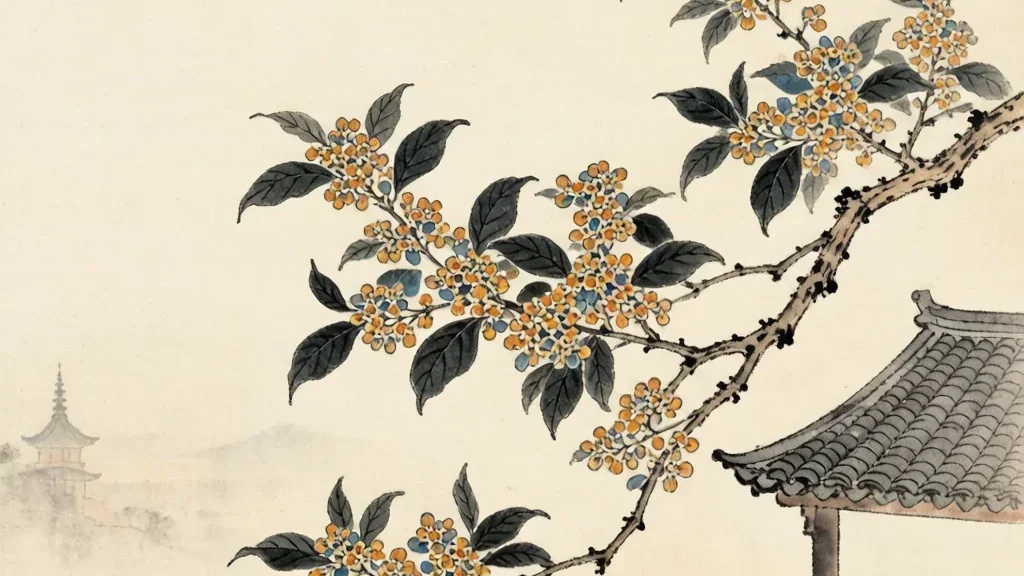
Osmanthus (桂花, guì huā, "osmanthus flower") is a small-flowered shrub whose tiny golden or ivory blossoms perfume the autumn air across southern and central China. Revered for its intense, apricot-like fragrance, osmanthus is used to scent tea, wine, and sweets, and it is a beloved emblem of the Mid-Autumn season. Though its flowers are almost weightless, their scent is so potent that a single tree can scent an entire lane, making osmanthus one of the most cherished fragrant plants in Chinese horticulture.
Botanical Identity
Osmanthus fragrans is an evergreen shrub or small tree in the olive family, the same family as jasmine and the olive. Its flowers are tiny, usually four-petaled, and clustered in the leaf axils.
Colors range from pale ivory (silver osmanthus) to golden-orange (golden osmanthus), with the latter generally the most fragrant. The leaves are leathery and toothed.
The plant is slow-growing but long-lived, and a mature specimen can flower heavily, releasing scent over many weeks in autumn.
The Scent of Autumn
Osmanthus blooms as summer turns to autumn, and its fragrance is so associated with the season that it signals the approach of the Mid-Autumn Festival and the moon-viewing tradition.
Unlike showy flowers, osmanthus is valued almost entirely for scent rather than appearance; many people smell it before they ever see it.
The aroma is often described as fruity and warm, reminiscent of apricot or peach, which explains its pairing with sweet and fermented foods.
Osmanthus in the Garden
In classical and modern Chinese gardens alike, osmanthus is planted along paths, near windows, and by moon-gazing pavilions so the evening scent can be enjoyed at leisure.
It pairs well with other fragrant and symbolic plants, and its compact form makes it suitable for courtyards and city courtyards where space is limited.
Because it stays green year-round, the shrub offers structure and shade as well as its seasonal perfume, a practical as well as poetic choice.
Osmanthus Tea and Wine
The most famous use is 桂花茶 (guì huā chá), tea scented or simply blended with dried osmanthus flowers, imparting a delicate floral-apricot note to green or oolong bases.
Osmanthus is also used to flavor 桂花酒 (guì huā jiǔ), an aromatic rice wine traditionally enjoyed at the Mid-Autumn Festival as a toast to the full moon.
These products turn a fleeting bloom into a keepsake of autumn, enjoyed long after the flowers have fallen.
Culinary Uses
Osmanthus appears in sweet soups, lotus-root desserts, and the famous 桂花糖藕 (osmanthus-scented sweet lotus root), where its perfume lifts the dish.
It is candied and made into 桂花酱 (guì huā jiàng), a fragrant sauce spooned over pastries, glutinous rice balls, and puddings.
A sprinkle of dried flowers finishes many festival sweets, linking the plant directly to celebratory eating.
Symbolism and Culture
Osmanthus connotes nobility, fragrance, and the refined pleasures of autumn. In old examinations lore, passing the imperial exam was likened to "plucking osmanthus in the moon palace."
The Moon Palace myth, where a osmanthus tree grows, ties the flower to the Mid-Autumn moon and to wishes for success and reunion.
Its modest size but overwhelming scent made it a gentle emblem of quiet distinction—virtue that announces itself through goodness rather than show.
Harvesting and Use
Flowers are gathered at peak fragrance, often by shaking them onto cloths, and used fresh or dried. They are delicate and lose scent if overheated.
Major osmanthus areas include Jiangsu, Zhejiang, and Guangxi, where the bloom supports a seasonal trade in flowers, tea, and wine.
Because the harvest window is short, fresh osmanthus treats are genuinely seasonal pleasures.
Modern Appreciation
Today osmanthus remains a favorite garden and street tree, and its products—tea, wine, syrup, and pastries—are widely available, especially in autumn.
The scent has also inspired perfumes and cosmetics, carrying the autumn mood into everyday items beyond the kitchen.
From a moonlit courtyard to a cup of scented tea, osmanthus continues to mark the Chinese autumn with unmistakable sweetness.
Few scents announce a season as clearly as osmanthus announces autumn in China, and few plants are so completely woven into both the kitchen and the imagination. Its brief, powerful bloom is a yearly lesson in savoring the moment.
Osmanthus Among Fragrant Plants
Osmanthus is part of a Chinese constellation of fragrant plants—jasmine, orchid, plum blossom—each with its season and symbolic niche.
Where jasmine rules summer nights and plum the deep winter, osmanthus owns the golden middle of autumn, the season of harvest and the full moon.
Knowing osmanthus helps place it in the annual calendar of scent that structures Chinese garden and table life.
Where jasmine speaks of summer nights and plum of deep winter, osmanthus claims the golden middle of autumn, the season of harvest and the full moon. Knowing the three together maps a whole year of Chinese scent, each flower marking its own turn of the calendar and teaching the nose to follow the seasons.
Osmanthus and the Moon
The Mid-Autumn moon-viewing gathering is unthinkable in much of southern China without the scent of osmanthus in the air or a cup of osmanthus wine raised to the full moon.
Poets likened the flower's fall to a gentle rain of fragrance, and lantern-lit evenings in osmanthus lanes remain a cherished urban scene during the autumn festival season.
Because the bloom is brief, communities time festivals and harvests to it, so the plant again acts as a living calendar marking the year's golden middle.
Its scent, captured in tea and wine, lets the season be remembered and shared long after the flowers themselves have dropped from the branches.
Growing Osmanthus at Home
A young osmanthus shrub rewards patience, slowly forming a rounded canopy that, once mature, can fill a courtyard with scent for weeks each autumn.
Growers value a sheltered, sunny spot with good drainage, and they prune lightly after flowering to keep the plant compact and the blooms within reach.
Container-grown osmanthus brings the autumn fragrance to balconies and rooftops, making the tree accessible even in dense city neighborhoods.
For many families, a single potted osmanthus is enough to mark the season and to supply blossoms for a few jars of homemade scented tea.
❓ Frequently Asked Questions
What does osmanthus smell like?
Its scent is fruity, warm, and apricot-like, intensely fragrant despite the flowers' tiny size.
How is osmanthus used in food?
In scented tea, aromatic wine, sweet syrups, lotus-root desserts, and festival pastries.
Why is osmanthus linked to the Mid-Autumn Festival?
It blooms in early autumn and is tied to moon-viewing and the mythic osmanthus tree in the moon palace.
What does osmanthus symbolize?
It stands for refinement, quiet distinction, and success, with a moon-palace association with achievement.
Is osmanthus hard to grow?
It is a slow-growing but hardy evergreen shrub suited to courtyards and gardens in warm regions.
When is osmanthus harvested?
At peak autumn fragrance, usually by shaking the flowers onto cloths; the window is short and seasonal.