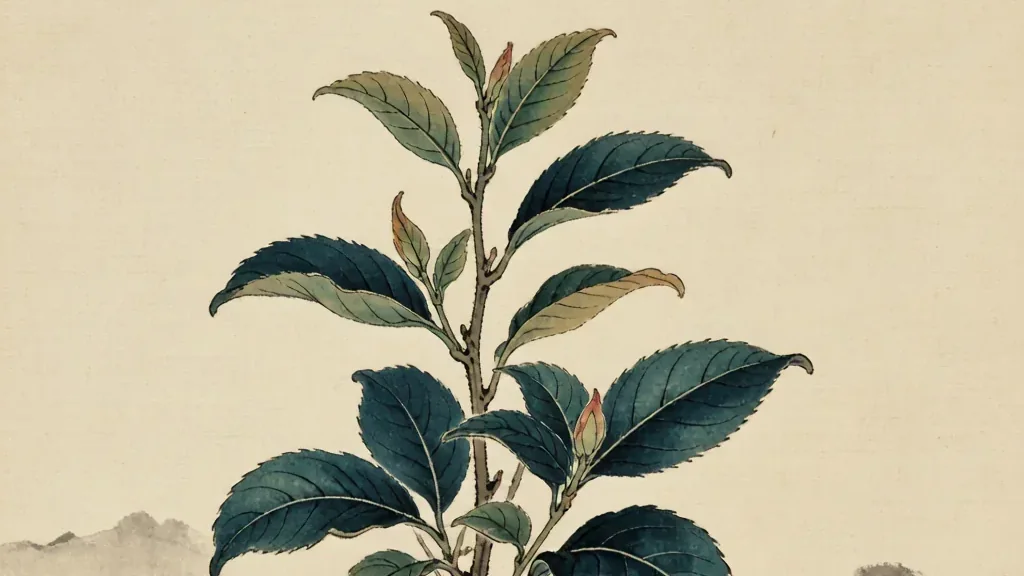
It is the plant that built empires, funded monasteries, and shaped the daily rhythm of a billion people. The tea plant — 茶树 () — is a camellia by botanical birth (Camellia sinensis) whose young leaves, when processed, become the world's most drunk beverage after water. In China, tea is far more than a drink: it is medicine, ritual, hospitality, and a path to clarity. To know the tea plant is to know how a single evergreen shrub became the quiet backbone of Chinese civilization.
A Camellia That Makes a Drink
Botanically, the tea plant is Camellia sinensis, a close relative of the ornamental camellia. Left unpruned it grows into a tree, but on farms it is kept as a low bush for easy plucking. The plant is evergreen, glossy-leaved, and native to the forested hills of southwest China — Yunnan, Sichuan, and Assam-border regions — where wild tea trees dozens of meters tall still stand.
Only the tender new shoots and buds are harvested, usually two leaves and a bud. What happens next decides the tea type: green tea is heated to stop oxidation, oolong is partially oxidized, black tea (red tea, 红茶) is fully oxidized, and white tea is barely processed at all. The same leaf, the same plant, yields a whole spectrum — a botanical generosity that explains tea's endless variety.
The Birthplace of Tea
China is unambiguously the homeland of tea. Genetic and historical evidence points to Yunnan as the center of origin, where ancient tea trees still grow. Legend attributes tea's discovery to the mythic Emperor Shennong, who is said to have found that boiling drinking water with a few leaves made it both safe and pleasant — the origin of the phrase that tea "tastes bitter first, then sweet."
By the Tang dynasty, tea drinking was a national habit, and the monk Lu Yu wrote the first definitive book on it, The Classic of Tea (茶经, ). Lu Yu turned a folk drink into an art and a philosophy, describing soils, waters, and the temperament of the brewer. From that moment tea was no longer merely refreshing; it was a disciplined path to composure, a liquid form of self-cultivation.
Tea as Medicine and Daily Ritual
Traditional Chinese medicine values tea for clearing heat, aiding digestion, and refreshing the mind. A post-meal cup cuts grease; a morning cup dispels sleep. The plant's caffeine and antioxidants are real, but the cultural frame is balance — tea is taken to harmonize the body with the season and the meal, never to excess.
Equally important is tea as social glue. Offering a guest a cup is the baseline of Chinese hospitality; refusing it is nearly unthinkable. The Gongfu tea ceremony of Fujian and Chaozhou turns serving into choreography — warming the pot, rinsing the leaves, pouring in arcs — a small performance of respect. In this ritual the tea plant becomes a vehicle for courtesy, patience, and attention to others.
Famous Teas and Terroirs
China's tea geography is as varied as its landscape. Longjing (龙井, Dragon Well) green tea comes from West Lake in Hangzhou; Tieguanyin oolong from Anxi; Keemun black tea from Anhui; Pu'er from Yunnan's ancient trees; and white silver-needle from Fujian. Each terroir — soil, mist, and cultivar — gives a signature taste, so that "where it grew" matters as much as "how it was made."
This regional pride turned tea into a kind of wine culture long before the West discovered terroir. Connoisseurs speak of "returning sweetness" (回甘, ) and "tea qi" (茶气), the warmth a strong brew sends through the body. To drink Chinese tea seriously is to read a map of the country's mountains in a cup — the plant as geography made liquid.
Tea, Buddhism, and the Scholar
Tea and Chinese Buddhism grew up together. Monks used it to stay awake during long meditation, and temple gardens became early tea estates. The Chan (Zen) saying "tea and Zen have the same taste" (茶禅一味, ) captured the idea that a mindful cup and a mindful sitting are one practice. Scholars, too, adopted tea as the companion of calligraphy and poetry, the drink of clear thought.
In the hands of the literati, the tea plant left the field and entered the studio. A friend's visit ended with tea, not wine; a poem was polished over a warming pot. The plant thus bridged the monastery and the study, the farmer and the philosopher — a rare plant that served both the body's wakefulness and the mind's calm at once.
Tea in the Modern World
Today China is again the world's largest tea producer, and the ancient plant fuels a global industry while old customs survive. Spring "tea-tasting" festivals draw crowds; young people rediscover the Gongfu ritual; and health research keeps confirming tea's benefits. Yet the essential experience is unchanged: hot water, fresh leaves, a quiet moment.
To plant a tea bush is to plant a century of possibility, since a single bush can be plucked for generations. The tea plant's gift to China was not just a beverage but a tempo — a reason to slow, to host, to notice. In a culture that prizes harmony, few plants have given more quietly, or more lastingly, than the camellia called 茶树.
The Ancient Tea-Horse Road
For centuries, tea traveled west from Yunnan and Sichuan along the Tea-Horse Road, a network of mountain trails where Chinese brick tea was bartered for Tibetan horses and the warhorses of frontier armies. Packed into compressed cakes for easy transport, tea withstood the long, high passes of the Himalayas and became a currency as dependable as silver. The trade knit Han, Tibetan, and minority communities together, and tea houses from Ya'an to Lhasa grew wealthy on the traffic. More than commerce, the road carried technique and taste: the fired green teas of the interior met the fermented pu'er prized on the plateau, and brewing customs diffused both ways. Today the old trails are heritage routes, but their logic endures, a reminder that the humble camellia leaf once moved empires as surely as silk or spice.
Water, Heat, and the Perfect Cup
Chinese tea masters have long insisted that water is half the tea. The classic treatises rank mountain spring water above river water and well water, warning that hard or chlorinated water flattens fragrance. Temperature is equally decisive: tender green and white teas are brewed near 80 degrees Celsius so their amino acids surface as sweetness rather than bitterness, while oolong, black, and aged pu'er want water just off the boil to open their tightly rolled leaves. The vessel matters too, a small Yixing clay pot or a gaiwan lets the drinker control steeping time by seconds, coaxing several infusions from one portion of leaves. This precision is not fussiness but respect for the plant: each terroir and cultivar asks for its own heat and moment, and the careful brewer is really a translator between leaf and cup.
❓ Frequently Asked Questions
📝 Chinese Vocabulary
茶树 — : tea plant.
茶经 — : The Classic of Tea by Lu Yu.
红茶 — : black tea ("red tea" in Chinese).
回甘 — : "returning sweetness," the aftertaste of fine tea.
茶禅一味 — : "tea and Zen have the same taste."
龙井 — : Longjing, a famous pan-fired green tea grown at West Lake near Hangzhou.
普洱 — : Pu'er, a fermented dark tea traditionally pressed into cakes and aged in Yunnan.
功夫茶 — : Gongfu tea, a meticulous brewing ceremony using small pots, short steeps, and many infusions.
🎉 Fun Facts
- Wild tea trees in Yunnan can grow dozens of meters tall and are centuries old.
- The same tea leaf yields green, white, oolong, and black tea depending only on how it is processed.
- Lu Yu's Classic of Tea in the Tang dynasty was the world's first thorough book on tea.
- A single tea bush can be plucked for generations, outliving the person who planted it.
- On the ancient Tea-Horse Road, compressed tea bricks were so trusted they served as currency, traded weight for weight for Tibetan horses.
- The tea plant's leaves carry both caffeine and L-theanine, the pairing that gives tea its unusual calm-but-alert feeling rather than a sharp jolt.