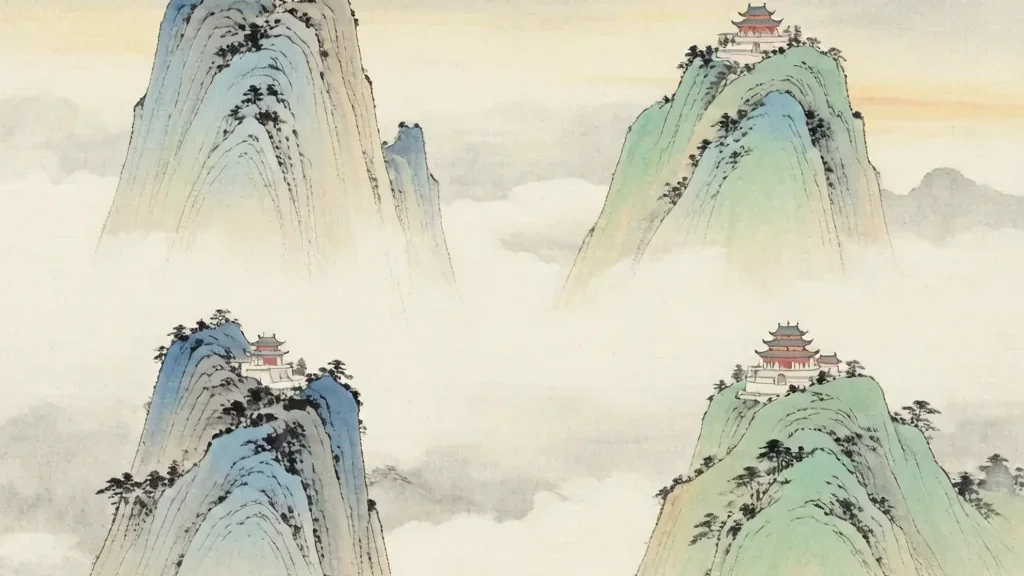
Long before mass tourism, Chinese pilgrims laced up straw sandals and set out on foot toward four specific peaks scattered across the map — a cold northern terrace in Shanxi, a green summit in Sichuan, a craggy crag in Anhui, and a sea island off the Zhejiang coast. Each mountain was believed to be the earthly dwelling of one of the great bodhisattvas (菩萨, púsà), enlightened beings who postpone their own final liberation to help others. Together they form the system of the Four Great Sacred Mountains (四大名山, sì dà míng shān), the geographic heart of Chinese Buddhist devotion.
Wutai (Manjushri)
Mount Wutai (五台山, Wǔtái Shān, "Five-Terrace Mountain") in northeastern Shanxi is the oldest and, by tradition, the most august of the four. Its five flat-topped ridges cradle a high, chill plateau where, even in summer, monks wear padded robes — hence its old name "Clear and Cool Mountain" (清凉山, Qīngliáng Shān). This is the scriptural seat of Manjushri (文殊菩萨, Wénshū Púsà), the bodhisattva of wisdom, often shown wielding a flaming sword that cuts through ignorance and a scripture resting on a lotus.
Crucially, Wutai is the only one of the four named directly in Indian sutras: the Avatamsaka Sutra (华严经, Huáyán Jīng) places Manjushri's pure land in a northeastern mountain of that name, and Chinese pilgrims from the Tang dynasty onward were convinced it was Wutai. Emperors endorsed it repeatedly — Tang Taizong, and later the Qing rulers Kangxi (康熙) and Qianlong (乾隆), each made multiple visits and lavished patronage on its monasteries. At its medieval peak Wutai held more than 300 temples and attracted monks from Tibet, Mongolia, and even India and Sri Lanka, making it one of the great international Buddhist centers of the premodern world.
The mountain's most revered image is the golden Manjushri in the Tayuan Temple (塔院寺), and its skyline is dominated by the white stupa (大白塔, dà bái tǎ) said to mark the spot where the bodhisattva frequently appears in the glow of the "Buddha's light" (佛光, fóguāng) that pilgrims report at dusk.
Emei (Samantabhadra)
Mount Emei (峨眉山, Éméi Shān) rises in Sichuan, its slopes climbing through subtropical forest to a wind-scoured summit where the sea of clouds earns it the name "the loftiest of the elegant mountains." It is the domain of Samantabhadra (普贤菩萨, Pǔxián Púsà), the bodhisattva of practice, vow, and meditation, usually depicted seated on a white six-tusked elephant symbolizing the steadiness and power of right conduct.
Emei's religious life dates to at least the Eastern Han, and it became firmly associated with Samantabhadra by the Tang. Its crowning monument is the Golden Summit (金顶, Jīndǐng), where a towering gilded statue of the bodhisattva on his elephant stands above cliffs that, on lucky mornings, blaze with the "sea of clouds" and the circular halo called the Buddhist glory (佛光). The mountain is also an ecological treasure: the monasteries share the slopes with wild Tibetan macaques (藏酋猴, zàng qiú hóu) that troop down the stone steps to beg from visitors, a reminder that Emei has been a protected landscape for over a millennium.
Emei's fame spread far beyond China. The Japanese monk Ennin and later Korean and Vietnamese pilgrims recorded its splendors, and its inclusion on the UNESCO World Heritage list in 1996 recognized both its natural and cultural weight — the mountain holds scores of intact temples from the Tang through the Qing.
Jiuhua (Ksitigarbha)
Mount Jiuhua (九华山, Jiǔhuá Shān, "Nine-Flower Mountain") in Anhui is the smallest and, historically, the last of the four to win its sacred status. It belongs to Ksitigarbha (地藏菩萨, Dìzàng Púsà), the bodhisattva who vows to rescue beings from the hell realms and who refuses buddhahood until the last suffering being is saved — a vow captured in the phrase "Until the hells are empty, I will not become a Buddha" (地狱不空,誓不成佛).
Jiuhua's sanctity rests on a tangible relic. In the 8th century a Silla (Korean) prince-turned-monk named Wuyue (金乔觉, Kim Gyo-gak, 696–794) arrived, lived as a naked ascetic in a mountain cave, and died at ninety-nine. His body reportedly neither decayed nor smelled, and his bones rang like metal when struck — signs, his followers declared, that he was the incarnation of Ksitigarbha. His mummified, gilded body was enshrined and is still venerated today, making Jiuhua a magnet for funeral rites and prayers for the dead and for ancestors in the underworld.
The mountain's wooded crags hold the Hall of the Corporeal Body (肉身宝殿, ròushēn bǎodiàn) built over Wuyue's tomb, and its many nunneries (Jiuhua has long been unusual for its large number of ordained women) give the peak a distinctive devotional atmosphere centered on filial care for the departed.
Putuo (Guanyin)
Mount Putuo (普陀山, Pǔtuó Shān) is unique among the four in being an island — one of the Zhoushan archipelago off the coast of Zhejiang, reachable only by ferry. It is the home of Guanyin (观音菩萨, Guānyīn Púsà), the bodhisattva of compassion, whose name is a contraction of "perceiving the sounds of the world's suffering" (观世音). Putuo's identification comes from the legend of the monk Huizeng, who in 916 CE was shipwrecked there and saw Guanyin appear on a rock (the "Chaoyin Cave," 潮音洞), after which a Japanese monk attempted to carry a Guanyin image home but was prevented by storms and left it on the island.
Putuo grew into a vast maritime pilgrimage center, its temples clinging to headlands above the East China Sea. The great image of the "South Sea Guanyin" (南海观音, Nánhǎi Guānyīn) — a towering gilded statue facing the ocean — has become its signature. Because Guanyin is also the patron of sailors and fishermen, Putuo's devotion has always been tied to the sea: storms calmed, safe returns, and children granted to the childless.
Unlike the other three, Putuo's mountain is low and green, more a garden-island than a peak, yet its spiritual gravity is undiminished. On Guanyin's three great days — her birthday (19th of the 2nd lunar month), enlightenment day (19th of the 6th), and nirvana day (19th of the 9th) — the island can host hundreds of thousands of pilgrims who circumambulate the island's sacred rocks overnight.
Pilgrimage Today
To this day the practice of "paying respects to the mountain" (朝山, cháoshān) unites the four. The most demanding expression is the "three steps and one bow" (三步一拜, sānbù yībài): the pilgrim takes three steps, then drops to the knees and prostrates full-length, repeating the circuit of the sacred path — a feat of devotion that can take days to reach a summit. Less austere pilgrims circle the peaks with rosary beads (念珠, niànzhū) and chant the bodhisattva's name.
Modern China has made the mountains accessible by cable car and paved road, and all four now balance the roles of living monastery and national scenic area — Wutai, Emei, and the nearby Lijiang-linked landscapes are UNESCO sites, while Putuo is a protected island reserve. The result is a sometimes uneasy mix of incense smoke and tour buses, yet the core experience persists: a quiet dawn bell, a bow before a gilded image, and the sense of standing where, for over a thousand years, the compassionate ones are said to walk.