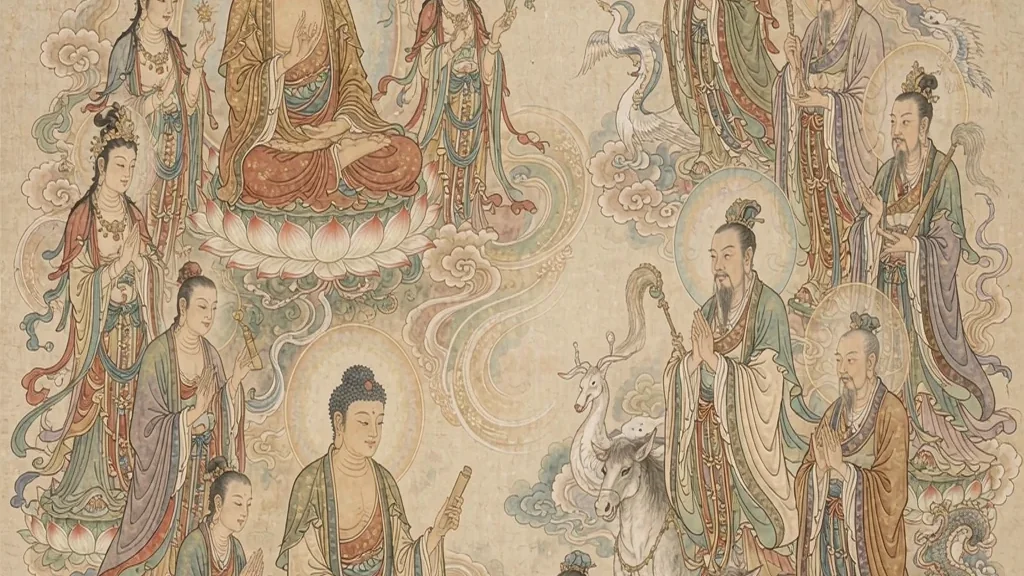
Chinese civilization has a unique distinction in world religious history: for over a millennium, three radically different systems of thought — Buddhism, Daoism, and Confucianism — have coexisted, competed, and ultimately interpenetrated within a single cultural sphere. The relationship among the "Three Teachings" (三教, sān jiào) is not one of simple harmony but of dynamic tension: periods of fierce conflict and persecution alternating with periods of creative synthesis and mutual enrichment. Understanding this triangular relationship is essential to understanding Chinese Buddhism, for the tradition was shaped as much by its rivals as by its own internal dynamics.
The Confucian Critique: Buddhism as a Foreign Threat
From its first appearance in China, Buddhism faced fierce Confucian opposition. The Confucian critique was comprehensive: Buddhism was unfilial (monks left their families and did not produce descendants), unproductive (monks did not farm or pay taxes), and unpatriotic (Buddhists revered the Buddha above the emperor). Han Yu (韩愈, 768–824 CE), the great Tang dynasty Confucian writer, penned a famous memorial against Buddhism that became the classic statement of the Confucian case.
Han Yu's argument was twofold. First, he charged that Buddhism was a foreign religion — a "barbarian teaching" — that had no place in Chinese civilization. China, he argued, had produced its own sages (the Confucian classics) and had no need of foreign gods. Second, he warned that Buddhism undermined the social order by promoting values — renunciation, monasticism, otherworldliness — that contradicted the Confucian virtues of family loyalty, productive labor, and civic duty.
The most dramatic expression of Confucian opposition was the Great Buddhist Persecution of 845 CE. Emperor Wuzong, influenced by Daoist advisors and Confucian officials, ordered the destruction of over 4,600 monasteries and 40,000 temples, the confiscation of monastic lands, and the laicization of over 260,000 monks and nuns. Buddhism in China never fully recovered its pre-845 institutional dominance. The persecution remains a traumatic memory in Chinese Buddhist history, a reminder of the vulnerability of a foreign-born tradition in a Confucian state.
The Daoist Challenge: Rivalry and Borrowing
The Daoist critique of Buddhism took a different form. Organized Daoism — which emerged as a formal religion around the 2nd century CE — viewed Buddhism as a competitor for imperial patronage and popular devotion. Daoist polemicists accused Buddhists of stealing from Daoist texts, inventing stories about the Buddha, and promoting a pessimistic, world-denying philosophy that contradicted Daoism's affirmation of life and nature.
The Huahu Jing (化胡经, Scripture of the Conversion of the Barbarians) was the most famous Daoist polemic. It claimed that after leaving China, Laozi — the founder of Daoism — traveled to India and became the Buddha, implying that Buddhism was merely a degraded version of Daoism adapted for foreigners. This narrative, which reversed the direction of influence, was used for centuries in Daoist arguments for supremacy over Buddhism.
Despite the rivalry, the relationship between Buddhism and Daoism was also deeply creative. Chinese Buddhists borrowed Daoist terminology to translate Buddhist concepts: Dao (道) was used for Dharma, wuwei (无为, non-action) for nirvana, shengren (圣人, sage) for arhat. Daoist meditation practices influenced Chan Buddhist meditation, and Daoist alchemical ideas were absorbed into Esoteric Buddhist ritual. The boundary between the two traditions was always porous, and many Chinese practitioners moved freely between Buddhist and Daoist practices.
The Imperial Balance: Patronage and Persecution
Chinese emperors played a crucial role in managing the relationship among the three teachings. Different dynasties — and different emperors within the same dynasty — favored different traditions. The Northern Wei and Liang dynasties heavily favored Buddhism. The Tang dynasty officially promoted Daoism (claiming Laozi, whose surname was Li, as an imperial ancestor) while patronizing Buddhism and supporting Confucian education. The Song dynasty elevated Neo-Confucianism as the state orthodoxy while continuing to support Buddhist and Daoist institutions.
The emperor's position was not merely a matter of personal piety. Each tradition offered different benefits to the state: Confucianism provided the civil service examination system and the ideology of bureaucratic governance; Buddhism offered merit-generating rituals for the imperial family and a universalizing ideology that transcended ethnic boundaries; Daoism contributed alchemical practices for longevity, divination for state decisions, and a connection to native Chinese traditions.
The imperial balancing act was never stable. Periods of Buddhist dominance triggered Confucian backlash, and Daoist influence at court could lead to Buddhist persecution. The Three Teachings were not equal partners; their relationships were shaped by power, politics, and the shifting interests of the ruling house. Nonetheless, the pattern of competition and coexistence created a religious ecology that was unique in the pre-modern world.
Syncretism: The Unity of the Three Teachings
Despite the conflicts, a powerful syncretic movement argued that the three teachings were ultimately one. The slogan "The three teachings are one" (三教合一, sān jiào hé yī) became widely popular from the Song dynasty onward. Syncretic thinkers argued that Confucianism, Daoism, and Buddhism were simply different paths to the same goal — the perfection of the human being and the harmony of the cosmos — and that each tradition offered insights the others lacked.
This syncretism was particularly developed in the Chan tradition. Chan masters studied Daoist texts and conversed with Confucian scholars. The Chan concept of the "everyday mind" — the awakened mind expressing itself in ordinary activities — resonated deeply with both Daoist naturalism and Confucian humanism. Chan monasteries were spaces where the three traditions could meet and merge, producing a Chinese spirituality that drew freely from all three sources.
In popular practice, the syncretism was even more pronounced. Ordinary Chinese people did not typically identify exclusively with one tradition. They might consult a Buddhist monk for funeral rites, a Daoist priest for illness and exorcism, and Confucian teachings for family ethics — all without feeling any contradiction. The gods of the three traditions were worshipped in the same temples, and the ethical principles of all three were invoked in daily life.
The Legacy: Three Teachings in Modern China
The relationship among the Three Teachings continues to evolve in contemporary China. The Chinese government recognizes all three as legitimate religions but regulates them closely. Buddhism, with its large monastic population and international connections, is the most visible. Daoism, though less organized, remains a vital folk tradition. Confucianism, which some scholars argue is not a religion at all, has experienced a revival as a cultural and ethical system.
The ecological implications of the three teachings have attracted attention. All three traditions emphasize harmony with nature — the Buddhist respect for all sentient life, the Daoist principle of following the natural way, the Confucian vision of cosmic balance. Environmental thinkers in China have drawn on these traditions to develop a Chinese ecological philosophy that offers an alternative to Western models.
In the global context, the Chinese model of religious coexistence has become a subject of comparative study. The Three Teachings did not simply tolerate each other; they actively borrowed from each other, debated with each other, and transformed each other. The result was a civilization in which multiple religious identities could coexist, sometimes uneasily but always creatively, within a single cultural framework. This legacy remains one of China's most significant contributions to the world's religious heritage.
Buddhism's Defense and Adaptation
Buddhist thinkers answered their critics by adapting language and emphasizing compatibility. Early translators used 'matching concepts' (格义) to explain Buddhist ideas through Daoist terms, making the foreign doctrine intelligible. Apologists argued that Buddhism deepened, rather than undermined, Confucian filial piety by teaching merit transfer to ancestors. Some monks presented Buddhism as the 'fruit' completing Confucian and Daoist 'roots.' Over centuries this rhetorical strategy softened opposition and let Buddhism enter the Chinese mainstream without appearing wholly alien. The result was a faith that could quote the Confucian classics in its own defense and adopt Daoist breath-cultivation in its monasteries, turning potential conflict into a long conversation of mutual influence. What began as polemic gradually softened into a shared vocabulary of merit, virtue, and cosmic order.
State Patronage and Control
Imperial policy swung between fervent patronage and harsh suppression. Most rulers used Buddhism for legitimation, funding monasteries and sponsoring translations, while Daoism often enjoyed favor when a dynasty claimed Laozi as an ancestor. The great reversal came with Emperor Wuzong's 845 persecution, which demolished tens of thousands of temples and forced monks back to lay life, chiefly for economic and anti-foreign reasons. Such swings taught the sangha to stay politically cautious and to embed itself in local society for survival. The pattern repeated across dynasties: a new house might favor Daoism or Buddhism in turn, yet both faiths learned to serve the throne while guarding their independence against the next shift of imperial mood. Each swing of favor taught the sangha to embed itself in local society rather than rely on the throne.
Everyday Blending in Folk Life
At the village level the three teachings rarely conflicted. A family might consult a Buddhist monk for funerals, a Daoist priest for exorcisms, and a Confucian teacher for schooling, seeing no contradiction. Local temples often honored deities from all three sources, and moral pamphlets merged Buddhist karma, Daoist longevity, and Confucian duty. This popular syncretism proved more durable than elite debate, producing the flexible religious landscape that still characterizes Chinese folk practice today. In daily life the boundary between the three was thin: the same altar might hold a Buddha, a Daoist immortal, and a tablet to Confucius, and the same person might bow before all three without feeling any doctrinal tension at all. The altar that honored all three at once expressed a pragmatism deeper than any single doctrine.
❓ Frequently Asked Questions
📝 Chinese Vocabulary
三教 — : The Three Teachings; Buddhism, Daoism, and Confucianism.
三教合一 — : The unity of the three teachings; the syncretic ideal.
化胡经 — : The Scripture of the Conversion of the Barbarians; the Daoist text claiming Laozi was the Buddha.
韩愈 — : Han Yu; the Tang Confucian writer who opposed Buddhism.
会昌法难 — : The Huichang Persecution; the great Buddhist persecution of 845 CE.
儒家 — : Confucianism, the tradition of ritual and ethics
道家 — : Daoism, the native Chinese tradition of the Dao
辟佛 — : the critique or rejection of Buddhism
🎉 Fun Facts
- The phrase "three teachings" appears in Chinese texts as early as the 6th century, but the concept became widespread only during the Song dynasty (960–1279).
- The Shaolin Temple is a Buddhist monastery, but its famous martial arts incorporate Daoist breathing exercises (qigong) and Confucian military ethics.
- Emperor Xiaowen of the Northern Wei (5th century) is one of the few Chinese emperors who claimed to be an incarnation of the Buddha, referencing all three traditions in his state policies.
- The 'Huahu jing' (化胡经) was a Daoist tract claiming Laozi traveled west and became the Buddha, a polemical attempt to subordinate Buddhism as a derivative of Daoism.
- The scholar Han Yu's 'Memorial on the Bone of the Buddha' risked his career by urging the emperor to destroy a relic, arguing Buddhism was a foreign threat to Confucian order.
- By the late imperial period 'three teachings as one' became so accepted that many shrines housed Buddhist, Daoist, and Confucian images side by side.