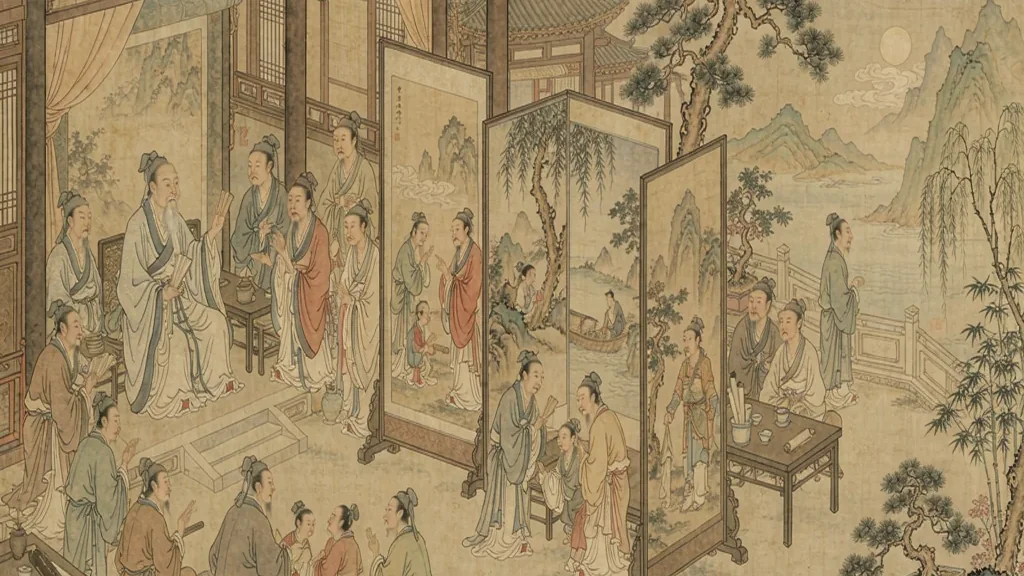
The xiaoshuojia (小说家), often translated as the "School of Minor Talks" or "School of Storytellers," occupies an unusual place among the philosophical currents of early China. Catalogued as one of the ten schools of thought in the Han dynasty bibliography, it was the only one that later commentators did not treat as a genuine philosophical lineage. Rather than advancing a systematic doctrine, its practitioners gathered street gossip, local lore, and anecdotes about worthy and unworthy officials. Yet this humble vocation preserved a layer of popular memory that the great systems overlooked, and the very word xiaoshuo eventually became the ancestor of the Chinese novel.
Origin of the Term
The character xiao (小) means "small" or "petty," and shuo (说) means "speech" or "teaching." Together they describe the "small talks" of ordinary people—the casual reports and rumours that circulated in marketplaces and villages. In the eyes of the imperial bibliographers, such material lacked the dignity of statecraft or cosmology.
Despite this low status, the Han court recognised that rulers could learn something from the grassroots. The "Minor Talks" were thought to capture the unvarnished voices of the common folk, a kind of informal petition from below that the filtered memorials of officials might conceal.
Classification in the Han Shu
The earliest substantive record of the school appears in the "Treatise on Literature" (Yiwenzhi) section of the Han Shu, compiled from the earlier catalogue work of Liu Xin and his father Liu Xiang. There the xiaoshuojia are listed with a collection of some fifteen titles, almost none of which survive today.
They were grouped alongside the nine properly philosophical schools—such as the Confucians, Daoists, and Legalists—yet the bibliographer's preface openly admitted that the Minor Talks "cannot be ranked among the nine schools." This half-membership is precisely what makes them fascinating to historians of literature.
The "Street Gossip" Tradition
What exactly did these writers collect? According to the treatise, they recorded the words of "those who make minor remarks in the lanes and markets." The content ranged from witty observations to moralising tales about past rulers and officials.
One famous anecdote preserved in later sources concerns a ruler who, hearing that his people were hungry, replied that they should eat meat soup—a story used to lampoon out-of-touch elites. Whether or not such tales were factual, they served as gentle social critique wrapped in entertainment.
Relationship to the Other Schools
Unlike the Mohists or Logicians, the xiaoshuojia advanced no theory of government and no metaphysics. Their contribution was documentary rather than philosophical. They were the archivists of the everyday, complementary to the abstract thinkers who supplied the era's big ideas.
Some scholars argue that the school's inclusion in the tenfold list reflects a Confucian anxiety: Liu Xin wanted to account for every kind of writing, even the frivolous, so as to domesticate it within the imperial library system.
From "Minor Talks" to the Novel
The most lasting legacy of the term lies in its evolution. During the Tang and Song dynasties, xiaoshuo broadened to mean any "minor" prose narrative—tales of the marvellous, records of the strange, and anecdotal sketches. By the Ming and Qing, it named the vernacular novel itself.
Thus the Water Margin, the Plum in the Golden Vase, and the Dream of the Red Chamber all descend, by name at least, from the humble "small talks" of the Han bibliographers. The school that was no school became the fountainhead of Chinese fiction.
Key Figures and Lost Texts
Because the original xiaoshuojia writings are lost, we know them mainly through the terse titles and fragmentary quotations preserved in the treatise. Names such as the Qing Shi Zi and the Zhou Xiao survive only as ghosts.
Later imperial collections, especially the Taiping Guangji and the Yijian Zhi, carried forward the spirit of the school by hoarding strange tales. In this sense the storytellers' guild never truly died; it migrated into the great anthologies of the supernatural.
The Moral Defence of Triviality
A recurring justification for the school was that even petty words might contain a grain of worth. The Analects itself says "even in a hamlet of ten households there are those loyal and trustworthy," implying wisdom can appear anywhere.
This democratic impulse—that truth is not the monopoly of princes or philosophers—gives the xiaoshuojia a quiet radicalism. They insisted, in effect, that the talk of the lane matters, a claim the novelists of later ages would enthusiastically endorse.
Modern Scholarly Reappraisal
Twentieth-century scholars, especially those interested in folk literature and popular culture, rehabilitated the school from its long neglect. They noted that oral performance, storytelling, and the circulation of anecdotes were central to how pre-modern Chinese actually learned their values.
Today the xiaoshuojia is studied not as a failed philosophy but as the missing link between classical statecraft literature and the vernacular narrative traditions that eventually produced one of the world's great novelistic canons.
Why the School Matters
For readers approaching Chinese thought through the familiar giants—Confucius, Laozi, Zhuangzi—the xiaoshuojia is a useful corrective. It reminds us that early Chinese intellectual life was not only about cosmology and ritual but also about listening to the street.
Its story also shows how categories shift: a dismissive label for gossip could, over fifteen centuries, become the proud name of a literary genre. Few schools have travelled so far from their origins.
❓ Frequently Asked Questions
Was the School of Minor Talks a real philosophy?
Not in the systematic sense. It collected anecdotes and gossip rather than teaching metaphysics or statecraft, which is why Han bibliographers excluded it from the nine proper schools.
Why was it included in the ten schools at all?
The imperial library wanted to catalogue every kind of writing, including the frivolous, so the Minor Talks were listed separately even though they were not ranked with true philosophical lineages.
Are any xiaoshuojia texts still extant?
No complete works survive. We know the school mainly through the titles and short descriptions in the "Treatise on Literature" of the Book of Han.
How did the term come to mean "novel"?
Over the Tang to Qing period, xiaoshuo widened from "petty talk" to denote anecdotal and marvellous tales, and finally the vernacular novel as a whole.
Who were the xiaoshuojia compared to?
They were contrasted with the major schools such as the Confucians and Daoists; their role was documentary and entertaining rather than doctrinal.
Why does the school matter today?
It links classical bibliography to the later Chinese novel and shows that early thought valued even the unofficial voices of ordinary people.