Among the great schools of ancient Chinese thought, one stands out as the most startlingly modern — and the most tragically forgotten. It is 墨家 (Mòjiā), Mohism, founded by a man named 墨子 (Mòzǐ), Mozi, who lived in the fifth century BCE. While Confucians spoke of love graded by closeness, Mozi preached 兼爱 (jiān ài), "universal love" — that one should care for others' families as one's own. He also championed meritocracy, thrift, and the engineering of practical defense. For a few centuries Mohism rivaled Confucianism, then faded. Its story is one of the great what-ifs of Chinese history.
Mozi and the Founder's Protest
Mozi was, by tradition, a former follower of Confucian teaching who broke away in disgust at what he saw as its waste and hypocrisy. He objected to the elaborate funerals and constant music of the ritualists, which he thought burdened the poor. More fundamentally, he disagreed with the Confucian idea that love should be stronger for those near to us. For Mozi, partial love was the root of conflict: if everyone loves only their own family and state, then families and states will fight.
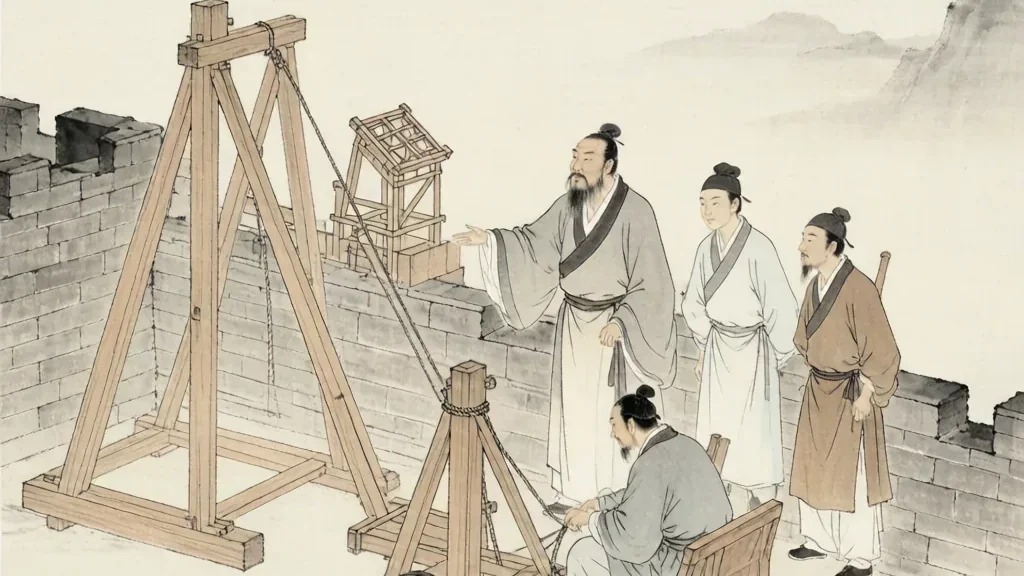
Mozi was not merely a theorist. He traveled among the warring states arguing for peace and, remarkably, organized a band of skilled followers who could physically defend cities against aggression. Tales describe him racing to besieged towns to build defenses and reasoning aggressors out of attack. He combined the moral fervor of a prophet with the practical skill of an engineer — a rare combination in any age.
Universal Love: Jian Ai
The centerpiece of Mohist ethics is 兼爱 (jiān ài), universal or impartial love. Mozi argued that the way to a peaceful world is for each person to care for others' lives, property, and families as sincerely as their own. He drew a famous contrast: the Confucian loves his father more than a stranger's father, and so may quietly benefit his own at another's expense; the Mohist loves all fathers alike, and so works for the good of all.
This sounds gentle, but Mozi gave it a hard-headed justification. Universal love is not a sentiment to admire but a policy to adopt, because it produces mutual benefit. If I care for your family, you will care for mine, and everyone gains. He even invited rulers to test it: adopt impartial love and watch disorder give way to order. It was, in effect, an early version of the golden rule, grounded not in feeling but in social utility.
Anti-Fatalism, Merit, and Thrift
Mohism was unusual in rejecting 命 (mìng), fate. Where some argued that prosperity or ruin was destined, Mozi insisted that human effort matters and that leaders must act. He urged rulers to appoint officials by ability rather than birth — a meritocratic stance later echoed by the imperial exams. He also attacked extravagance, calling for simple living, restrained funerals, and an end to the costly music and rituals that drained resources from the people.
These positions made Mohism attractive to commoners and artisans, and uncomfortable to the elite. Mozi's "ten doctrines" ranged across love, thrift, reverence for heaven, rejection of fatalism, and the condemnation of aggressive war. Taken together they form one of the world's earliest systematic moral philosophies built on the principle of benefit (利, lì) for all, rather than on tradition or ancestry.
The Strange Logic of Mo Zi's Followers
The Mohists were famous for their devotion. They lived simply, bound themselves to their leader, and were ready to die for the cause of defensive justice. They also developed a remarkable tradition of logic and argumentation. Surviving Mohist texts contain careful discussions of definition, analogy, and reasoning — among the earliest formal logic in China, anticipating debates that in the West belong to the Greek tradition.
Their canons even touched on optics and mechanics, recording observations about the behavior of light and shadows and the principles of levers. This scientific bent set them apart from rival schools and explains why later Chinese engineers and inventors sometimes traced their craft back to Mohist roots. For a movement so often dismissed as merely "kindhearted," the Mohists were strikingly rigorous.
Why Mohism Faded
Despite its power, Mohism declined after the third century BCE. Several reasons are suggested. Its strict communal discipline was hard to sustain once the founding generation passed. Its austere rejection of music, art, and ceremony ran against the grain of Chinese cultural taste. And as Confucianism and Daoism matured, they absorbed or outshone Mohist themes — Confucians kept meritocracy, Daoists kept simplicity, while the distinctive claim of universal love lost its institutional home.
When the Han dynasty later declared Confucianism the state creed, Mohism was left outside the canon and its texts scattered. Yet its spirit never wholly vanished. The ideal of impartial care, the suspicion of wasteful ritual, and the faith that reason and engineering can serve humanity all echo in later Chinese thought and, strikingly, in modern universalist ethics. Mohism is the road not taken — and perhaps a road worth remembering.
The Knightly Defenders
More than a philosophy, Mohism was a movement. Mozi and his followers formed a disciplined fellowship pledged to aid any state under threat, travelling at need to stand in the breach. Their signature act was defensive: when a stronger state prepared to attack, Mohist engineers would help the victim fortify its walls, calculating angles and stockpiles so the assault would fail and the war lose its point. Mozi himself was said to have argued a would-be aggressor out of attack by demonstrating, with a belt and a model, that the defense was unbeatable. This mixture of pacifism and practical military skill was unusual, rejecting conquest while refusing to leave the weak undefended. The order's discipline, shared poverty, and loyalty made it feared and respected. Though the fellowship faded, its ethic of active protection left a distinct mark on Chinese thought about war.
Mohist Mechanics and Optics
Mohists were among the most technically minded thinkers of their age. They studied the mechanics of levers, pulleys, and inclined planes, and they applied the geometry of optics to explain how mirrors and shadows form, anticipating questions later treated in formal physics. Their manuals, preserved only in fragments, laid out methods of siege defense: wall heights, tower placement, and the use of counterweights and shielded ladders. A good deal of early Chinese engineering lore is woven into these texts. This practical bent grew from the school's values: if one truly loved others, one should be able to protect them, and protection required knowing how things worked. The Mohists thus joined hands-on craft to moral purpose, treating the carpenter's skill as a branch of care for the world. Their legacy surfaces wherever Chinese thought turns kindly toward the useful arts.
How Mohists Judged Truth
Mohism stands out for demanding evidence. Rather than rely on tradition or charm, Mozi proposed clear tests for any belief or policy: does it accord with the recorded deeds of the worthy ancient kings, does it fit what ordinary people see and hear, and does it bring practical benefit to the state and its people. A claim that failed these checks, he argued, should be set aside. This was an early, rough version of empirical argument, striking because it asked rulers to defend spending and rituals by results rather than precedent. The school also cultivated explicit rules of reasoning to expose contradictions in opponents' words. Later Chinese philosophy mostly preferred intuition and analogy, so Mohism's hard-edged method looked foreign; rediscovered by modern scholars, it reads almost like a prelude to science. Its three tests remain a tidy summary of how to weigh an idea.
❓ Frequently Asked Questions
📝 Chinese Vocabulary
墨家 — : The Mohist school of thought.
墨子 — : Mozi, the founder of Mohism.
兼爱 — : Universal or impartial love.
利 — : Benefit or advantage, a key Mohist measure of right action.
非攻 — : "Condemnation of aggressive war," a central Mohist doctrine.
非命 — : Against fatalism, the Mohist rejection of the belief that fortune is fixed by destiny.
尚贤 — : Exalting the worthy, the principle that office should go to ability rather than birth.
节用 — : Moderation in expenditure, the Mohist call to avoid wasteful display and spend on what benefits the people.
🎉 Fun Facts
- Mozi is said to have walked ten days and nights to dissuade a ruler from attacking a neighboring state, his legs so blistered he could only walk on his heels.
- Mohist texts include some of the earliest formal logic and even experiments in optics found anywhere in the ancient world.
- For a time during the Warring States period, Mohism was considered one of the two great schools alongside Confucianism.
- Mozi argued against elaborate funerals and music, preaching thrift so that a state's wealth could feed and arm the people instead of honouring the dead.
- Mohist followers organised themselves like a disciplined order, ready to travel anywhere to defend a weak state threatened with attack.
- The school's strict standard of 'three tests' asked whether a claim matched the deeds of the ancient sage kings, the senses of ordinary people, and the public benefit.