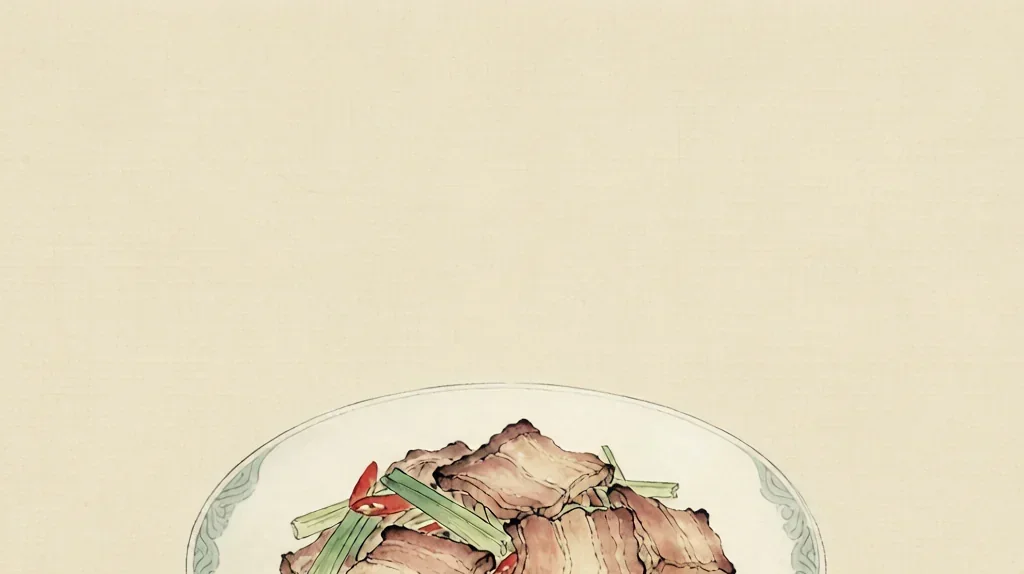
If Sichuan cuisine had a home movie — the dish cooks make on a normal Tuesday night — it would be Twice-Cooked Pork (回锅肉, ). Translating literally as "return-to-the-pot meat," it takes boiled pork belly, slices it thin, and returns it to a screaming-hot wok with chili bean paste, fermented black beans, and a tangle of leeks or garlic sprouts. The result is glossy, faintly smoky, numbing-kissed, and addictively savory. It is, for many Sichuan households, the dish that defines "home."
Unlike the elaborate banquet showpieces of other provinces, twice-cooked pork is everyday genius: a clever way to turn a plain boiled pork into something extraordinary with a second pass of heat. In this article we look at the dish's practical origins, its place in Sichuan's flavor system, the key ingredients that make it sing, the two-stage cooking method, and why it remains a benchmark of a good Sichuan cook.
Origins: Frugality Becomes Flavor
Twice-cooked pork grew out of practicality. In rural Sichuan, a whole piece of pork belly was often boiled first as part of preparing it for storage or for a multi-day household supply, and the already-cooked meat was then stir-fried later to serve. The "twice-cooked" method was a thrifty way to reuse boiled pork while producing a dish far better than the sum of its steps.
Over time the humble reuse became a deliberate technique. Cooks discovered that boiling the belly first rendered some fat, firmed the meat, and made it slice cleanly, while the later high-heat stir-fry built color, aroma, and a slightly crisp edge. What began as economy matured into one of Sichuan's signature stir-fries, beloved enough to appear at both family tables and restaurant menus across the country.
The dish also reflects the Sichuanese genius for transformation: taking simple pantry staples and a reused ingredient, then deploying the region's signature seasonings to create depth. It is a democratic dish — no rare seafood, no exotic spice — yet it demands real skill to balance fat, salt, and heat.
Regional Context: The Heart of Sichuan
Sichuan cuisine is defined by its "numbing and spicy" (má là) profile, built on Sichuan peppercorns and chili, but it is far more than heat. Twice-cooked pork sits within the province's broader repertoire of stir-fries that balance savory, sweet, aromatic, and pungent notes. Chengdu and Chongqing, the two great cities of the region, each claim slightly different versions.
In the classic Chengdu style, the pork is paired with garlic sprouts (蒜苗, suàn miáo) or leeks, which lend a gentle bite and sweetness. Some Chongqing renditions lean sharper, with more chili and a bolder use of doubanjiang, the fermented broad-bean chili paste that is the soul of Sichuan cooking. Either way, the dish is a staple "guest dish" — something made when friends drop by, because the components are always on hand.
Because it uses no difficult ingredients, twice-cooked pork also travels well. You will find it on Chinese restaurant menus worldwide, often listed simply as "double-cooked pork" or "Sichuan-style pork," and it is a reliable gauge of a kitchen's authenticity: if the version is greasy, flabby, or flat, the rest of the menu probably is too.
Ingredients: The Holy Trio
Three ingredients make or break the dish. First is the pork belly, ideally with a good fat-to-lean ratio and the skin on, boiled until just cooked. Second is doubanjiang, the fermented chili-bean paste from Pixian (Pi county), whose earthy, funky heat is irreplaceable. Third is the aromatic vegetable — traditionally garlic sprouts, though green leeks, bell pepper, or cabbage stems are common substitutes.
To these are added a little sweet flour sauce (tianmianjiang) or soy for depth, sometimes a touch of sugar to round the edges, and a scattering of ginger and garlic. Sichuan peppercorns may be added whole or as ground powder for the characteristic tingling numbness, though many home versions keep the pepper light so the pork and doubanjiang lead.
Notice what is absent: there is no heavy breading, no cornstarch slurry, no long list of vegetables. The discipline of the recipe is its short ingredient list. Each element must be fresh and well-made, because nothing hides behind sauce. A good doubanjiang, in particular, is the difference between a forgettable stir-fry and a memorable one.
How It Is Made: Boil, Slice, Sear
Step one is the boil. The pork belly is simmered in plain water, often with a slice of ginger and maybe a scallion, until a chopstick slides through the skin and fat with little resistance. It is then cooled completely — chilled if possible — because cold, firm meat slices into thin, even rounds that will not shred in the wok.
Step two is the stir-fry. The wok is heated until nearly smoking and given a film of oil. The sliced pork goes in first; as it heats, more fat renders out and the edges begin to curl and brown, a stage Chinese cooks call "灯盏窝" (lamp-cup shape), when the slice arches like a little shallow bowl. This browning is where much of the flavor lives.
Step three is the seasoning. The pork is pushed to the side, doubanjiang is fried briefly in the cleared oil to release its red oil and aroma, then ginger, garlic, and the aromatics join. A splash of wine, a little soy or sweet sauce, and a pinch of sugar follow, and everything is tossed together quickly so the pork glazes without stewing. The whole second stage takes only a few minutes — fast, hot, and finished the moment the vegetables wilt.
Cultural Meaning: The Taste of Home
Ask a Sichuan native abroad what they miss most, and twice-cooked pork is near the top of the list. It is the dish of ordinary life: the sizzle when a parent comes home, the red oil clinging to rice, the smell that says "dinner is ready." Its very name — "return to the pot" — suggests continuity and return, themes close to the Chinese heart.
The dish also embodies a value prized in Chinese cooking: nothing is wasted, and a second chance at the stove can produce something better than the first. It is humble food treated with respect, which is itself a kind of philosophy. In a culture that honors both thrift and flavor, twice-cooked pork is a quiet hero.
Among cooks, it is also a test. Because the recipe is short, there is nowhere to hide a weak hand. A great version shows that the cook understands heat, timing, and the character of doubanjiang — the fundamentals of the whole Sichuan tradition in a single plate.
When and Where It Is Eaten
Twice-cooked pork is an all-purpose dish: a weeknight staple, a casual restaurant order, and a reliable item at Sichuan banquets alongside more elaborate fare. It is eaten with steamed rice, which absorbs the red oil and balances the intensity. In Sichuan itself, it is as common as a sandwich in the West.
It pairs beautifully with mild sides — a clear soup, blanched greens, or plain congee — to keep the meal from becoming too rich. At festive tables it might sit among mapo tofu, kung pao chicken, and fish-fragrant dishes, showing off the range of the province's flavors.
For travelers, ordering it at a neighborhood Sichuan spot is one of the best ways to read a kitchen's soul. If the pork is crisp-edged, the leeks sweet, and the oil fragrant rather than merely hot, you have found a cook who knows the province's greatest everyday dish by heart.
The Lamp-Cup Stage: Reading The Wok
The moment that separates a good twice-cooked pork from a flat one is what Sichuan cooks call the lamp-cup shape. As the chilled slices hit the nearly smoking wok, more fat renders out and the meat arches into a small shallow bowl, edges curling and browning while the center stays tender. This is the signal that the pork has crisped rather than merely warmed, and it is where much of the toasty, savory flavor develops. A cook reads the wok by watching for that arch and by listening to the change in sizzle as moisture leaves the fat. Once the slices reach this stage, the doubanjiang is fried in the cleared oil to release its red aroma, and everything is tossed fast so the pork glazes instead of stewing. Mastering the lamp-cup is mastering the dish.
Twice-Cooked Pork Beyond Sichuan
What began as a thrifty Sichuan home dish has become a standard of Chinese restaurants almost everywhere. On menus abroad it often appears as double-cooked pork or Sichuan-style pork, a reliable gauge of a kitchen's authenticity: greasy and flabby signals a weak hand, while crisp-edged and fragrant signals a confident one. Its spread followed Sichuan migrants and the global appetite for bold, aromatic food, and the recipe adapts easily to local vegetables when garlic sprouts are unavailable. Even so, purists argue the true version lives only where doubanjiang, Sichuan peppercorn, and the boil-then-sear method are taken for granted. The dish's journey shows how a humble reuse of leftovers became one of China's most recognized stir-fries, carried far beyond its home province by taste alone.
❓ Frequently Asked Questions
📝 Chinese Vocabulary
回锅肉 — : Twice-Cooked Pork, the Sichuan stir-fry of boiled-then-fried pork.
豆瓣酱 — : fermented chili-bean paste, the dish's flavor base.
蒜苗 — : garlic sprouts, the traditional aromatic vegetable.
花椒 — : Sichuan peppercorn, source of the numbing tingle.
五花肉 — : pork belly, the cut used for the dish.
麻辣 — : Numbing and spicy, the signature Sichuan flavor built from Sichuan peppercorn and chili.
甜面酱 — : Sweet flour sauce, added to round out the salt and heat of the dish.
川菜 — : Sichuan cuisine, the regional tradition to which twice-cooked pork belongs.
🎉 Fun Facts
- The dish began as a thrifty way to reuse boiled pork belly, then became one of Sichuan's most loved stir-fries.
- Cooks prize the moment the pork slice arches into a "lamp-cup" shape as it renders and crisps at the edges.
- The fermented bean paste from Pixian county is so valued that it is often aged for months or years.
- Twice-cooked pork is considered a reliable test of a Sichuan kitchen's authenticity.
- In reader polls run by Chinese food media, twice-cooked pork routinely ranks among the most representative home dishes of Sichuan, often near the top of foods people say they learned from a parent.
- Among Sichuan cooks there is a saying that a well-made twice-cooked pork should leave a glossy red film of flavor on the plate, a sign the fat and chili-bean paste emulsified rather than pooling as grease.