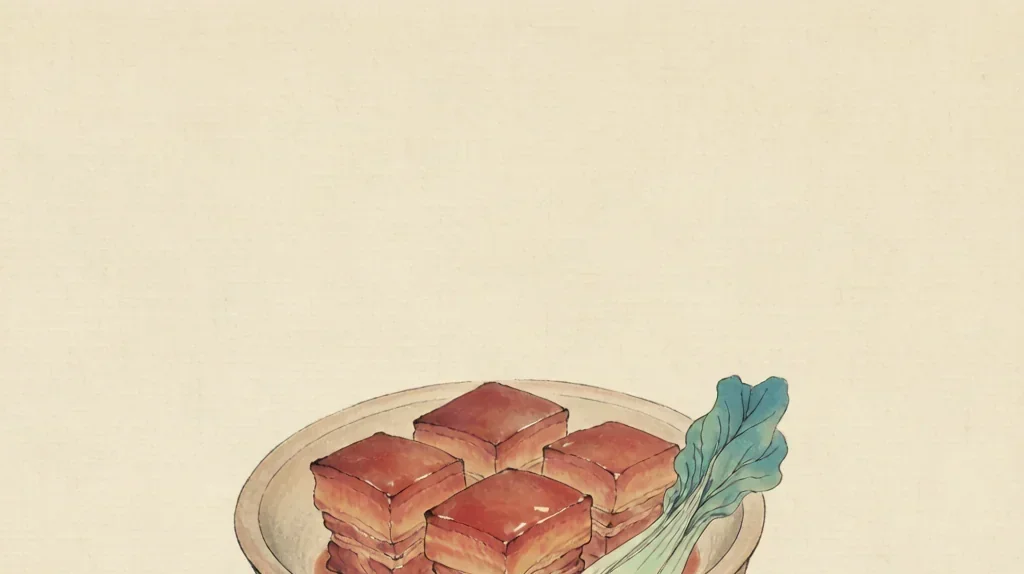
A square of pork belly, glossy and trembling, braised until it melts at the touch of a chopstick — this is Dongpo Pork (东坡肉, ), one of the most beloved dishes in all of Chinese cooking. Named after the Song-dynasty poet and statesman Su Shi, who styled himself "Dongpo Jushi" (the Lay Buddhist of Eastern Slope), the dish is famous for its perfect balance of fat and lean, its deep mahogany glaze, and its almost custard-like tenderness. It is sweet, savory, and rich without being greasy, and it carries a story that links great food to great literature.
What makes Dongpo Pork special is not complexity of technique but patience and proportion. The pork is cut into neat cubes, tied or left whole, and slow-braised in a mixture of soy sauce, wine, ginger, scallion, and sugar until the collagen collapses into silk. In this article we explore the life of the poet who gave the dish its name, the regional styles that claim it, the ingredients and method, and the cultural place of pork in Chinese cuisine.
Origins: A Poet in Exile
The dish is named for Su Shi (1037–1101), one of China's most celebrated writers, calligraphers, and statesmen of the Song dynasty. After falling out of favor at court, Su was exiled to Huangzhou, a modest posting where he took up farming on an eastern slope of land — hence his pen name, "Dongpo." Far from the capital's luxuries, he reportedly learned to cook humble ingredients with care, and a braised pork dish became associated with his name.
A popular story says that while living in Huangzhou, Su Shi wrote a line instructing cooks to simmer pork slowly over a low fire with a little wine and salt, never rushing it. Locals adopted the method, and the resulting dish was called "Dongpo Pork" in his honor. Whether or not the recipe is exactly his, the association stuck: the dish became a tribute to a man who found joy and creativity in difficult circumstances.
Su Shi's own writings show a genuine love of food and a philosophy that simple pleasures — a good meal, a fine view, a friend — were among life's truest rewards. Dongpo Pork thus carries more than flavor; it carries a lesson in contentment. To eat it is, in a small way, to share the table with a poet who refused to be defeated by exile.
Regional Context: Hangzhou and Beyond
Although the dish's spirit comes from Huangzhou, its most famous incarnation is tied to Hangzhou, in Zhejiang province, where the West Lake and refined Jiangnan cooking made it a local treasure. Hangzhou's version uses square, individually portioned cubes of pork belly, braised in a rich brown sauce and often served with a few stalks of scallion or a strand of greens for color.
Other regions have their own takes. In Sichuan, a "Dongpo Pork" may carry a hint of the province's signature flavor through a touch of rock sugar and Shaoxing wine, but it stays gently sweet rather than fiery. In the north, cooks sometimes steam the pork rather than braise it, producing a clearer, less saucy result. The through-line is the same: a respect for the pork's own richness, balanced by wine and sugar.
The dish belongs to the broader family of Chinese red-braised (hong shao) cooking, in which soy sauce, sugar, and often wine create a lacquered, savory-sweet glaze. Dongpo Pork is the most elegant member of that family — a dish refined enough for a banquet yet rooted in home cooking.
Ingredients: Less Is More
The ingredient list for Dongpo Pork is short, which is precisely the point. The star is pork belly with clean layers of fat and lean, cut into thick squares of roughly five to eight centimeters. Good butchering matters: even striping ensures that each bite has both richness and substance.
The braising liquids are soy sauce (often a mix of light and dark for color and salt), Shaoxing rice wine, rock sugar or yellow sugar, ginger, scallion, and sometimes a few cloves of star anise or a piece of dried tangerine peel. A small amount of dark soy gives the deep mahogany color; the wine lifts the aroma and cuts the fat; the sugar rounds everything into a glossy glaze.
Some recipes add a little stock, but many traditional versions use almost no water, relying instead on wine and the pork's own rendered fat to carry the braise. The restraint is deliberate. With so few components, each must be of good quality, and the cooking must be slow enough to let them harmonize. This is a dish where the shopping matters as much as the stove.
How It Is Made: Slow and Low
The method begins with blanching the pork squares in boiling water to clean them and firm the texture. They are then placed skin-side down (or tied with kitchen string to hold their shape) in a heavy pot, often lined with scallion and ginger so the meat does not scorch. The braising liquid is poured over, the pot is covered, and the pork is simmered gently for one to two hours.
The low temperature is essential. High heat would toughen the lean meat and separate the fat unattractively; a bare simmer lets the collagen melt into gelatin, which is what gives the dish its signature melt-in-the-mouth feel. Many cooks finish the dish in a steamer or a low oven, which keeps the temperature even and the texture tender.
At the end, the liquid is reduced to a shining sauce and spooned back over the pork. A well-made cube should hold its shape on the plate yet yield completely to a chopstick, the fat translucent and the lean moist. Served with steamed buns or plain rice to absorb the sauce, it is comfort food elevated to an art form.
Cultural Meaning: Food as Consolation
Dongpo Pork is more than a recipe; it is a small monument to a cultural ideal — the gentleman-scholar who meets misfortune with grace. Su Shi's life was full of political ups and downs, yet his poetry and his cooking both radiate good humor and gratitude. The dish lets ordinary people connect with that story every time they lift a lid from the pot.
It also reflects a Chinese appreciation for pork as the default festive meat and for the alchemy of slow cooking. Where some cuisines prize lean and quick, Chinese red-braising celebrates the fat, treating it as flavor rather than something to be feared. The result is a dish that feels generous and celebratory, suited to family gatherings and holiday tables.
In restaurants, Dongpo Pork is a quiet status dish: not flashy like a whole fish or a roasted duck, but a sign that the kitchen respects tradition. Its very plainness — a square of pork, a dark glaze — is the point. It asks to be judged on execution alone.
When and Where It Is Eaten
Dongpo Pork is eaten year-round but is especially favored in the Yangtze Delta region, where it appears at banquets, family dinners, and specialty restaurants devoted to Jiangnan flavor. In Hangzhou, visitors can find it at historic restaurants near the West Lake, often presented as a single glossy cube with a sprig of greenery.
At home, families make it for weekends and festivals, often preparing a larger batch that tastes even better reheated the next day as the flavors deepen. It pairs naturally with plain steamed rice, which soaks up the sauce, or with a lightly pickled vegetable to cut the richness.
Because it keeps and reheats well, Dongpo Pork is also a favorite dish to make ahead for guests. Like the poet who inspired it, the dish rewards those who plan, wait, and then share — a square of braised bliss that turns an ordinary meal into a small occasion.
The Dongpo Brand: A Poet's Name on Many Dishes
Su Shi's fame was so large that his nickname became a culinary label. Besides the famous pork belly, Hangzhou and beyond serve Dongpo pork knuckle, a larger joint braised to the same glossy tenderness, and Dongpo tofu or Dongpo fish appear in regional home cooking. The pattern is consistent: a humble ingredient, slow treatment, and a name that promises a story as much as a flavor. Restaurants lean on the brand because it signals both tradition and a gentle literary charm — eating 'Dongpo' is eating with a poet. This spread also shows how Chinese food names travel: a personal taste of one Song-dynasty official became a franchise of dishes unified by patience and a good tale. Few ingredients have earned such a lasting namesake, and fewer still wear it across an entire menu.
Slow Cooking as Philosophy: Patience in a Cube
Dongpo Pork is really an argument for patience. Where modern cooking often rushes, the dish demands a low fire and time — an hour or two in which collagen becomes gelatin and harsh soy softens into a rounded glaze. Su Shi himself wrote of finding contentment in simple pleasures and slow days, and the method mirrors that temper: you cannot hurry a good cube, and trying to will only toughen it. The result rewards the wait with a texture that yields to a chopstick yet holds its shape, a balance no shortcut achieves. In a culture that values restraint and harmony, the dish teaches that richness need not be rushed or hidden. Each square is a small lesson in letting heat and time do their quiet work. To cook it is to practice, briefly, the calm the poet preached.
❓ Frequently Asked Questions
📝 Chinese Vocabulary
东坡肉 — : Dongpo Pork, the famous braised pork belly.
苏东坡 — : Su Shi, the Song poet who gave the dish its name.
红烧 — : red-braising, a soy-and-sugar cooking method.
五花肉 — : pork belly with layered fat and lean.
黄酒 — : yellow rice wine such as Shaoxing, used in the braise.
东坡 — : Dongpo, 'Eastern Slope,' the pen name of the poet Su Shi
冰糖 — : Rock sugar, used to build the glossy sweet-savory glaze
东坡肘子 — : Dongpo pork knuckle, a related braised dish bearing the poet's name
🎉 Fun Facts
- Su Shi, the dish's namesake, was also a celebrated calligrapher and wrote essays praising the simple pleasures of food and farming.
- The pork is traditionally cut into neat squares, echoing the disciplined, composed spirit of a scholar's life.
- In Hangzhou the dish is often served as a single glossy cube beside the West Lake that made it famous.
- A well-braised cube holds its shape on the plate yet falls apart at the touch of a chopstick.
- Su Shi is credited with an actual recipe poem, the 'Ode to Pork' (Zhurou song), that instructs simmering pork slowly with a little wine — a literary birth certificate for the dish.
- The 'Dongpo' name now graces several dishes across China, from pork knuckle to Dongpo tofu, showing how one poet's brand spread across the menu.