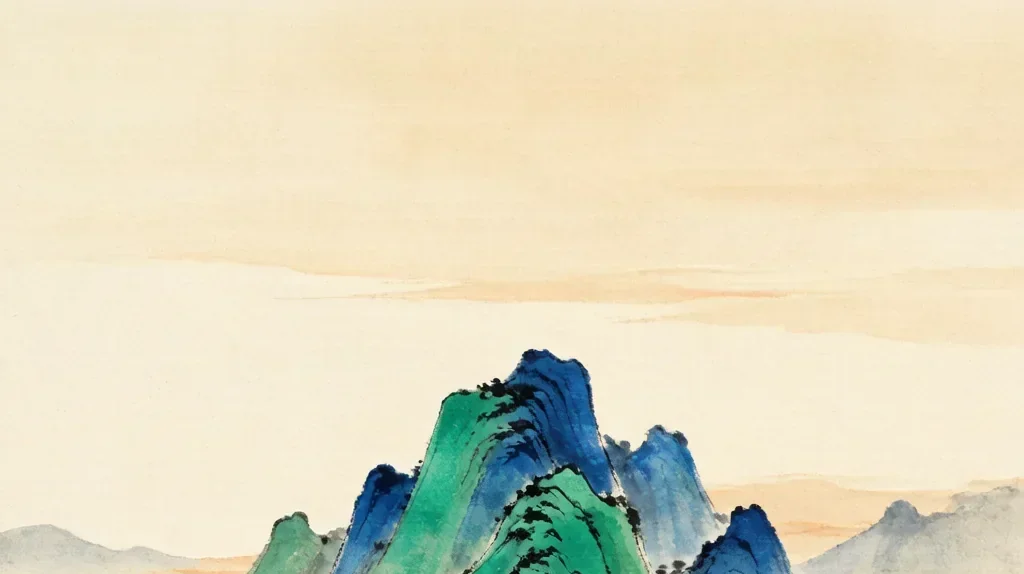
Blue-green landscape (qinglü shanshui, 青绿山水) is the brilliant mineral-pigment manner of Chinese landscape painting in which mountains and hills are built from layers of azurite blue (shiqing) and malachite green (shilü) over ink outlines, often highlighted with gold. Distinct from the ink-monochrome landscapes favored by later literati, the blue-green style is the most jewel-like and festive register of Chinese painting. Developed in the Tang dynasty by the Li family of painters and reaching a supreme expression in the Song youth Wang Ximeng's "A Thousand Li of Rivers and Mountains," it remained a courtly and decorative tradition prized for monumentality, color, and splendor across the centuries.
What "Blue-Green" Means
The term qinglü joins qing (blue/azure, here azurite) and lü (green, here malachite). The painter first lays ink contours and a base, then applies ground mineral pigments in successive thin layers so the color sits opaquely on the silk or paper. The result is a crisp, glowing topography of blue peaks and green valleys.
Because the pigments are mineral and opaque, the style differs sharply from ink wash, where form is suggested by diluted tones. Blue-green landscape is assertive and architectural—a "colored map of the cosmos" more than a mood piece—yet it can also be subtle in its grading.
Tang Dynasty Origins
The manner was formalized in the Tang by Li Sixun (李思训, c. 653–718) and his son Li Zhaodao, court aristocrats who painted monumental, brightly colored landscapes that later writers contrasted with the ink-only landscapes of the poet-painter Wang Wei. The Lis were said to use costly azurite and malachite and to outline forms in gold.
Tang blue-green work suited the empire's taste for splendor and is linked to the "gold-and-blue-green" (jin bi) manner used on screens and walls. Though few Tang originals survive, copies and records confirm its prestige as the courtly landscape idiom.
Wang Ximeng's Masterpiece
The single greatest blue-green landscape is "A Thousand Li of Rivers and Mountains" (Qianli jiangshan tu, 千里江山图) by Wang Ximeng (王希孟, c. 1096–c. 1119), painted when he was about eighteen and presented to Emperor Huizong. The handscroll, nearly twelve meters long, unfolds continuous ranges of azurite peaks, malachite valleys, rivers, villages, and bridges.
Its scale, seamless composition, and saturated color make it a peak of the Song academy's ambition. The painting's legendary status rests on both its perfection of the blue-green technique and the poignancy of a masterpiece by a teenager who died young.
Materials: Azurite and Malachite
The signature colors come from crushed minerals: azurite (copper carbonate) yields blue, malachite (also copper-based) yields green. Both were imported or mined, carefully graded by fineness, and bound with animal glue. Their opacity and permanence give blue-green paintings their lasting glow.
Preparing the pigments was skilled work; coarser grains gave deep tone, finer ones a pale wash. The layered application—often many passes—built the rich, enamel-like surface that distinguishes a fine qinglü work from a merely colored one.
Technique and Composition
A blue-green landscape begins like a gongbi picture: precise ink outlines, then a white or light base, then graded mineral layers, with the blue reserved for distant or high peaks and the green for nearer slopes and valleys. Gold might pick out ridges, waves, or palace roofs. The drawing must be exact, since opaque color hides nothing.
Compositions tend to be panoramic and symmetrically grand, organized around a central massif with winding rivers leading the eye deep into the scene. This monumentality is the style's signature, contrasting with the intimate crops of later academy manner.
Courtly and Decorative Role
Blue-green landscape was above all a court and ceremonial art: screens for halls, walls for palaces, and festive scrolls for imperial occasions. Its splendor signaled order, prosperity, and the emperor's harmonious rule over a vast terrain—literally a "thousand li" of blessed land.
Because it was expensive and public, the manner aligned with professional and court painters rather than the private scholar's studio. Yet some literati collected and even attempted it, respecting its difficulty and magnificence.
Later History
After the Tang-Song peak, blue-green landscape continued in court workshops of the Yuan, Ming, and Qing, often revived for imperial commissions. The Ming "Zhe School" and Qing court painters produced blue-green screens, and the Qianlong era especially valued the style for its auspicious grandeur.
It never displaced ink landscape as the literati ideal, but it persisted as the "formal" alternative—proof that Chinese painting had a full color tradition alongside its famous monochrome one, and a link to the gold-and-silver decorative arts.
Modern Appreciation
Today blue-green landscape is admired for its bold, almost modern chromatic confidence and its labor-intensive craft. Exhibitions of Wang Ximeng's scroll draw huge crowds, and contemporary "heavy-color" (zhong cai) painters revisit mineral pigments for their permanence and vividness.
For viewers, the style is a reminder that the Chinese landscape was not always quiet and inked. At its most celebratory, it could blaze with blue and green—a painted hymn to the abundance and order of the land.
The manner also shaped architecture and garden design, where painted beams and glazed tiles echoed the same blue-green palette. Imperial roofs of yellow tile and blue-green decorations are, in a sense, blue-green landscape translated into building. The dialogue between the painted mountain and the built one helps explain why the style felt so natural to a court that saw itself as keeper of a harmonious world.
❓ Frequently Asked Questions
What is blue-green landscape?
It is a Chinese landscape manner built from layers of azurite blue and malachite green over ink outlines, often with gold, creating a jewel-like, monumental image.
Where did it come from?
It was formalized in the Tang dynasty by the court painters Li Sixun and Li Zhaodao as the premier courtly landscape idiom.
What is its most famous work?
Wang Ximeng's "A Thousand Li of Rivers and Mountains" (c. 1113), a nearly twelve-meter Song handscroll, is its supreme masterpiece.
How is it made?
The painter lays ink contours, a light base, then graded mineral layers—blue for high/distant peaks, green for nearer slopes—sometimes with gold highlights.
How does it differ from ink landscape?
It uses opaque, permanent mineral color for a bright, architectural look, whereas ink landscape suggests form through diluted tones and values restraint.
Is blue-green landscape still made?
Yes. It persisted in court workshops and is revisited by modern "heavy-color" painters for its vividness and the permanence of mineral pigments.