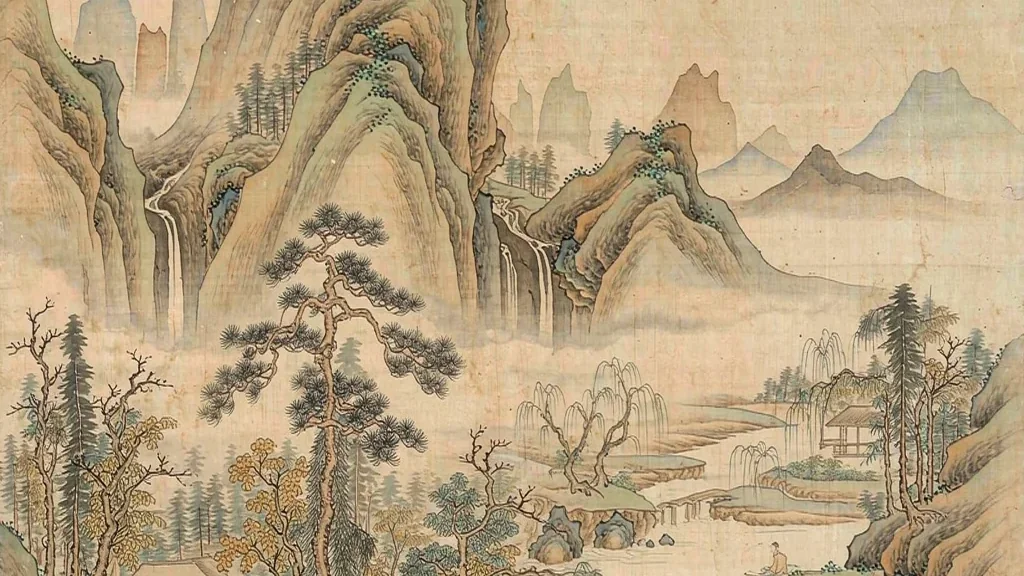
Song dynasty landscape painting (roughly the 10th to 13th centuries) represents one of the most admired achievements of Chinese art. Characterized by monumental, atmospheric mountains, vast empty space, and a refined monochrome ink manner, Song landscape shifted the focus of painting from figure subjects toward nature as a vehicle for philosophical and emotional meditation. Produced under both court and scholarly patronage, these works established compositional and technical standards—such as the towering "high distance" view and subtle ink gradations—that later generations of artists returned to for centuries. This article surveys the origins, major masters, techniques, and enduring legacy of the Song landscape tradition.
Origins in the Five Dynasties and Early Song
Before the Song unified China, the short-lived Five Dynasties period (907–960) nurtured regional landscape schools that became the foundation for Song achievement. In the north, masters such as Jing Hao and his follower Guan Tong developed rugged, cliff-faced mountains rendered with vigorous axe-cut texture strokes. In the south, Dong Yuan and Juran painted the soft, misty hills and river villages of the lower Yangzi region using rounded, dotted brushwork and wet, atmospheric washes.
When the Song court established its painting academy, it absorbed both northern monumentality and southern lyricism. Early Song emperors collected earlier works and encouraged painters to synthesize these regional manners into a grand, comprehensive vision of the empire's mountains and rivers. This synthesis produced the first great "monumental landscape" masters of the 10th and 11th centuries.
Monumental Landscape and the Northern Masters
The early Northern Song is famous for towering, full-page mountain compositions. Li Cheng (c. 919–967) was revered for gnarled old trees, level distances, and cold, crystalline air; his manner influenced generations even though few works securely survive. Fan Kuan, active in the early 11th century, turned toward massive, frontal peaks—his "Travelers Among Mountains and Streams" presents a mountain so dominant that tiny human figures seem almost swallowed by nature.
Guo Xi, a court painter of the later 11th century, systematized landscape theory in his treatise "The Lofty Message of Forests and Streams." He described three kinds of distance—high, deep, and level—and taught how a viewer should be drawn into a picture. His "Early Spring" demonstrates a mist-laden, rising mountain world full of movement and seasonal renewal, combining careful observation with cosmic ambition.
The Academy and Court Patronage
The Song imperial painting academy offered painters salaries, ranks, and direct imperial favor. Emperors such as Huizong (r. 1100–1126) took a personal, exacting interest in the arts, setting themes and judging submissions. Academy painters favored technical finish, careful observation of nature, and often a degree of color, though monochrome ink remained central to landscape.
Court patronage produced both grand decorative screens and intimate album leaves. The academy's emphasis on "realism" meant that rocks, trees, and birds were studied from life, yet the goal was never mere imitation; rather, a convincing particular scene was meant to evoke the larger order of nature. This balance of observation and idealization defined the polished Song academic style.
Atmospheric Space and Monochrome Ink
A hallmark of Song landscape is the poetic use of empty space and mist. Rather than filling the picture, painters left vast areas of plain silk or paper to suggest distance, weather, and mood. Ink was graded from dense blacks to pale grays through layered washes, so that far mountains dissolve into haze and near rocks stand with crisp definition.
This restraint gave Song landscape its contemplative quiet. The absence of heavy color focused attention on structure, rhythm, and the play of light and air. Later critics praised Song painters for "using ink like color," achieving richness not through pigments but through the infinite subtlety of a single black tone on white ground.
Southern Song and the Lyric Mode
After the court relocated south to Hangzhou in 1127, landscape grew more intimate and lyrical. Masters associated with the academy—Li Tang, Liu Songnian, Ma Yuan, and Xia Gui—favored angled, off-center compositions with bold foreground motifs and broad empty expanses. This "one-corner" manner, especially linked to Ma Yuan and Xia Gui, uses asymmetry to create breathing room and poetic suggestion.
These Southern Song works often pair a slice of cliff, a few reeds, or a fishing boat with huge voids of mist and water. The effect is less the all-encompassing cosmic mountain of the north and more a fleeting, personal encounter with nature—an mood suited to the exiled, nostalgic sensibility of a court remembering its lost northern capital.
Technique: Texture Strokes and Perspective
Song landscapists codified brush methods still taught today. "Axe-cut" strokes (hatchet-shaped, used by Li Tang and northern masters) describe hard cliff faces; "hemp-fiber" strokes (long, curving) suit the rounded southern hills of Dong Yuan's tradition; "raindrop" and "alum-head" textures name other characteristic rock surfaces. Tree types—crab-claw branches, entangled old pines—were likewise standardized.
Composition followed what later theorists called "scattering perspective": rather than a single fixed vanishing point, the painter moved the viewpoint, combining high, deep, and level distances so the viewer seems to travel through the scene. This liberated landscape from a single standpoint and allowed a mountain to unfold as a continuous, explorable world.
Philosophy: Nature, Dao, and Neutrality
Song landscape cannot be separated from the era's thought. Neo-Confucian interest in the underlying patterns (li) of things encouraged close study of natural form, while Daoist and Chan Buddhist currents valued spontaneity, emptiness, and the smallness of human concerns before vast nature. A painted mountain could thus be at once an observed fact and a meditation on cosmic order.
The famous ideal of "noble neutrality" (a calm, impersonal tone) led painters to suppress obvious individualism in favor of a balanced, almost anonymous vision of nature. Yet within that restraint lies intense feeling—precisely the paradox that later scholars found so moving, and that helped elevate landscape above figure and narrative painting.
Notable Surviving Works
Among the landmarks often studied are Fan Kuan's "Travelers Among Mountains and Streams," Guo Xi's "Early Spring," and a group of anonymous monumental works long attributed to the "Li-Guo" manner (after Li Cheng and Guo Xi). From the Southern Song, Ma Yuan's "Walking on a Mountain Path in Spring" and Xia Gui's "Twelve Views of Landscape" exemplify the lyric, angled academy style.
Zhang Zeduan's "Along the River During the Qingming Festival," though a cityscape rather than a pure landscape, shows the period's observational power at panoramic scale. Such works survive largely because they were treasured, copied, and collected by later connoisseurs, preserving a tradition that might otherwise have faded.
Influence on Later Painting
The Yuan, Ming, and Qing dynasties all looked back to Song landscape as a classical norm. Yuan literati painters absorbed its structure while loosening its realism; Ming academicians revived its monumentality; and Qing masters such as the "Orthodox School" traced their lineage explicitly to Song and Yuan models. Even anti-academic individualists measured themselves against it.
Beyond China, Song landscape profoundly shaped Korean Joseon painting and Japanese Zen-influenced ink painting (sumi-e), where monochrome mountains and empty space became enduring ideals. The Song synthesis of observation, structure, and mood remains a global reference point for landscape as a serious, philosophical art.
Materials and Format
Song landscapes were executed on silk and, increasingly, on paper, using ink sticks ground with water and a range of brush sizes. Formats varied: tall hanging scrolls for monumental peaks, long handscrolls for travel-like viewing, fans and album leaves for intimate studies, and screens for architectural settings. Each format shaped how the image unfolded before the viewer.
Because ink on silk is fragile, many original Song paintings survive only as later copies or as sections remounted over centuries. Connoisseurship—distinguishing original from imitation—became a refined discipline, and the very act of collecting and cataloguing Song landscape helped canonize it as the pinnacle of Chinese painting.
❓ Frequently Asked Questions
What is Song dynasty landscape painting?
It is the tradition of monochrome ink mountain-and-water painting that flourished under the Song dynasty (10th–13th centuries), known for monumental peaks, atmospheric space, and a philosophical, meditative tone.
Who were the most famous Song landscape masters?
Northern Song highlights include Li Cheng, Fan Kuan, and Guo Xi; the Southern Song academy is associated with Li Tang, Ma Yuan, and Xia Gui.
What is the "one-corner" composition?
A Southern Song manner, especially linked to Ma Yuan and Xia Gui, that places a strong motif in one area and leaves the rest as empty space, creating poetic asymmetry.
How did Song landscape use empty space?
Painters left broad areas of blank silk or paper to suggest mist, distance, and mood, focusing attention on structure and atmosphere rather than filling the surface.
What techniques did Song landscapists use?
They developed codified texture strokes such as axe-cut and hemp-fiber, graded ink washes, and "scattering perspective" combining high, deep, and level distances.
Why is Song landscape considered so important?
It established the classical standards of Chinese landscape—structure, atmosphere, and philosophical depth—that later dynasties and neighboring cultures treated as a norm.